Wednesday, July 22nd 2026

NVIDIA RTX 4060 Running on Arm Desktop Shows Promise for Gaming on Windows-on-Arm
News recently broke that NVIDIA had published the first native Windows-on-Arm toolkit for its RTX Spark platform, and it didn't take long for a Chinese developer, VoidTech, and modder to use NVIDIA's work to get an NVIDIA RTX 4060 working on an Arm-powered Huawei Qingyun desktop with a Kunpeng 920 CPU.
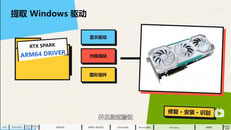
In a video on Bilibili, the developer explains that he managed to get the device supported by extracting NVIDIA's ARM64 driver from the Spark software. He adds that, while the device is recognized by both NVIDIA's driver and TechPowerUp's GPU-Z, and is able to accelerate graphics tasks, there is no video output, so he notes that it is "suitable for use with streaming" (machine translation).
At the end of the day, the modder tested the RTX 4060 in a handful of games, and the performance was underwhelming. Although the actual GPU seems to work fine, CPU performance appears to be a significant bottleneck, although this is likely a result of the unimpressive Huawei SoC. In previous early benchmarks of the same Huawei SoC, its CPU performance was almost a decade behind modern x86 CPUs.
Given performance figures we've seen from Qualcomm Snapdragon X2 Elite benchmarks, as long as there are no translation issues, we could see significantly higher gaming performance on that SoC.
Sources:
VoidTech on Bilibili, via Windows Latest
In a video on Bilibili, the developer explains that he managed to get the device supported by extracting NVIDIA's ARM64 driver from the Spark software. He adds that, while the device is recognized by both NVIDIA's driver and TechPowerUp's GPU-Z, and is able to accelerate graphics tasks, there is no video output, so he notes that it is "suitable for use with streaming" (machine translation).


The fact that he managed to get the GPU working at all is even more impressive, since the Kunpeng platform was never built with Windows in mind, so that presented an additional roadblock to getting the device supported. To remedy this, the modder resorted to a project called dixyes/d920s10 to correct ACPI tables and boot Windows on Arm.
At the end of the day, the modder tested the RTX 4060 in a handful of games, and the performance was underwhelming. Although the actual GPU seems to work fine, CPU performance appears to be a significant bottleneck, although this is likely a result of the unimpressive Huawei SoC. In previous early benchmarks of the same Huawei SoC, its CPU performance was almost a decade behind modern x86 CPUs.
Given performance figures we've seen from Qualcomm Snapdragon X2 Elite benchmarks, as long as there are no translation issues, we could see significantly higher gaming performance on that SoC.
10 Comments on NVIDIA RTX 4060 Running on Arm Desktop Shows Promise for Gaming on Windows-on-Arm
That desktop they used originally ships with AMD GPUs and a homegrown Linux distro (pretty much all modern GPUs work under ARM and even other ISAs on Linux).
We're going to need hardware in the wild before we see any sort of shift towards native ARM software, and what weve gotten so far from Qualcomm aint it.
So again, no thanks.This is a good point. For ARM to make a better presence in the desktop/laptop domain(beyond Apple Mac) further development and optimization is needed.
www.notebookcheck.net/After-testing-several-Snapdragon-X2E-systems-this-is-how-they-compare-to-the-latest-Intel-and-AMD-laptops.1343280.0.html