Monday, August 24th 2026

AMD Gains Ground as Intel x86 Market Share Goes Back to 1995 Levels
According to Mercury Research, Intel's x86 CPU market share has dropped below 70% for the first time since 1995, hitting 69.3% in Q2 2026, a 6.5-point drop year over year. AMD was there to pick up the difference, reaching 30.7%, a new record for the company. Mercury Research president Dean McCarron confirmed the 31-year low to CRN following the release of his second-quarter CPU market share report. Those figures cover PC and server CPU shipments only. When semi-custom, embedded, and IoT products are included, the Intel market share falls to 65.9% vs. AMD's 34.1%, with the latter getting a boost from a stronger than expected gaming console SoC shipments, a segment Intel doesn't compete in, if we skip the Arc G3 CPU family dedicated to handhelds.
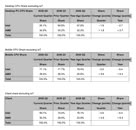
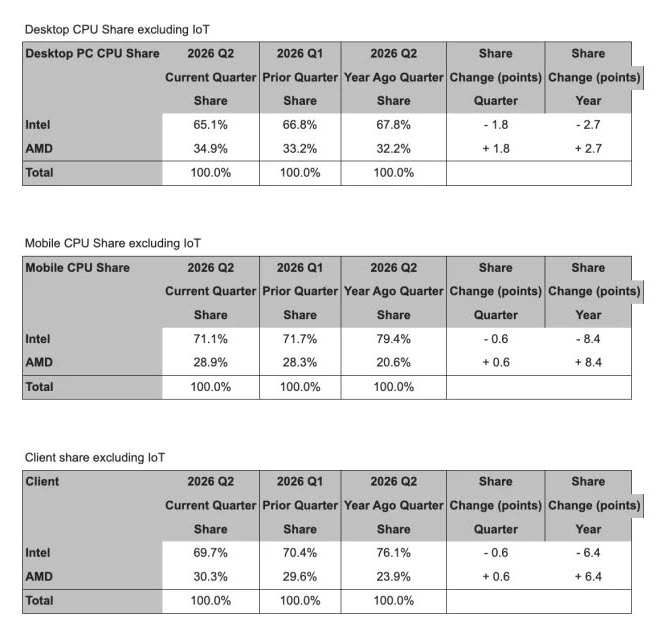
Breaking it down by segment, AMD's desktop share reached 34.9%, up 2.7 points year over year against Intel's 65.1%, despite Intel CPUs returning to Amazon's CPU Top 10 sales ranking yesterday. In the server CPU market, AMD managed to grow by 7.3 points year over year, reaching 34.5% against Intel's 65.5%. The competition is fierce in this segment, AMD has launched the 6th Gen EPYC "Venice" server processors powered by the "Zen 6" CPU microarchitecture, while Intel just announced its upcoming Xeon 7 "Diamond Rapids" CPUs and the "Crescent Island" graphics card for data centers and workstations. The laptop market is where AMD moved the most, climbing to 28.9%, up 8.4 points year over year, while Intel stays at 71.1%. Overall PC market share for AMD hit a record 30.3%, up 6.4 points year over year.
 Intel pointed to record year-over-year sales growth in its Data Center Group and a growing number of long-term supply agreements when asked to comment. On the channel side, a U.S. systems integrator executive told CRN that Intel's partner engagement has picked up noticeably after a period when AMD was getting more attention. "I think they're realizing that they have to be active," the executive said, speaking anonymously.
Source:
CRN
Breaking it down by segment, AMD's desktop share reached 34.9%, up 2.7 points year over year against Intel's 65.1%, despite Intel CPUs returning to Amazon's CPU Top 10 sales ranking yesterday. In the server CPU market, AMD managed to grow by 7.3 points year over year, reaching 34.5% against Intel's 65.5%. The competition is fierce in this segment, AMD has launched the 6th Gen EPYC "Venice" server processors powered by the "Zen 6" CPU microarchitecture, while Intel just announced its upcoming Xeon 7 "Diamond Rapids" CPUs and the "Crescent Island" graphics card for data centers and workstations. The laptop market is where AMD moved the most, climbing to 28.9%, up 8.4 points year over year, while Intel stays at 71.1%. Overall PC market share for AMD hit a record 30.3%, up 6.4 points year over year.

122 Comments on AMD Gains Ground as Intel x86 Market Share Goes Back to 1995 Levels
So to me, it sounds like you're saying "Yeah amd, could make its own chips, could not, doesn't really matter'
Well.... I don't think its quite as simple as that.
However, it is very simple - Intel is LOSING marketshare on all fronts, for last 10 years. They are dominant market player, so if dominant market playes is losing marketshare to competitor, only reason I can think of is that competitor have better c/p ratio and better product.
Yet, you claim that Intel have better offering and it is even dominating in both ST and MT - yet losese marketshare? So, most customers are simply AMD fans or just plain stupid (although goes without saying that being a fan of any company - Intel, AMD, nVIdia or Coca Cola equals to being stupid).Yes, also look what happend to many fabs... They gone under the water, or stuck on old processes - they are producing, but not competing. So, no way in hell AMD could run GloFo and survive - heck, Intel also wouldn't survive without US jumping in.
Intel is selling drastically more cpus than amd. Your claim is that Intel has WORSE cpus but they are selling vastly more? Yeah, rightIts not a claim, it's true. If it wasn't true you would also actually tell me which generation was that not true? Ald rpl rpl+ and ARL all offer more st and vastly more MT performance at most price points. It's not even close actually. For example the 13600k, a 300$ Intel cpu not only was vastly faster in MT than it's competition, the R5 7600x, it was also faster than the much more expensive R7 7700x. It was also vastly faster than the much newer and 50% more expensive 7800x 3d. That's in 2022, and since then the gap has only grown bigger, with arrowlake being far ahead of amd at their respective price points. Intel's 200$ and 300$ chips are as fast or faster than AMD's 450$ and 700$ chips. The gap is freaking massive.
On the other hand, that will make AMD absolute monopoly. Which would be weird considering the position AMD was in 10 years ago, but something that will suck for us consumers.
Ideal would be for NVIDIA to struggle for few years, AMD to improve significantly in GPU segment and for Intel, well, it would be ideal if they greatly improved in CPU and GPU segment. They were already doing great with ARC and then they just dropped it because of chasing Ai for some dumb reason. Intel CPU's aren't bad, but their policies are still like they are the monopoly of the old. They really need to drop the 2 generations only per platform bollocks so people start actually buying their shit and sticking with it. Like, why would I bother locking myself in platforms that are dead by design when AMD allows me to just sit on their platform and actually upgrade CPUs within 1 generation of a platform?! You have to be absolutely stupid to even consider Intel because of this alone unless you buy something and use it for 10 years and then throw it away. What a crazy concept! Have Ryzen 7700X from the launch and buy 10800X3D or whatever will be called in a year or two in the future. Or even 9800X3D depending on situation. Or go all out compute with 10950X, some insane 64 core beast or whatever it will be when it comes out. You have so many options. On Intel, you can get Core Ultra 5 270. Or whatever it's called. And that's your only option really as a "new version". And then it's a dead platform.
Im still for example running a 12900k , a CPU that is slower than the 13700k. I still use it cause it's fine for my needs. If I went for the 7700x instead it would have been upgraded a long time ago.
While I don't quite like how AMD steers their development focus nowadays,
it's fair to admit that back then Intel had much more money and manpower,
and yet, here we are, Intel now struggling to keep up the pace.
Intel's server and AI solutions are generation(s) behind AMD's. Intel's own GPU project is doomed (iGPUs are doomed as well because of partnership with Nvidia). They keep releasing sort of protype generations - every generation since 11th there's something ... something strange, not quite flawless or polished. Server companies don't really like these changes with each generation of CPUs. Instead of fixing what was wrong and building up a solid foundation and expanding it further with next generations, they like to do experimenting and try to do multiple bigger changes in single generation.
Rocket Lake (11th gen) - HT on all cores, native AVX-512 support
Alder Lake (12th gen) - introducing hybrid P-core and e-core architecture, introducing scheduling issues, HT on P-cores only, AVX-512 support fused off
Raptor Lake (13th & 14th gen) - brute forcing clocks with no regard to efficiency and exceeding voltage that degraded CPUs, HT on P-cores only, no AVX-512 support
Arrow Lake & Arrow Lake Refresh (15th gen) - no HT, no AVX-512, P- & and e-cores are physically mixed, not clustered as before
Bartlett Lake - OEM only, not really a new generation, reused Raptor Cove cores but with no HT, up to 12 P-cores only, no AVX-512
Nova Lake (16th gen - not released yet) - HT on P-cores only, native AVX-512 support on all types of cores, introducing P-cores + e-cores + LP e-cores (in SoC) combo in desktop (another scheduling issues), bringing back clustered cores of same type (unlike Arrow Lake mashup), bringing big LLC (modular, cache size depends on core clusters - one P-core stands for 12 MB LLC cache and one 4e-core cluster stands for 12 MB LLC, which means 6P+12e CPU will have 108 MB of LLC, LPe-cores with no access to bLLC)
What comes after Nova Lake? Another xxxx Lake with P-cores only, HT on, AVX-512 supported ... gamer's dream might finally come true?
I wish Intel success, as we desperately need more competition. We all see what monopoly in GPU market translates to.
Intel needs another Sandy Bridge-like success. I really hope they will achieve it, as this will also put a lot of pressure on competitors.
Contrary to the claims, consumer perception has already shifted and marketshare numbers reflect exactly that.
There is no scenario where TSMC only stumbles for YEARS with regard to NVIDIA products exclusively. That is just not realistically going to happen unless AMD somehow manage to bribe TSMC into sabotaging NVIDIA products only.
They were making billions every quarter, and if you are making that much money you can maintain a couple of fabs and upgrade them every so many years.
Yes a scanner costs hundreds of millions, but a scanner like that will remain in service for many years over a couple of nodes and generate a many more hundreds of millions.
Bulldozer didn't live up to the expectations It wouldn't have mattered if they had TSMC make it or Glofo
The USG chose to support Intel based on its need for domestic advanced semiconductor manufacturing, and Intel 18A is the most advanced semiconductor technology, so the USG desperately needs Intel's 18A and subsequent nodes to meet its own requirements.
Intel claimed from the very beginning that they could develop its business on its own without government intervention, and that the money from the CHIPS Act could be used to accelerate the foundry. Intel has had a bit of a cash crunch in the past, but it is not the kind of company that needs a government bailout, and if you invest 90 billion in the short term, it is normal to be a little tight on money, while providing working capital remains well within Intel's capacity.
On the contrary, without the antitrust laws provided by the government, AMD would not be able to survive.
Intel was run in to the ground by management that didn't understand technology, and the guy who put them back on the course of technical superiority was basically misled into overextending by building more fabs than was sustainable by politicians that wanted to spread chipsact money.
Without that misstep intel could have lasted in zombie mode for many many years.
servers are being held back by heat due to density.
And we’re heading in to a serious economic correction.
So things will cool down a bit until someone find a way to have chips run at 6ghz at 300C