Monday, August 24th 2026

AMD Gains Ground as Intel x86 Market Share Goes Back to 1995 Levels
According to Mercury Research, Intel's x86 CPU market share has dropped below 70% for the first time since 1995, hitting 69.3% in Q2 2026, a 6.5-point drop year over year. AMD was there to pick up the difference, reaching 30.7%, a new record for the company. Mercury Research president Dean McCarron confirmed the 31-year low to CRN following the release of his second-quarter CPU market share report. Those figures cover PC and server CPU shipments only. When semi-custom, embedded, and IoT products are included, the Intel market share falls to 65.9% vs. AMD's 34.1%, with the latter getting a boost from a stronger than expected gaming console SoC shipments, a segment Intel doesn't compete in, if we skip the Arc G3 CPU family dedicated to handhelds.
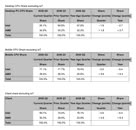
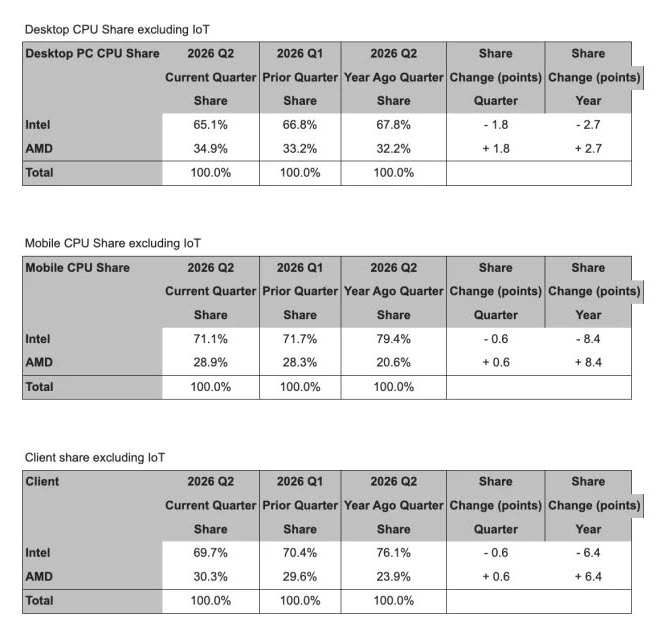
Breaking it down by segment, AMD's desktop share reached 34.9%, up 2.7 points year over year against Intel's 65.1%, despite Intel CPUs returning to Amazon's CPU Top 10 sales ranking yesterday. In the server CPU market, AMD managed to grow by 7.3 points year over year, reaching 34.5% against Intel's 65.5%. The competition is fierce in this segment, AMD has launched the 6th Gen EPYC "Venice" server processors powered by the "Zen 6" CPU microarchitecture, while Intel just announced its upcoming Xeon 7 "Diamond Rapids" CPUs and the "Crescent Island" graphics card for data centers and workstations. The laptop market is where AMD moved the most, climbing to 28.9%, up 8.4 points year over year, while Intel stays at 71.1%. Overall PC market share for AMD hit a record 30.3%, up 6.4 points year over year.
 Intel pointed to record year-over-year sales growth in its Data Center Group and a growing number of long-term supply agreements when asked to comment. On the channel side, a U.S. systems integrator executive told CRN that Intel's partner engagement has picked up noticeably after a period when AMD was getting more attention. "I think they're realizing that they have to be active," the executive said, speaking anonymously.
Source:
CRN
Breaking it down by segment, AMD's desktop share reached 34.9%, up 2.7 points year over year against Intel's 65.1%, despite Intel CPUs returning to Amazon's CPU Top 10 sales ranking yesterday. In the server CPU market, AMD managed to grow by 7.3 points year over year, reaching 34.5% against Intel's 65.5%. The competition is fierce in this segment, AMD has launched the 6th Gen EPYC "Venice" server processors powered by the "Zen 6" CPU microarchitecture, while Intel just announced its upcoming Xeon 7 "Diamond Rapids" CPUs and the "Crescent Island" graphics card for data centers and workstations. The laptop market is where AMD moved the most, climbing to 28.9%, up 8.4 points year over year, while Intel stays at 71.1%. Overall PC market share for AMD hit a record 30.3%, up 6.4 points year over year.

122 Comments on AMD Gains Ground as Intel x86 Market Share Goes Back to 1995 Levels
Not that arm today is all that awesome a company.
The next gen should be an interesting battle.
quallcom buying tenstorrent might throw a wrench in wide industry adoption as tenstorrent was pushing the isa forward a lot.
they also dumped ati's mobile graphics on Qualcomm or Samsung for some cash.
They had important x86 IP investors saw value in, that's what kept them alive.
It paid off.
They also managed to squeeze a couple of hundred million out of Chinese hygon by licensing the half baked zen 1 arch.
For which it was thanked by being placed on the entities list.
I kinda feel like AMD treated the graphics division as an unwanted stepchild, they got lucky nvidia was making inroads in to cuda not putting much effort in graphics rendering while amd still had some work left that was done under ATI.
Now it's a company that is making tens of billions each quarter and they still aren't bothering bringing anything interesting to market.
the 5090 an absolute joke due to it's price, but it does bring awesome graphics power.
AMD hasn't even bothered releasing big silicon to compete
We good? Can we be friends again?
I feel perfectly fine with what I wrote, amd doesn’t care about graphics
"...McCarron said, AMD’s share would have been higher in the segment if the company counted embedded CPUs it shipped for networking and storage applications in data centers. Intel, on the other hand, counts such CPUs within its Data Center Group. Without this accounting difference, AMD’s server CPU share would have grown 9.2 points year over year and 2.9 points sequentially to 46.4 percent against Intel’s 53.6 percent, according to the CPU market researcher."
www.crn.com/news/components-peripherals/2026/intel-s-cpu-market-share-falls-to-31-year-low-as-ai-mania-fuels-record-growthThey obviously compete in data centre GPUs with MI400 series. Nvidia is simply bigger and the first mover, but hey, there's a lot of space in that market. TAM is enormous, to the point that Microsoft, Google, Amazon and others can simply produce their own chips and racks. It's huge.
In client, AMD will try to come back with wider GPU portfolio on RDNA5 architecture. Currently, their upper mid range 9070XT is ding pretty, pretty well.This is generic nonsense, a meaningless word salad hoping to make sense. A simple example ahead. Intel was forced to cut prices across Xeon range, rapidly and dramatically. Just four months after the launch, the flagship 128 core Granite Rapids lost ~$5,400 (~30%) from the launch price, because it turned out that it was crushed in performance reviews against EPYCs and in TCO.
It's a shame that you spend so much time defending Intel without reading enough on this very tech platform and elsewhere. The credibility of your posts equals zero. Get informed.
www.tomshardware.com/pc-components/cpus/intel-quietly-slashes-prices-of-xeon-6-cpus-by-up-to-usd5-340
www.techpowerup.com/331709/intel-cuts-xeon-6-prices-up-to-30-to-battle-amd-in-the-data-center
In client market, you will need to explain why buyers increasingly buy CPUs that are losing 'top to bottom'. Here is your opportunity to shine.It's AI data centre super cycle around the world. Tough at the moment for consumers. Still, new consoles are in development and CPUs too. Premium gaming CPUs will be expensive. You cannot expect anything different on most advanced N2 node, but there will be more budget options too. Don't forget that behind companies are shareholders. What appears to be not caring for consumer market is also driven by current law. It is called fiduciary duty, aka profit-driven rules of the bigger economy. You can always complain to your local politician to try to change those rules and make companies more caring to average Joe. Good luck!
"AMD Gains Ground as Intel x86 Market Share Goes Back to 1995 Levels"
Did you read the article? I quote:
"In the server CPU market, AMD managed to grow by 7.3 points year over year, reaching 34.5% against Intel's 65.5%. The competition is fierce in this segment, AMD has launched the 6th Gen EPYC "Venice" server processors powered by the "Zen 6" CPU microarchitecture, while Intel just announced its upcoming Xeon 7 "Diamond Rapids" CPUs and the "Crescent Island" graphics card for data centers and workstations."
The thread is about x86 ecosystem. Thank you.
So according to your own argument (regarding marketshare), Intel has the better CPUs, that's why they are selling more.
You will need to explain what's stopping increasing number of buyers from purchasing Intel CPUs with dominant ST and MT performance. I am curious how you handle this because I am not asking you to defend Intel, but to explain why allegedly superior products are not as popular any more, across x86 segments.This. Well said.
But regardless of that, superior products ARE selling more. How many times do I need to repeat it? Intel sells over twice as many CPUs as AMD according to the very article you are commenting on. So what are you talking about my man?
Except at the top, Intel is losing while having to undercut AMD in the server market, since AMD is ahead in power efficiency and price per core count.Out of those 70, 60 of them are buying whatever laptop they see in the store, odds are it's Intel since they're better at flooding the market with lower end CPU's.Sure here you go. 7800X3D is $330, faster and more efficient in games, also has an upgrade path to Zen 6 instead of needing to buy a new board and ram.
www.techpowerup.com/review/amd-ryzen-7-9850x3d/18.htmlDid you read the title or the article? AMD is gaining ground, why do they have to sell more than Intel?
You keep ignoring logical arguments to move goalposts, and I assume you'd be upset unless Intel has a near monopoly.
AMD gaining market share is a good thing, without AMD's Ryzen comeback we'd still have 4 core 14nm Intel CPU's.
Also gaming is irrelevant on the bigger picture. It's a tiny marketshare.
wccftech.com/nvidias-cowos-ai-chip-packaging-demand-to-be-foreshadowed-in-2027-by-amd-due-to-agentic-ai-cpu-ramp-says-morgan-stanley/