Monday, August 24th 2026

AMD Gains Ground as Intel x86 Market Share Goes Back to 1995 Levels
According to Mercury Research, Intel's x86 CPU market share has dropped below 70% for the first time since 1995, hitting 69.3% in Q2 2026, a 6.5-point drop year over year. AMD was there to pick up the difference, reaching 30.7%, a new record for the company. Mercury Research president Dean McCarron confirmed the 31-year low to CRN following the release of his second-quarter CPU market share report. Those figures cover PC and server CPU shipments only. When semi-custom, embedded, and IoT products are included, the Intel market share falls to 65.9% vs. AMD's 34.1%, with the latter getting a boost from a stronger than expected gaming console SoC shipments, a segment Intel doesn't compete in, if we skip the Arc G3 CPU family dedicated to handhelds.
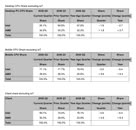
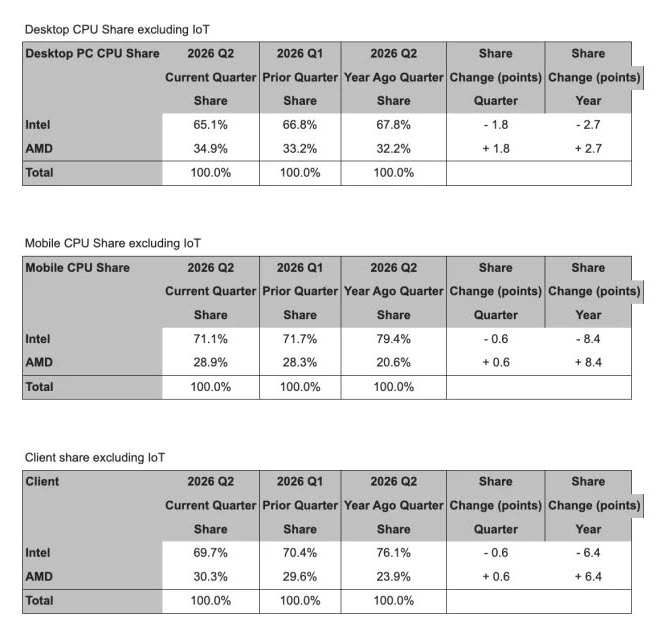
Breaking it down by segment, AMD's desktop share reached 34.9%, up 2.7 points year over year against Intel's 65.1%, despite Intel CPUs returning to Amazon's CPU Top 10 sales ranking yesterday. In the server CPU market, AMD managed to grow by 7.3 points year over year, reaching 34.5% against Intel's 65.5%. The competition is fierce in this segment, AMD has launched the 6th Gen EPYC "Venice" server processors powered by the "Zen 6" CPU microarchitecture, while Intel just announced its upcoming Xeon 7 "Diamond Rapids" CPUs and the "Crescent Island" graphics card for data centers and workstations. The laptop market is where AMD moved the most, climbing to 28.9%, up 8.4 points year over year, while Intel stays at 71.1%. Overall PC market share for AMD hit a record 30.3%, up 6.4 points year over year.
 Intel pointed to record year-over-year sales growth in its Data Center Group and a growing number of long-term supply agreements when asked to comment. On the channel side, a U.S. systems integrator executive told CRN that Intel's partner engagement has picked up noticeably after a period when AMD was getting more attention. "I think they're realizing that they have to be active," the executive said, speaking anonymously.
Source:
CRN
Breaking it down by segment, AMD's desktop share reached 34.9%, up 2.7 points year over year against Intel's 65.1%, despite Intel CPUs returning to Amazon's CPU Top 10 sales ranking yesterday. In the server CPU market, AMD managed to grow by 7.3 points year over year, reaching 34.5% against Intel's 65.5%. The competition is fierce in this segment, AMD has launched the 6th Gen EPYC "Venice" server processors powered by the "Zen 6" CPU microarchitecture, while Intel just announced its upcoming Xeon 7 "Diamond Rapids" CPUs and the "Crescent Island" graphics card for data centers and workstations. The laptop market is where AMD moved the most, climbing to 28.9%, up 8.4 points year over year, while Intel stays at 71.1%. Overall PC market share for AMD hit a record 30.3%, up 6.4 points year over year.

122 Comments on AMD Gains Ground as Intel x86 Market Share Goes Back to 1995 Levels
Do you subscribe to the idea that higher marketshare = better products? If yes, then clearly Intel has better chips since they are selling more (according to your own article). Also nvidia has been making infinitely better GPUs as well. Am I right or wrong?
You keep rambling about lower prices and better performance, but less and less people are buying it. You still have not explained to us as to why this is the case.
So Intel marketshare is dwindling although they have better product due to people being stupid.
This is serious case of fanboyism. Get real and grow up.
Is this some weird gaslighting attempt or something? You want people to say that Intel is better because they have more market share and sell more CPU's, which isn't the topic of the article, and is very much besides the point here.
Gaming is a part of the picture, as an enthusiast gaming is an important metric IMO.So if the 7800X3D is so horribly slow, I wonder why it out sells faster CPU's with more cores.
Intel has not diversified their products much at all, so they are literally stuck in only certain segments of the industry for the most part.
However if Intel are making better products in every market, why are they losing ground in market share?As already mentioned, people tend to buy the better product, better products raise market share. Nvidia has the 5080 and 5090 and until the RAMpocalypse Nvidia cards were selling better, now the 9000 series is doing very well being a better value for effectively the same performance outside the extreme niche of path tracing being promoted in a few games.
Intel got lazy with 14nm, combined with bad leadership and buying too many other companies they got too complacent, despite Intel being a larger company with more employees they can't expand into other markets as AMD has. Even with the experience Intel has with iGPU's they haven't been able to get into the dedicated gaming GPU market, or stopped what progress they had since Nvidia gave them $5 billion.
Great for the market, no competition.
Intel wasn’t as far behind technically and the financial problems it got it self in I already touched in this topic.
Monopolies are bad, vertically integrated companies can be good.
Anyways, if AMD makes better products why are they selling vastly lower number of CPUs?
Hypothetically Intel selling their fabs would save them a ton of money spent, though I think they'd get bailed out before that would happen.Intel market share of course went up when they had made themselves the only choice, very close to being a monopoly after illegal practices of bribing OEM's to only sell PC's with Intel CPU's.
Anything with X3D is expensive, though hopefully that will change when Intel competes with bLCC cache, unless Intel decides to ramp up their prices and claim large cache is too expensive, also I'm sure Intel will want the brand prestige on a gaming CPU which will drive up the cost even more. The 5800X3D should've been $200 at most, however production had to be restarted, CPU's aren't simply extra stock sitting in a warehouse as AMD has to pay current TSMC fab prices. In the current market an AM4 CPU still provides better value than buying DDR5, building a new PC in the current market isn't ideal but I'd rather get a used AM4 motherboard and cheaper DDR4, than pay 400X more over normal prices for DDR5.
I've been seeing lots of criticism lately for AMD prioritizing the server and AI market, because of shareholders AMD has to, they're following the AI hype Nvidia has set up with the AI bubble, also going for more profitable markets helps them innovate in the rest of the product stack. And by that logic if AMD is stepping on their consumers, Nvidia is stomping on people.
AMD still provides competitive CPU's, along with long lived sockets, and GPU's with better price/performance. It would be nice if the AI bubble could pop and every company go back to focusing on the market which helped put these companies where they are now.
Anyways, AMD is majorly losing in performance in the things that matter to the PC space at large, and sadly gaming isn't it. DIY is a tiny space, gaming is a tiny subspace of a tiny space. Even in the gaming space AMD isn't winning. Their 250$ 9700x isn't faster than the 200$ Intel chip in gaming, and it's far slower in MT. People are overwhelmingly buying Intel CPUs because as I've said repeatedly and nobody can refute it Intel is offering vastly more performance in MT, for vastly less money. They have been making the better CPUs for the past half a decade, the same way AMD was making the better CPUs between 2017 and 2019 even though they were losing in gaming. You don't want to accept it for ideological reasons and nothing can convince you so I'm not sure why you are quoting me. I on the other hand im absolutely ready to change my mind, show me a review of any CPU costing between 0$ and 400$ from AMD beating an Intel chip of equal price in ST or MT the past 5 years. I mean their latest R7 9700x are barely beating Intel's 5 year old i7 and it's getting blasted by Intel's 2022 i7 13700k. The gap is massive.
I can imagine what you'd be saying if the i7 270k was actually slower than the R7 7700x. Cause this is what's going on in reverse, and yet we have to pretend that it isn't happening.
Here, easy question for you. The 14700k released in 2023 for 400$. The 9700x released in 2024 for 360$. According to every review the 14700k is faster in ST, gaming, and vastly vastly faster in MT performance. What are we talking about here?
tpucdn.com/review/amd-ryzen-7-9700x/images/relative-performance-games-1280-720.png
In the latest one also doesn't seem to be much between them
tpucdn.com/review/intel-core-ultra-7-270k-plus/images/relative-performance-games-1920-1080.pngDo you understand that the article you are reading is talking about SHIPMENTS? It's the % of sales each company has shipped. 30% of the chips sold in q2 2026 were amd, 70% were intel. This isn't total marketshare, ie how many people have amd vs how many people have intel. If you still don't get it I can't help you, I can't understand it for you.
But you pretend to misread or misunderstand to make a point. Oh wellYeah, im arguing in terrible faith when i say that Intel has been dominating for over half a decade in MT performance at most price points. It's totally not true, that's why people have pushed back with plenty of examples instead of personal attacks.