Monday, August 24th 2026

AMD Gains Ground as Intel x86 Market Share Goes Back to 1995 Levels
According to Mercury Research, Intel's x86 CPU market share has dropped below 70% for the first time since 1995, hitting 69.3% in Q2 2026, a 6.5-point drop year over year. AMD was there to pick up the difference, reaching 30.7%, a new record for the company. Mercury Research president Dean McCarron confirmed the 31-year low to CRN following the release of his second-quarter CPU market share report. Those figures cover PC and server CPU shipments only. When semi-custom, embedded, and IoT products are included, the Intel market share falls to 65.9% vs. AMD's 34.1%, with the latter getting a boost from a stronger than expected gaming console SoC shipments, a segment Intel doesn't compete in, if we skip the Arc G3 CPU family dedicated to handhelds.
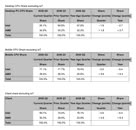
Breaking it down by segment, AMD's desktop share reached 34.9%, up 2.7 points year over year against Intel's 65.1%, despite Intel CPUs returning to Amazon's CPU Top 10 sales ranking yesterday. In the server CPU market, AMD managed to grow by 7.3 points year over year, reaching 34.5% against Intel's 65.5%. The competition is fierce in this segment, AMD has launched the 6th Gen EPYC "Venice" server processors powered by the "Zen 6" CPU microarchitecture, while Intel just announced its upcoming Xeon 7 "Diamond Rapids" CPUs and the "Crescent Island" graphics card for data centers and workstations. The laptop market is where AMD moved the most, climbing to 28.9%, up 8.4 points year over year, while Intel stays at 71.1%. Overall PC market share for AMD hit a record 30.3%, up 6.4 points year over year.
 Intel pointed to record year-over-year sales growth in its Data Center Group and a growing number of long-term supply agreements when asked to comment. On the channel side, a U.S. systems integrator executive told CRN that Intel's partner engagement has picked up noticeably after a period when AMD was getting more attention. "I think they're realizing that they have to be active," the executive said, speaking anonymously.
Source:
CRN
Breaking it down by segment, AMD's desktop share reached 34.9%, up 2.7 points year over year against Intel's 65.1%, despite Intel CPUs returning to Amazon's CPU Top 10 sales ranking yesterday. In the server CPU market, AMD managed to grow by 7.3 points year over year, reaching 34.5% against Intel's 65.5%. The competition is fierce in this segment, AMD has launched the 6th Gen EPYC "Venice" server processors powered by the "Zen 6" CPU microarchitecture, while Intel just announced its upcoming Xeon 7 "Diamond Rapids" CPUs and the "Crescent Island" graphics card for data centers and workstations. The laptop market is where AMD moved the most, climbing to 28.9%, up 8.4 points year over year, while Intel stays at 71.1%. Overall PC market share for AMD hit a record 30.3%, up 6.4 points year over year.

122 Comments on AMD Gains Ground as Intel x86 Market Share Goes Back to 1995 Levels
This thread isn't about what CPU is faster in certain tasks, AMD is gaining market share in server and desktop where they have the overall better products, not niche cases where a certain task benefits from a bunch of atom cores. I had though some people here were shilling, but no company would want to represent sh*t this stupid.
Don't send it to me, send it to the mods, lol. Again if this is a serious threat to your life, you should send it to the mods so they can vet it and take action, wtf...
Looked at Wiz's latest review, price/performance looks like a mixed bag in Intels favour. AMDs cheaper in the UK, so more mixed here.
I wonder what percantage of AMDs CPU sales come from people already on a compatible socket? If Intel keeps it up, will be interesting to see the market share once AM6 drops.Yeah my bad, I meant RDNA. CDNA is doing great. nVidia managed to pull off a unified arch, here's to hoping UDNA does well. AMD struggled to cost effectively do both last time (he who chases two rabbits etc.). It'd be nice if I don't have to skip another gen... With RAM prices being what they are, competition is our only hope for stomachable prices...
Not enough forensic analysis. The forensic scientists in these threads need at least page-15 to determine which benchmark supports the conclusion they already reached on page one.
Page-16 should be interesting.... thats when personal attacks start outperforming the CPUs. You can't put a page number on that sort of contaminated crime scene.
Intel was always known for their FABs more so than their chip designs. If you can stay a few generations ahead in FABs even run of the mill chip designs can be world leaders. Cyrix and AMD had design wins in the past for short periods, but Intel could just lower prices and vastly outproduce competition to weather the storm nicely.
AMD with the Ryzen series changed their fortunes from being the cheapest CPU/motherboard you can find to get the job done to being competitive at a time when Intel figured they had already won the race and let their FABs stagnate to save money. TSMC won the FAB war and if AMD could have purchased 1000% more wafers then allocated Intel would be toast. That is the major difference between them, how many chips they can actually make. Intel had to lower prices to be competitive and make it up in volume since they still own their own FABs while AMD has been selling higher profit chips to make the most of the wafer allocation they can (while still making lower profit contracted console chips and a few GPUs to keep the brand alive).
For consumers it's all about availability vs price/performance. If AMD had an unlimited amount of 16GB RX 9070 XTs at MSRP to sell they would dominate the market, but they don't because the dies are large and that would cut into more profitable high-end CPUs.
AMD's valuation is more than intel's because people are gambling that as AMD buys more and more wafers, they should be able to overtake Intel's production over time. Intel will end up like AMD down the road with underperforming foundries that they have to keep dumping money into like AMD did with GoFlo. Now maybe if Intel can get their shit together and be on par with TSMC they can reverse their fortunes because the competition has caused Intel to actually make better chips designs that were hobbled by poorer manufacturing nodes.
Secondly, Intel doesn't have a proper AI data center GPU, so their volume is mostly confined to Xeons and client market. Whether thid changes any time soon, we shall see. They seem overvalued in stock markets, but hey, that's the case with many companies.