Thursday, September 10th 2026

Majority of TPU Users Don't See Microsoft's Promised Windows 11 Improvements
A few months ago, Microsoft promised its Windows enthusiast community that the company would implement a major overhaul to improve performance and stability in the Windows 11 operating system. We conducted a poll and received nearly 33,000 responses from the community to answer one question: Are you experiencing the promised improvements in Windows 11? However, the findings are quite polarized, as the majority of the enthusiast community doesn't actually notice any difference before and after the promise was made. Among all respondents, 43.4% voted that there are no noticeable improvements. This represents thousands of Windows 11 users worldwide who are not seeing any enhancement in their day-to-day operations with Microsoft's latest operating system.
What is perhaps more alarming is that many enthusiasts report a worse experience following Microsoft's promises. About 38.1% of the voters indicated they are experiencing actual degradation in day-to-day operations, as Microsoft continues to push updates that negatively impact everyday use and introduce more bugs. Notably, a recent example is the Windows 11 August update, which reset custom cursors to an oversized default one. In some cases, the color and size settings don't stick, no matter how many times they are changed. This update has also caused gameplay issues, such as forced crashes, random freezing, errors, and unexpected device restarts due to RGB peripherals.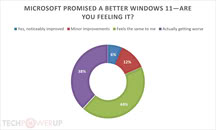 Regarding other responses in the poll, only 12.6% of participants reported that Microsoft managed to introduce a few minor improvements in their daily use, while just 6.3% noticed significant improvements. While the results vary, it's important to note that Windows 11 runs on half a billion PCs worldwide, many of which have unique configurations and hardware differences, each with its own issues and quirks.
At the recent IFA 2026 show, Microsoft confirmed that the company is listening to user feedback on various aspects of the Windows experience, including boot times, Windows Hello, and optimizations for PC systems with 8 GB of RAM. Microsoft is already working on improving Windows 11 performance through the Low Latency Profile, which is expanding to more applications and could potentially make software launch faster on less powerful hardware. However, we have yet to see these optimizations make a real-world impact, so for now, that remains uncertain.
What is perhaps more alarming is that many enthusiasts report a worse experience following Microsoft's promises. About 38.1% of the voters indicated they are experiencing actual degradation in day-to-day operations, as Microsoft continues to push updates that negatively impact everyday use and introduce more bugs. Notably, a recent example is the Windows 11 August update, which reset custom cursors to an oversized default one. In some cases, the color and size settings don't stick, no matter how many times they are changed. This update has also caused gameplay issues, such as forced crashes, random freezing, errors, and unexpected device restarts due to RGB peripherals.

At the recent IFA 2026 show, Microsoft confirmed that the company is listening to user feedback on various aspects of the Windows experience, including boot times, Windows Hello, and optimizations for PC systems with 8 GB of RAM. Microsoft is already working on improving Windows 11 performance through the Low Latency Profile, which is expanding to more applications and could potentially make software launch faster on less powerful hardware. However, we have yet to see these optimizations make a real-world impact, so for now, that remains uncertain.
84 Comments on Majority of TPU Users Don't See Microsoft's Promised Windows 11 Improvements
Only healthy thing in Windows is Win32 part -they should go back to Win7, and then start from scratch. Eventually 8.1.
Even Windows 10, which is now praised by many, was actually disaster when it appeared. It was not until late 2018 that it become relatively stable.
About windows 11 I've changed to linux, and linux while updating is not hogging resources, in comparison to windows 11 in work was today installing updates and was sounding like meltdown in powerplant.
Still, Metro was great sign of times that are about to come...
Stage 1) "OS" is AWFUL, I will never move on from "OS-1"
Stage 2) "OS" is Awful, but I've made it work, but MS should make it more like "OS-1"
Stage 3) "OS" is still pretty bad, but in hindsight "OS-1" had some big issues, they really need to start again from Windows 7. <------ You are here
Stage 4) "OS" runs pretty good, I've used it for years without issue, I still prefer "OS-1"
Stage 5) "OS+1" Looks AWFUL, I'll probably just stick to "OS", why couldn't they just improve upon it?
50: goto 10:.
Repeat ad infinitum with every Microsoft OS release.
Unfortunately, Windows 10 and 10 mobile really screwed a lot of things - stability and speed mainly, plus UWP approach that backfire terribly due to lack of support from Microsoft itself.
Also, I switched to 11 and never looked back to 10, because I was not satisfied with 10 either, so 11 was not much difference :)
Cheers.
Most of the poll votes were MORE than likely propagandized feelings anyway!I think the poll distribution won't change much until Microsoft actually overhauls the OS in drastically obvious in-your-face ways. For some that might be a pop-up during the update that asks questions like:
[INDENT=2]☑️ Remove ALL non-critical software installed during the OS installation process?[/INDENT]
[INDENT=4]☑️ OneDrive[/INDENT]
[INDENT=4]☑️ MS Paint[/INDENT]
[INDENT=4]☑️ Bitlocker[/INDENT]
[INDENT=4]☑️ Edge[/INDENT]
[INDENT=4]☑️ Outlook[/INDENT]
[INDENT=4]☑️ etc.[/INDENT]
[INDENT=2]☑️ Remove, disable or block ALL telemetry data transport from MS products?[/INDENT]
[INDENT=4]☑️ Same sort of itemized checklist.[/INDENT]
[INDENT=2]☑️ Mix & Match File Explorer behaviors from XP, Win 8, Win 10?[/INDENT]
[INDENT=4]☑️ Huge list of options.[/INDENT]
[INDENT=2]☑️ Remove TPM/TPM2 dependencies.[/INDENT]
[INDENT=2]☑️ Fix Secure Boot and Fast Boot to be aware of and work properly with, Dual-Boot systems.[/INDENT]
[INDENT=2]☑️ Remove or repair other things people bitch about endlessly.[/INDENT]
and ect. etc. etc. like that. Until something like this happens, people's perceptions and thus the poll distribution (as well as the mythical "customer satisfaction") aren't going to change much - at least not any time in the foreseeable future..
W7 was really the last good Windows they ever released. I used it as long as possible, until i was forced on 10, because of new hardware.
Now if they could get this running on modern Hardware, without vibe-coding it into hell, then count me in!
Another thing Windows should have included is an audio equalizer and it also should have kept the Windows 98 Start menu.
Regards,
Fred.
Microsoft and other software developers don't care if a person likes men, women, or both... or if they think Adam Sandler is a great actor. None of that matters. They only want telemetry data to fix bugs (and also to send ads tailored to the person's tastes).
This is reflected on the language employed throughout Windows - it's no longer "My Computer", it's "This PC". It's no longer "your machine" but "this device". No longer "click", but "tap" - they really assume we're all room temperature IQ users on touchscreen mobile computers, after the "Windows Experience" - not that we use Windows out of a need, again, reiterating they believe they always know what's best for the user.
Microsoft spends an insane amount of time trying to control and standardize the behavior of the average Windows installation these days, which is why many requirements are enforced and why they foist nonsense like memory isolation on everyone - instead of letting the machine's operator figure it out for themselves. They make extensive use of eKBs to remotely enable and disable parts of the operating system and its code, install, update, and remove drivers through the Windows Update system, etc. - it's literally built with the assumption you are a retard.
This has been a trend since WIndows 8, the last OS that assumed that the user had somewhat of a functional brain was Windows 7. I've lost count of how many PCs I used to get that didn't even have a basic video driver installed because the user didn't know what they were for and never bothered looking, it was that bad. Microsoft's approach fixes this and genuinely gives these... retards... a better experience, at the expense of power users, or at least, a somewhat competent operator with a basic understanding of the concept of computer security and maintenance practices.
If Microsoft brought back an actual workstation OS with an UX designed for desktop computers, without the whole inclusive verbiage and terminology they insist on using, specifically meant for people who know what they're doing, with no "customer support" provided, I think they'd get a lot of goodwill back.
It's impossible to make significant changes on an OS of the scale of windows in such a short time.
Windows mostly survives because of widespread deployment in corporate, enterprise, government sectors, etc. In fact, Windows has strong legacy support for this reason not so that Gamer Dude can play OG Quake.
Microsoft is happy that Windows remains the de facto PC operating system for gaming but 98% of their focus is on appeasing their corporate customers.