Friday, October 9th 2026

GIGABYTE BIOS Update Points to New DDR4 Intel Processors Coming Next Year
GIGABYTE has released BIOS updates that prepare its entire Intel B760 and H610 motherboard lineup for upcoming LGA1700 processors, which the company says are "expected to launch in early 2027." As reported by Videocardz, the update covers DDR4 and DDR5 boards alike, so owners only need to flash the new firmware and drop in the new CPU once it arrives. GIGABYTE doesn't name the processors in its press release, and Intel has yet to announce anything new for the socket. However, the timing lines up what we've been reporting for months. Intel is said to be readying "Raptor Lake Next" chips for LGA1700 in 2027, based on the original Raptor Lake silicon.
That makes GIGABYTE's BIOS the closest thing to a confirmation of new DDR4-compatible Intel processors for 2027, and it comes before Intel has announced them. It looks like the firmware was rolling out quietly even before the press release. The B760 Gaming X AX, for example, received its F18 BIOS on September 29, with a changelog that lists a CPU microcode update and "preparation for upcoming processor support." GIGABYTE also claims to be the first vendor to cover every B760 and H610 model. The press release makes no mention of Z790, Z690, or B660 boards, and there's no word on whether those will follow.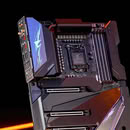
 DDR4 support is probably the key point here. LGA1700 chips carry both DDR4 and DDR5 memory interfaces, while the newer LGA1851 platform is DDR5-only. Not only that, Intel's next-gen "Nova Lake-S" desktop CPUs are moving to a brand-new LGA1954 socket, that too is only DDR5-compatible. High DDR5 prices have pushed plenty of builders back toward older hardware recently, and it looks like Raptor Lake Next is supposed to be a more affordable DDR4 alternative to the main Nova Lake-S lineup. Recent leaks also point to an 8P+8E chip replacing the Core i5-14600K, although none of that is confirmed. Owners of B760 or H610 boards can grab the BIOS from GIGABYTE's website now, and it's reasonable to expect other vendors to follow before launch.
Sources:
Gigabyte, via Videocardz
That makes GIGABYTE's BIOS the closest thing to a confirmation of new DDR4-compatible Intel processors for 2027, and it comes before Intel has announced them. It looks like the firmware was rolling out quietly even before the press release. The B760 Gaming X AX, for example, received its F18 BIOS on September 29, with a changelog that lists a CPU microcode update and "preparation for upcoming processor support." GIGABYTE also claims to be the first vendor to cover every B760 and H610 model. The press release makes no mention of Z790, Z690, or B660 boards, and there's no word on whether those will follow.


24 Comments on GIGABYTE BIOS Update Points to New DDR4 Intel Processors Coming Next Year
Was thinking of getting raptor about few days ago but it is a dead end platform… leaning towards more to nova lake… even though the ram and ssd is rubbishly priced
Long live LGA1700!
NtM, LGA2066(X299) in-particular actively prohibited cheap and plentiful DDR4 RDIMMs; truncating the usefulness of the platform to below that of 'X99'.E5 2666 V4, E5 2686 V4, and E5 2696 V4 support Quad-Channel DDR3.
Quad-Channel DDR3 is actually competitive with Slow/Single-Channel DDR5 and Dual-Channel DDR4 for memory bandwidth but, is obscenely power hungry by modern standards.We are. I have a MACHINIST X99 K9-D3 w/ 4x64GB DDR3 LRDIMMs, I built last year.
Also, I'm seeing YouTubers, etc. actively building and advising on the 'optimal' max budget-friendly DDR3 builds-
While Skylake and Kaby Lake had DDR3 memory controllers and Broadwell did see a limited Desktop rollout, folks are genuinely looking at the Haswell 4790K again, for bargain basement entry-level gaming builds.
Skylake, Kaby Lake, and Broadwell-C are just too expensive and hard to find proper DDR3 boards for, while the 4790K offers Early-AM4 level performance w/ tweaking.
It's a massive bottleneck to performance but, it goes to show just how bad things have gotten...
Otherwise, it will be pointless. Remove the P-core and E-core setup and go back to HT.
Wish they were doing bartlett lake though not just a raptor rake refresh.
Raptor lake gaming performance is significantly better than the 5800x3d. 1%low gap larger
HT decreases gaming performance, e core increases gaming performance.5800x3d should not be bought. Even considering its hyped gaming performance, it is very mediocre, roughly equivalent to the gaming performance of a tuned 12600k, or the untuned gaming performance of 9600x/14600k ddr4/265k
tpucdn.com/review/intel-core-i7-13700k/images/relative-performance-games-1920-1080.png
tpucdn.com/review/intel-core-i5-14600k/images/relative-performance-games-1920-1080.png
I also found that when TPU uses 3080 to test, the gaming performance of 5800x3d is equivalent to 12600. when changing to 4090, the performance is equivalent to 12700k, and when changing to 5090, the gaming performance is equivalent to 9600x. it seems that as the GPU gets better, the scores will improve in the test. this also means that for most people without 5090, its widely hyped gaming performance is also meaningless.
gaming performance is only 12600k tier, and other aspects like ST are worse.
In dense computation scenarios, the 5800x3d is prone to frame drops, and short term game reviews can hardly measure such complex scenarios, but for users who use the cpu daily, it is perceptible. many related discussions.
That is why, even if the 5800x3d is close to the 7700x/9600x/12900k in media gaming benchmarks, you should not expect the real world gaming experience of the 5800x3d to actually be the same as those cpu models.
The principle of marginal effects reveals that people need more when their needs are not satisfied, while they barely need additional things when their needs are already met. People need to increase fps when game fps are low, but it doesn't matter when fps are sufficient. The 5800x3d performs poorly in games with lower fps like ue5, while performing relatively well in games with higher fps, which means that even if the 5800x3d performs better in 5 out of 10 games compared to 12900k, appearing to have the same number of well-performing games as the 12900k, the satisfaction people get is lower.
MT is low, plus it cannot be overclocked, so why buy such a thing.
The oced 12600k(like 5ghz/4000mhz) games similarly to a stock 12900k, while the 5800x3d does not support oc.
HUB 12900k ddr4 tested too low, likely tested using gear2
According to TPU testing, the 12900k using ddr4 3600c16 gear1 is similar to ddr5 6000c36
Therefore 4000c16 gear1 is equal to ddr5 6000c36 in gaming, slightly worse than 7200 ddr5