Saturday, November 21st 2026
Moore Threads Claims Its Next GPU Will Break the Consumer VRAM Record
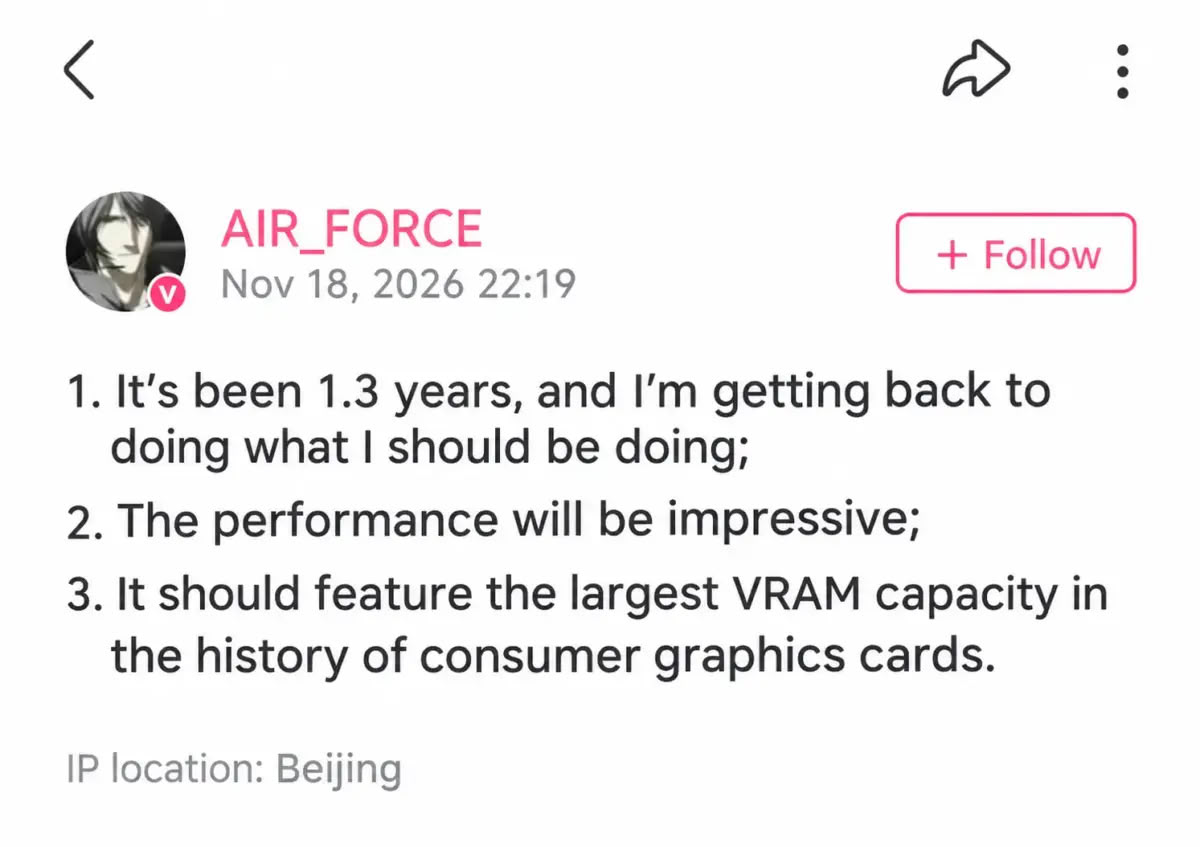
Another player is coming to stake their claim against NVIDIA, AMD, and Intel in the GPU market. A product manager behind Moore Threads' MTT S80 claims that the company's next desktop graphics card, codenamed Lushan, could set the record for the largest VRAM capacity ever put on a consumer graphics card. He posted this on November 18 on Weibo, but didn't disclose how much VRAM it would actually have. After that, Moore Threads published its first poster for MDC 2026, and the artwork hints at the graphics card. It is mostly hidden behind a pair of peaks, with one rendered as a 3D mesh and the other as a neural network. MDC is the MUSA Developer Conference, set for December 29 in Beijing.
We saw the concept behind Lushan at the first MUSA Developer Conference last December, alongside the Huagang architecture. The company then claimed 15x higher AAA gaming performance than its previous generation, as well as 50x faster ray tracing and 64x more compute, some truly gigantic leaps. If we look at what Moore Threads is claiming, the target to beat is the GeForce RTX 5090 at 32 GB of VRAM (if you consider the 5090 a consumer card at all). The MTT S80 has 16 GB of VRAM, and Moore Threads has previously promised four times the memory capacity over its predecessor. That works out to 64 GB, which would definitely be a record, but this is speculation, and Moore Threads has not confirmed any number at the time of writing. There's also debate over whether gamers really need that much VRAM, and whether such a large memory pool would attract workstation and local LLM users instead.

Sources:
Moore Threads, Videocardz
We saw the concept behind Lushan at the first MUSA Developer Conference last December, alongside the Huagang architecture. The company then claimed 15x higher AAA gaming performance than its previous generation, as well as 50x faster ray tracing and 64x more compute, some truly gigantic leaps. If we look at what Moore Threads is claiming, the target to beat is the GeForce RTX 5090 at 32 GB of VRAM (if you consider the 5090 a consumer card at all). The MTT S80 has 16 GB of VRAM, and Moore Threads has previously promised four times the memory capacity over its predecessor. That works out to 64 GB, which would definitely be a record, but this is speculation, and Moore Threads has not confirmed any number at the time of writing. There's also debate over whether gamers really need that much VRAM, and whether such a large memory pool would attract workstation and local LLM users instead.

30 Comments on Moore Threads Claims Its Next GPU Will Break the Consumer VRAM Record
This amount of memory will clearly price it out of any gaming audience that would be willing to pay for the rendering performance.
get everyone to include more of it.
So demand remains high enough to keep fabs running and prices don't drop to critical levels
I wonder if More threads has improved their drivers
Unfortunately this is not specific to the various types of RAM and also applies to NAND overall, it seems like the worst case scenario really came to pass as for years this was a cartelized commodity, with capacity and speeds withheld by the industry. Only now that it's all worth a veritable fortune.
The Titan X has 12GB of VRAM and was a bit quicker than a GTX 980 but it's beaten by a GTX 1070 in performance years ago and, whilst the 12GB allows it to do what a GTX 980 can't, it doesn't have the grunt to be a particularly good solution in games where that extra VRAM is needed.
Going on the previous MTT performance numbers, I can't see them doing anything other than having a similar situation unless they have a multi-generational performance jump.
Possible, but I don't think they can manage it based on where they are now Vs where they need to be.
No one will buy it for LLMs. A decade old Pascal based Tesla probably has better compute for LLMs than whatever they have.
CEOs coke hallucinationsChina… you know.It requires chips to make those graphics cards, so I would imagine its still going to cost more than a 5090. If its cheaper than that well, heh, its not something I would invest in. The other graphics card manufacturers already have a majority of the market(excluding intel), so I don't see this going anywhere unless its going to target workstation builds for non-Iray tasks.
We're kind of in a weird place ATM.
Give me 24GB please at 1/3rd the cost of that 64GB monster.
It can't be HBM, that's all sold out for years
It can't be GDDR7 or 6, for the same reason
It might be GDDR4 or 5, if they found stockpiles someplace?
Unless this is going to be a China only card, using VRAM from domestic supply?
How many Titan V CEO editions were there...?
For the ones that are destined to end up in a datacentre I expect the memory supply taps to miraculously open up when needed.
www.techpowerup.com/vgabios/206188/nvidia-titanv-32768-18060
Hurdles are tooling and cost, Tesla V100 cards still fetch around 1k and Quadro GV100s go on 1700-2k range. Not something you buy to gut and make a frankenboard. Hopefully someone will end up finding out how to "unlock" Titan V's just like the folks managed to unlock those Ampere mining GPUs... doubt it's possible but would be hilarious.
Especially if it's for light weight crap like LLM's for dialog.