Wednesday, November 25th 2026

Intel Core Ultra 4000 "Nova Lake-S" Preliminary Specs Leaked

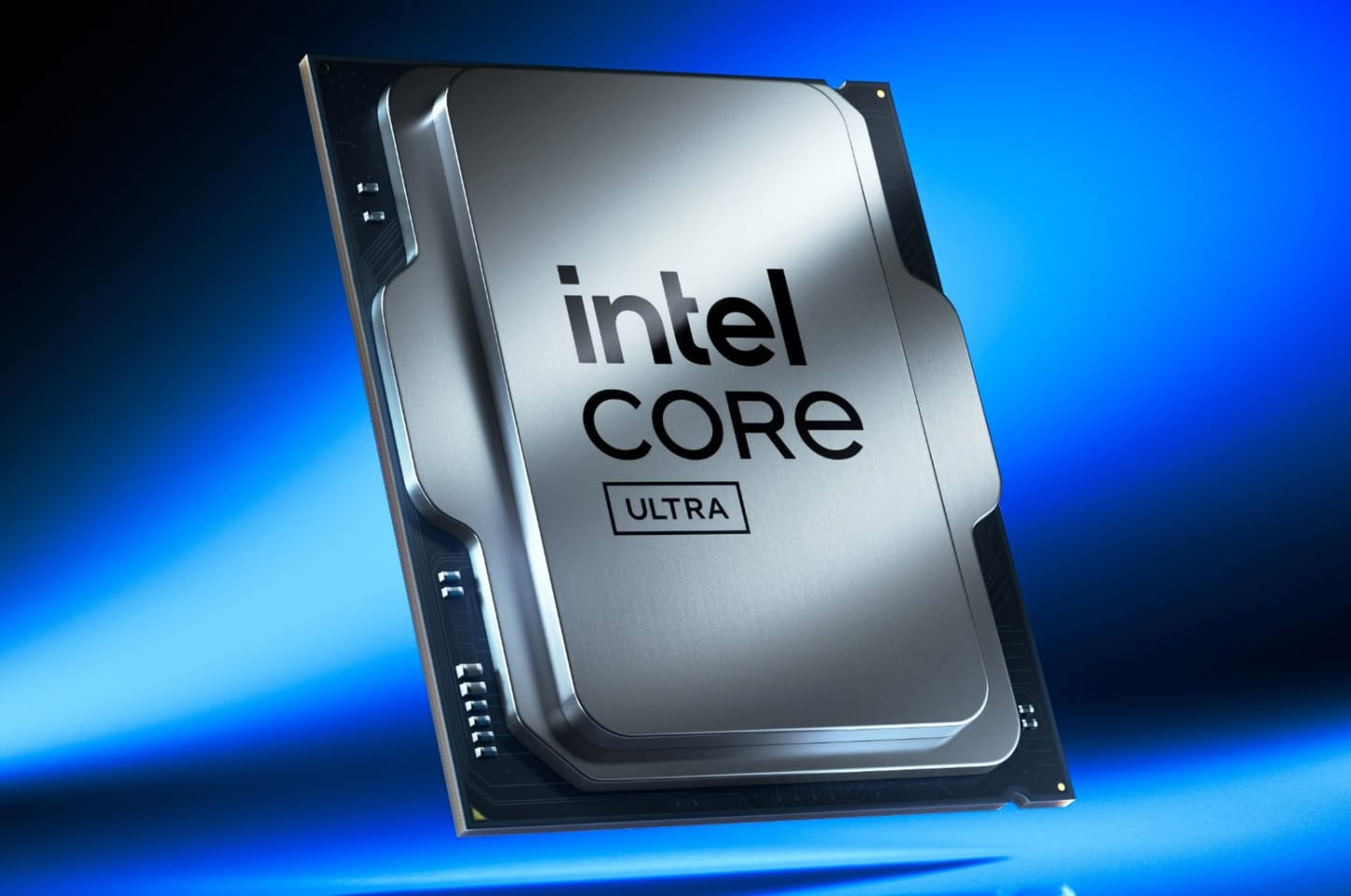
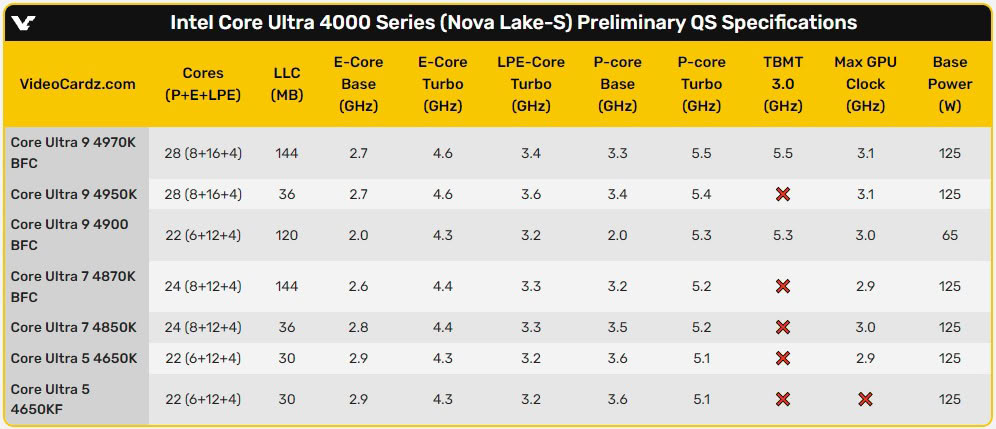
More information has surfaced about Intel's upcoming "Nova Lake-S" desktop CPU lineup. According to an Intel document obtained by Videocardz, the Core Ultra 4000 series lineup will be led by the Ultra 9 4970K BFC, with 28 cores and 144 MB of L3 cache, along with a 5.5 GHz boost clock. The document lists specs for seven Nova Lake-S desktop chips. Videocardz notes that these are C1-stepping qualification samples, so there may be some changes between these specs and the retail models, particularly the final clock speeds. We don't often see changes between qualification samples and retail processors so close to launch, but it's something to remember regardless.

Looking at the table, the Core Ultra 9 4950K slots in just under the flagship 28-core 4970K BFC. The 4950K also has 28 cores in an 8P+16E+4LPE configuration, but it drops the BFC suffix and doesn't carry the additional L3 cache, topping out at 36 MB. The boost clock drops from 5.5 GHz on the 4970K to 5.4 GHz on the 4950K. This settles the confusion around the 4950K's core count, since the October lineup leak showed it without any LPE cores. There's also the 22-core Ultra 9 4900 BFC, an interesting non-K SKU that has fewer cores than the Ultra 7 models. This model only has a 65 W TDP, while all other leaked variants show a 125 W base power rating.
After that, we get the Core Ultra 7 4870K BFC and 4850K, both of which have 24 cores (8P+12E+4LPE) and a 5.2 GHz boost, but are again split by the difference in L3 cache. Moving down the stack, the Core Ultra 5 4650K and 4650KF get 22 cores (6P+12E+4LPE), 30 MB of L3 cache, and a 5.1 GHz boost clock. Of course, the KF variant does not have an iGPU. Curiously, the 125 W 6P+12E+4LPE bLLC chip is missing from this stack, which lines up with leaker Jaykihn's claim that it was moved to Razor Lake. All Nova Lake-S CPUs support DDR5-8000 memory, up from DDR5-6400 on Arrow Lake-S. Per Videocardz, Intel is planning a next-generation desktop event in Berlin between February 22 and 25, which is now expected to be the launch event for Nova Lake-S.
Source: Videocardz
Add your own comment

68 Comments on Intel Core Ultra 4000 "Nova Lake-S" Preliminary Specs Leaked

#51
wheresmycar
WirkoWe don't even know for sure what vector extensions the P and E cores will support, much less LPE. Those may as well be "RISC", meaning a reduced instruction set without AVX512/AVX10 or even AVX2. Then the executables would have to be tagged as LPE compatible, and the OS would allow only those to run on LPE cores. That's totally conceivable because these cores seem reserved for a specific, limited set of background tasks.
Thats the first thing that came to mind... another layer of complexity to scheduling. I've seen people having had enough fun and games with hybrid scheduling since ALD.

"limited" compatibility and select background/lightweight task support won't cut it. If they get it right (or eventually), we want to see LPE cores taking care of all background tasks and lightweight workloads whilst sipping as little power as possible for it to make any sense. That would be an excellent selling point for Intel.

Anyway, personally I'm not that fussed... gimme something well priced, matched or ahead on compo and something that just works out of the box - I'd be interested.
Posted on Reply
#52
N/A
The scheduler is going to use the performance cores first in that order, then threads, then the garbage cores and lastly the new type of SOC cores, that are the same garbage, but without access to big L3 cache and are going to add a layer of stuttering, so disable All that mush you're left with 8 p core, the rest are good only for heavy rendering, but who needs that. So forget it. Insanity. Just give me a pure 14 core with 128 MB and hyperthreading like my Xeon and integrated memory controller on the same tile. Shouldn't be more than 150 sq mm same as 8+16 tile 144mb. Little less performance and more power, but who cares for desktop consumption. Get real .
Posted on Reply
#53
Dubiopolis
N/AThe scheduler is going to use the performance cores first in that order, then threads, then the garbage cores and lastly the new type of SOC cores, that are the same garbage, but without access to big L3 cache and are going to add a layer of stuttering, so disable All that mush you're left with 8 p core, the rest are good only for heavy rendering, but who needs that. So forget it. Insanity. Just give me a pure 14 core with 128 MB and hyperthreading like my Xeon and integrated memory controller on the same tile. Shouldn't be more than 150 sq mm same as 8+16 tile 144mb. Little less performance and more power, but who cares for desktop consumption. Get real .
neither the E cores or the LPE cores have any L3 cache
Posted on Reply
#54
N/A
E cores sitting on the ring bus can tap into the big L3. But the SOC LPE probably can't through the interconnect. They have to request data from the memory, they'll be handling tasks with the green leaf icon and wake up the compute tile only if it hits a certain threshold. I would still prefer p cores with SMT, since 4 e cores equal 3 p cores and 2.5 with SMT. So there's no point of having them when you can have 2P/4T in the SOC instead for basic Windows OS function.
Posted on Reply
#55
Doctor Who
Underwhelming so far.
G00d job Intel,
Posted on Reply
#56
MufasaV
N/AE cores sitting on the ring bus can tap into the big L3. But the SOC LPE probably can't through the interconnect. They have to request data from the memory, they'll be handling tasks with the green leaf icon and wake up the compute tile only if it hits a certain threshold. I would still prefer p cores with SMT, since 4 e cores equal 3 p cores and 2.5 with SMT. So there's no point of having them when you can have 2P/4T in the SOC instead for basic Windows OS function.
They access it but indirectly through the Memory Side Cache (with heavy latency penalty) if I'm not mistaken. Even the iGPU can access L3 cache in the ring albeit with limited access/permissions and bad latency
Posted on Reply
#57
Phayzon
N/AJust give me a pure 14 core with 128 MB and hyperthreading like my Xeon and integrated memory controller on the same tile. Shouldn't be more than 150 sq mm same as 8+16 tile 144mb. Little less performance and more power, but who cares
Fascinating that you are knowingly, directly asking for a worse product.
Posted on Reply
#58
efikkan
wheresmycarThats the first thing that came to mind... another layer of complexity to scheduling. I've seen people having had enough fun and games with hybrid scheduling since ALD.
The issue there is running an antiquated kernel (ahem Windows). Scheduling different on different tiers of cores is generally easier than SMT, where pairs of threads needs to be balanced or latency will suffer, and the hardware is actually controlling the switching between threads. While SMT is fine for big async workloads, it's sub-optimal for e.g. gaming. While hybrid architectures might not be perfect, I'd still prefer it over SMT, and leave SMT in the server space where it belongs.
Posted on Reply
#59
AddSub
PhayzonFascinating that you are knowingly, directly asking for a worse product.
Worse for what, is the question. Assumption on TPU is that it is overwhelmingly 1. gamers and 2. power users, aka community of "enthusiasts", so a potentially not-as-efficient-as-it-can-be, but raw in throughput and "HWBOT records might be getting broken" type of silicone is going to be prefered. Which is why I always recomend Intel HEDT or Pro platforms (LGA 4677, LGA 4710 & LGA 7529), or even X299 if you want to keep it budget friendly and go legacy route. Some of those platforms support up to 288 cores and up to 6 TB of RAM, as in terrabytes of RAM.

Now if you just want to... check your email, browse YouTube, and dont really care what setting you play your games at (at that point, you should really be using a smartphone as billions of people already are doing), or simply dont know which setting means what (which is a lot if not majority of users), and HWBOT is just random assortement of letters to you, then anything, ANYTHING, Intel, AMD, Qualcom, VIA, ChineseSiliconeNewcomers, whomever, anything released in current year will be just fine.

Sure there are HTPC enthusiasts around who like them cores low power and low power enthusiasts/tinkerers that named their first kid "Raspberry Pi", but assumption on on TPU is that the average user/poster wants their TimeSpy benchmark result to be "NUMBER IS TOO HIGH TO PRINT!".

That said, will AMD's Zen6 and SuperDuperNextGenLake from Intel be impovements over previous gens? Sure, but not in the way people who got their first computer in 1970s or 1980s think. More efficient? Yeah, sure, them nodes be shrinking. That is a given. But we've hit the power wall with Conroe 20 years ago and it's been IPC/transistor stacking and density alchemy ever since then. That is, getting a +500mhz +20% IPC uplift across the board on your GPU/CPU every 18 months is just not going to happen anymore.

So these mutant CPUs with novel core layouts and architectures, are they fine? Sure, for most of humanity, they won't know or care what's good/bad/different about them. HWBot crowd?! Oofff! I mean those dudes will overclock a toaster but they know how badly tech innovation has stagnated and they know what concessions and compromises triple tiered core arch like these new Intel toys bring to the table.

...
..
.
Posted on Reply
#60
Squared
4970K? What is it 2013 again?
Posted on Reply
#61
Onasi
@AddSub
The gaming performance is fine with hybrids, those extra 2 P-cores people are drumming about wouldn’t really improve things significantly. The extra cache in the BFC SKUs is more of a difference maker. And, I am sure you understand this yourself, nobody at Intel gives a fuck about HWBOT competitors. On the other hand, having small, efficient cores that take on all the background nonsense in modern Windows are universally useful to pretty much everyone. And they provide quite a lot of value for people who run MT workloads, but don’t want to shell pit their kidneys for a Threadripper (provided those workloads aren’t fully memory bound).
AddSubbut assumption on on TPU is that the average user/poster wants their TimeSpy benchmark result to be "NUMBER IS TOO HIGH TO PRINT!".
Weird assumption. We are just discussing tech here. I am pretty sure most people on TPU don’t even bother with OCing anything beyond the basics of turning on XMP/EXPO because there’s little point in it for day to day operations. Some undervolts, maybe. But the benchmarking community isn’t the majority.
Posted on Reply
#62
kondamin
PhayzonNone of the model numbers match up so it’ll be very easy to tell if someone’s selling a Haswell or a Nova Lake chip.
I talked to an other person that is working in the "business" he only spoke about i5 and disregarded the generation.
A heck of a lot of people only look at those numbers cursory if at all.
Posted on Reply
#63
Onasi
kondaminI talked to an other person that is working in the "business" he only spoke about i5 and disregarded the generation.
A heck of a lot of people only look at those numbers cursory if at all.
Then those people are in luck since the whole i3/5/7/9 nomenclature is gone anyway.
Posted on Reply
#64
EsaT
DSTBenchThe only true real way for a CPU to has more power is: Just Power Consumption, and power consumption belongs to SIZE.
Mostly not true.
Power consumption depends by far most on what you do you with the silicon and transistors, as in do you push it to hell and beyond, or keep it at power efficient clocks.
For example Snapdragon SM8975 is almost the size of TWO Zen5 CCDs. (top mobile SOCs have for years been around that size level)
Yet that huge pile of transistors can be run under phone's very limited cooling, because clocks are kept (mostly) at level where voltage can be kept limited.

Power consumption rises to square of voltage increase, because current rises same amount, making just cranking clocks toward silicon's maximum possible bad way to increase performance.
(and suspect leakage currents have non-linear behaviour)
And more outputted heat usually means higher temperature, which further makes chip consume more power per clock (more resistance in conductors, slower transistor switching...) along with increasing leakage currents.
Hence pushing past optimal clocks can fast incur big efficiency penalty.

So bigger chip run at power efficiency optimal clocks could give more total performance for less power consumption than smaller chip pushed to redline.
Where the biggest problem lies is the execution speed of code which must be run serially and won't benefit from extra cores/threads.
But for that having the highest number of the biggest/highest performance cores doesn't matter anyway.
Posted on Reply
#65
AddSub
Onasi@AddSub
The gaming performance is fine with hybrids, those extra 2 P-cores people are drumming about wouldn’t really improve things significantly. The extra cache in the BFC SKUs is more of a difference maker. And, I am sure you understand this yourself, nobody at Intel gives a fuck about HWBOT competitors. On the other hand, having small, efficient cores that take on all the background nonsense in modern Windows are universally useful to pretty much everyone. And they provide quite a lot of value for people who run MT workloads, but don’t want to shell pit their kidneys for a Threadripper (provided those workloads aren’t fully memory bound).


Weird assumption. We are just discussing tech here. I am pretty sure most people on TPU don’t even bother with OCing anything beyond the basics of turning on XMP/EXPO because there’s little point in it for day to day operations. Some undervolts, maybe. But the benchmarking community isn’t the majority.
Right, 95-99% of the people/planet in 2026 are fine with whatever AMD/Intel/whomever excrete, hell most don't know what Intel or AMD are! They don't know what a CPU is. "That's computah right?!" 😁 And most of those people are rapidly moving to their iPhones/SamsungGalaxies or to whatever tier of personal budget laptop device, at a retailer of their choice. For younger gens (Z/Alpha) many have never even owned a desktop or ever will, most likely. Even in "nerd" or "enthusiast" circles.

That said, lets not pretend these mutant architectures are anything but afterthoughts by their corporate entities, in the age of AI, and era where people increasingly do everything on their phones and their phones only. These CPUs, these... things, are "Meh" products and their makers/designers know this. They are designed by entities whom all want to exit the consumer market ASAP if they can, but there is still demand for laptops/desktops, so here is some "Meh", mostly to keep up appearances for shareholders. All the sexy stuff is happening on phone silicone anyway. And the real money is in infrastructure/ai/pro industries, not whatever is on shelf at your local electronics store, if your town/city even has one anymore.

If you are serious, you skip these Meh products and go straight for the Pro HEDT stuff, get something with 100+ cores and 128GB+ of RAM and call it a decade, if you are not, you get Zen6789 or IntelIceHairOnFire Lake, but let's be honest, most people just get an iPhone.

...
..
.
Posted on Reply
#66
kondamin
OnasiThen those people are in luck since the whole i3/5/7/9 nomenclature is gone anyway.
they ignore the numbers behind it so they will ignore the "ultra" too
Posted on Reply
#67
Onasi
kondaminthey ignore the numbers behind it so they will ignore the "ultra" too
Fair point. But, well, stupidity is not a right. If one doesn’t bother to do any research, even cursory, on tech products they buy, fairly pricey ones at that, then I just don’t have sympathy.
Posted on Reply
#68
MufasaV
AddSubYeah, lots of marketing fluff, since IPC counts literally can mean everything OR nothing. Yeah, 20% boost!? (while fine print tells you uplift is when only using the ABCXYZ instruction set which is utilized by some super niche scientific software that is used by 300 people on the planet in total). That has been the case forever though. But yeah, a brute forced 500w 32P core 7GHz CPU is not going to happen in 2026 or ever. Outside HEDT where I have been since late 2000s. Consumers will just get what they get, which is increasingly bizarre Frankestein architectures where you have several, up to 3 apparently, different kind of CPU cores slammed together on a single die while your choice of OS is going "WTF is this?!"

And yeah Linux is butchered mess. Like wow, utterly wow how things have regressed. Used to be you could grab a distro and throw it on any, ANY, hw config and it would install and "run", peripheral hw support always being a question mark, now the entire premise of run is the question mark.

...
..
.
All you need to do is open the materials where they explicitly layout which apps IPC was measured for (yes they do this, that's why we can't figure out why you are still spouting outdated performance claims based on Gracemont)
Posted on Reply
Add your own comment
Nov 27th, 2026 11:55 CST change timezone

New Forum Posts

Popular Reviews

TPU on YouTube

Controversial News Posts