News Posts matching #2026

Return to Keyword Browsing

AMD GPUs Get Price Hike in China with International Increases To Follow

As if GPU prices weren't high enough, thanks to the ongoing RAMpocalypse driving up BOM costs continuously for what seems like the last year, the trend is clear. According to recent reports, it now seems as though AMD GPUs are slated to get even more price hikes in the near future. As reported by VideoCardz, based on a source on Board Channels, AMD has increased GPU vendor pricing by as much as $104 in China.

Reportedly, the AMD Radeon RX 9070 XT and RX6500 XT pricing will remain unchanged, but the RX 9070 will get a price hike equivalent to $104, being the steepest price increase on the list, while the RX 9060 XT 8 GB will get the smallest price increase, at $45. It is said that these price hikes are motivated by higher memory prices and manufacturing costs, and that, while they are seemingly local to China for the time being, international board partners have also been informed of the upcoming changes.
Nintendo Switch 2 Dominates Sales as Gaming Hardware Spend Drops 11% in 2026 but Game Spending is Healthier

Circana's Mat Piscatella recently published the analytics firm's 2026 gaming sales data that effectively shows reduced game and console sales, with total US market spend dropping across the board, despite rising prices of both video games and gaming hardware. More precisely, total video game hardware sales in the US for the 2026 year to date saw a YoY drop of 11%, from $2.856 billion in 2025 to $2.543 billion in 2026. Further, video game content, including physical and digital media, DLCs, microtransactions, and subscriptions, saw a 10% decline in August 2026 compared to the same month in 2025, but the year-to-date spend in the same category is down only 2%.

Perhaps expectedly, the August 2026 content spending data shows a 7% decline in US console content spending, while PC content spending increased by 13%, and subscriptions grew by 3%. Much of this PC growth is likely driven by increasing PC hardware prices caused by the ongoing AI data center demand squeeze, instead of an actual increase in PC adoption. Moreover, we are in the middle of a console generation, and the Nintendo Switch 2 launched long enough ago that its resulting bump in console sales would likely have flattened by now, although the Switch 2 was still the best-selling console in the US for both unit sales and dollar spend for August 2026 and the 2026 year to date.

Rising Costs Threaten Notebook Demand in 2027, Raising Risks of Shipment Declines and Price Increase

TrendForce's latest notebook industry research reveals that the primary risk facing the market in 2027 is expected to shift from supply constraints to the impact of rising costs on demand. Global notebook shipments are currently projected to decline by a low-single-digit percentage in 2027. However, if DRAM and CPU prices remain elevated, brands may be forced to pass more of these costs on to consumers. These higher retail prices could further extend replacement cycles, potentially pushing the full-year shipment decline into the high-single-digit range.

In 2026, improved CPU availability, early procurement by brands, and the pull-forward of some replacement demand helped support notebook shipments. However, this does not indicate a meaningful recovery in end-market demand. With some purchases originally expected in the second half of 2026 and beyond already brought forward, replacement momentum in subsequent periods is likely to weaken. Furthermore, as lower-cost inventories are gradually depleted, brands will face more direct pressure from rising CPU, DRAM, and SSD prices.

HPE Announces ProLiant Gen13 Servers Powered by 6th Gen AMD EPYC CPUs

HPE (NYSE: HPE) today announced the first four of its HPE ProLiant Gen13 Servers powered by 6th Generation AMD EPYC Server processors. The new systems expand compute, memory, and I/O capabilities to help enterprises accelerate agentic AI and inference, analytics, virtualization, simulation, and modeling while strengthening security, simplifying operations, and providing reliability across distributed IT environments.
As AI systems evolve from generating insights to taking autonomous action, trust becomes a prerequisite for scale. McKinsey's 2026 AI Trust Maturity Survey found that nearly two-thirds of respondents cited security and risk concerns as the top barrier to fully scaling agentic AI. Within this evolving landscape, HPE ProLiant Gen13 helps customers address security and operational barriers with a trusted infrastructure foundation that combines HPE iLO 8 innovations for automatic protection, infrastructure trust, and post-quantum readiness with enhanced visibility and control from HPE Compute Ops Management.

AMD Shares Its Progress with Agentic PCs

AMD held a press briefing to share how its "Agentic PC" push is going, and it brought a fair number of figures along. Apparently, the company has shipped over half a million Agentic PCs across more than 50 designs, alongside tens of millions of AI PCs across more than 250 designs. Of course, the term "Agentic PC" is AMD's own. It covers any PC whose CPU, GPU, and NPU can run AI agents locally, and AMD says Ryzen AI Max+ systems with 64 GB of memory or more give the best experience. The Ryzen AI Max 400 series is pitched as the "next-gen Agentic PC" for 2026, and most of the briefing focused on its flagship, the Ryzen AI Max+ PRO 495 "Gorgon Halo" with 192 GB of memory.

Leaked GameStop Memo Calls $1,399.99 Used PS5 Pro Pricing "Intentional"

GameStop is now reportedly asking $1,399.99 for a pre-owned PlayStation 5 Pro, which is $500 more than Sony's $899.99 list price for a new one. Consoles with the disc drive attached go for $1,499.99, and GameStop Pro members apparently get the base unit for $1,329.99. An internal memo shared on the r/GameStop subreddit, reportedly by a store employee, addresses the gap directly. It says "the preowned console will have a higher price than the new console," and calls this "intentional." The memo doesn't seem to spell out a reason, but it isn't hard to guess. New PS5 Pro units are largely sold out at list price, and the few listings left at big retailers are apparently going for around $1,500.

Contrary to how it may appear at first, then, GameStop's used price still sits under what a new console costs on the open market today. The same memo reportedly puts trade-in values at $800 for the Pro and $850 with a disc drive, which is more than the console's $699.99 launch price in 2024. Sony raised the PS5 Pro to $899.99 in April and blamed rising memory costs. With GTA 6 arriving on November 19 and the memory crisis in full swing, demand probably isn't going to ease soon. Although r/GameStop moderators have since confirmed the validity of the poster, readers should still treat it as an internal leak for now, not an official price change. GameStop hasn't commented on this incident yet.

AMD CEO Lisa Su Says 2027 Will Bring a "Substantial" Supply Increase

AMD will "substantially" increase its chip supply in 2027, CEO Lisa Su told reporters in Taipei on Tuesday, while admitting that demand is still running ahead of what the company can ship. Su is on her third trip to Taiwan this year, meeting partners such as Foxconn, Quanta, Acer, and ASUS, with TSMC also on the schedule. She is reportedly heading to South Korea later this week to sit down with memory suppliers Samsung and SK Hynix. Here's what she said:
We've been able to increase our supply as we've gone through 2026, and we're going to substantially increase our supply in 2027, but we can definitely use more. There's very, very high demand for the next several years. We can see very high demand, and so we need more advanced wafer capacity.

Chinese NAND Maker YMTC Reportedly Expects Memory Shortage to Last Another Three Years

Chinese NAND flash maker YMTC apparently expects the global memory shortage to last another three years. The claim comes from a profile of the company published by The Wire China, in which a YMTC employee, speaking anonymously, shared the outlook. The same employee said YMTC has raised prices for its chips and shifted capacity toward higher-margin products. The excerpt was shared on X by @jukan05, who read it as a NAND forecast, although the employee's wording covers memory in general. Three more years would put the end of the shortage somewhere around late 2029. This is one unnamed employee's words, of course, and not public guidance from YMTC.

That 2029 prediction is well past TrendForce's estimate, which has NAND flash supply loosening in the second half of 2027 as new capacity comes online. It sits closer to Micron's view, with CEO Sanjay Mehrotra saying last week that supply will be much tighter in 2027 and 2028. The shift in capacity matters too, especially for regular PC builders. Counterpoint Research ranked YMTC fourth in NAND bit shipments in Q2 with a 14% share, yet only fifth in revenue, since its product mix leans toward consumer applications. Moving capacity to higher-margin chips could leave less for consumer SSDs, even as YMTC works to double its wafer output with new fabs. Nevertheless, readers planning a storage upgrade shouldn't count on prices dropping anytime soon.

Steam on Track for $20 Billion Year After Record $1.7 Billion September

Steam reportedly just had its best September on record. Alinea Analytics estimates that the platform generated a hefty $1.7 billion last month, up 13% from September 2025, which held the previous record. The third quarter was also Steam's best to date at $5.5 billion, a 12% increase year over year. That puts the 2026 total at $16.5 billion after nine months, compared to $14.5 billion in the same period last year, and well past the $11.1 billion it made in the first half. Valve doesn't publish these figures, so all of this is Alinea's estimate. Bulkhead's early access shooter Wardogs was the top premium game with $86.9 million after launching on September 10, followed by Onimusha: Way of the Sword at $30.4 million and The Blood of Dawnwalker at $26.9 million.

Free-to-play is still a big part of the picture, however. Counter-Strike 2, Apex Legends, PUBG, and Dota 2 brought in almost $168 million combined, nearly 10% of the month's total. Alinea also noted that The Witcher 3: Wild Hunt Remastered, a free upgrade for existing owners, pushed the 11-year-old game to roughly 2.4 million daily active users across Steam, PlayStation, and Xbox on its September 30 launch day, over ten times its 2026 average. All of this spending comes at a time when PC hardware is anything but cheap. Valve's own Steam Machine starts at $1,049, and Micron expects memory supply to be much tighter in 2027 and 2028. The analytics suggest people are buying games regardless, and Alinea expects Steam to cross $20 billion in a year for the first time. With the Q4 release slate still to come, that looks to be a safe bet.

Steam Hardware Survey: 32 GB Overtakes 16 GB as the Most Common System RAM Configuration

Valve's September 2026 Steam Hardware & Software Survey shows that 32 GB of RAM is now the most common memory capacity among participating gamers. The 32 GB tier gained 4.77 points to reach 42.22%, while 16 GB fell 3.38 points to 37.82%. Last month, 16 GB still led with 41.20% against 37.45%, so that is a big swing for a single month. The idea had been around for a while, with 32 GB already being floated as the next standard back in August 2025. Steam only reports capacity, so the survey says nothing about speed or whether those kits are DDR4 or DDR5. It makes sense, though, with several recent games asking for 32 GB RAM in the recommended specs, with 16 GB now often listed in the minimum requirements.

Elsewhere, AMD gained 1.89 points on Windows to reach 47.41% CPU share, and the GeForce RTX 5070 is the most common GPU at 5.86%, up 2.30 points. 1440p primary displays climbed 5.18 points to 27.04%, and Windows 11 keeps growing at 71.34%. Of course, one month doesn't make a trend, so it's reasonable to wait for October's numbers to see whether 32 GB remains at the top. The survey is also voluntary, and the sample changed a lot this month. For example, Simplified Chinese jumped 7.42 points to 31.39% of surveyed systems. That change in sampled systems could explain part of the RAM swing, though it could also simply be 32 GB RAM gaining popularity.

Micron CEO Says Memory Supply Will Be Much Tighter in 2027 and 2028 Than in 2026

Micron CEO Sanjay Mehrotra says memory and storage supply will likely be much tighter in 2027 and 2028 than it was in 2026. He made the remarks during Micron's fiscal Q4 2026 earnings call on September 30, where the company reported record quarterly revenue of $54.2 billion. Here's what he said:
Industry demand has strengthened since our last earnings call, and we expect memory and storage supply-demand conditions to be much tighter in fiscal 2027 and 2028 than they were in 2026. AI is becoming super intelligent, and memory enhances this intelligence and the competitiveness of our customers' platforms. Even with additional industry DRAM clean room space plans with robust demand trends, including new upside requests from customers, we do not have line of sight to when supply and demand will return to balance.

Microsoft Launches Windows 11 26H2 Update

Microsoft today released its latest Windows 11 26H2 update, bringing a new milestone for Windows 11 users. In this release, Microsoft is highlighting a few features that Windows 11 25H2 users have not yet experienced. These include a smarter File Explorer with new capabilities such as summarization, additional archive formats, and AI productivity enhancements. Additionally, Windows Search has been improved to prioritize searching through your files before resorting to web searches, while also handling typos and partial application names more effectively. Frequently used folders will receive automatic indexing, making them easier to find. Other optimizations include updates to Magnifier with new zoom and screen tint options, Narrator adding a Braille Viewer, and Voice gaining a wider range of voice-driven commands on Copilot+ PC. Finally, the Start menu and Taskbar now offer new customization options, positioning changes, and a smaller view option.

Interestingly, this update focuses more on resetting the support cycles that Microsoft is implementing, rather than introducing major features or overhauls. For those upgrading, the main change will be an extension of the support cycle as users transition to the 26H2 release. Starting September 29, 2026, there will be 36 months of servicing support for Enterprise and Education editions of Windows 11, version 26H2. Home and Pro editions will receive 24 months of support.

Apple CEO John Ternus Reportedly Plans Faster Product Launches and a Leaner Company

New Apple CEO John Ternus, who took over from Tim Cook on September 1, is reportedly planning an overhaul aimed at faster launches and a leaner company, according to Bloomberg's Mark Gurman. Ternus, previously Apple's hardware engineering chief, has apparently discussed moving away from the usual spring and fall launch windows and wants the company to be more experimental. Product teams are said to be pushing out more devices on shorter timelines, and one person familiar with the situation described the mood inside as hectic. Moreover, the cuts have already started.

Apple has reportedly dismissed a number of engineering program managers in hardware engineering over the past two weeks, including roughly half a dozen directors. Some affected staff were given a limited window to find other roles inside Apple, and those who don't will apparently be let go later this year. Apple also reportedly considered cutting about 5,000 AppleCare jobs this summer while looking at AI support agents, but dropped that plan. It's unclear how this affects the October launches rumored for the OLED iPad mini, HomePod mini 2, and Apple TV 4K. Employees reportedly expect more job cuts in the coming months, and they caution that changing how Apple builds products could take years.

Microsoft Blames "Limited Portfolio" For Lack of AMD-Powered Surface Devices

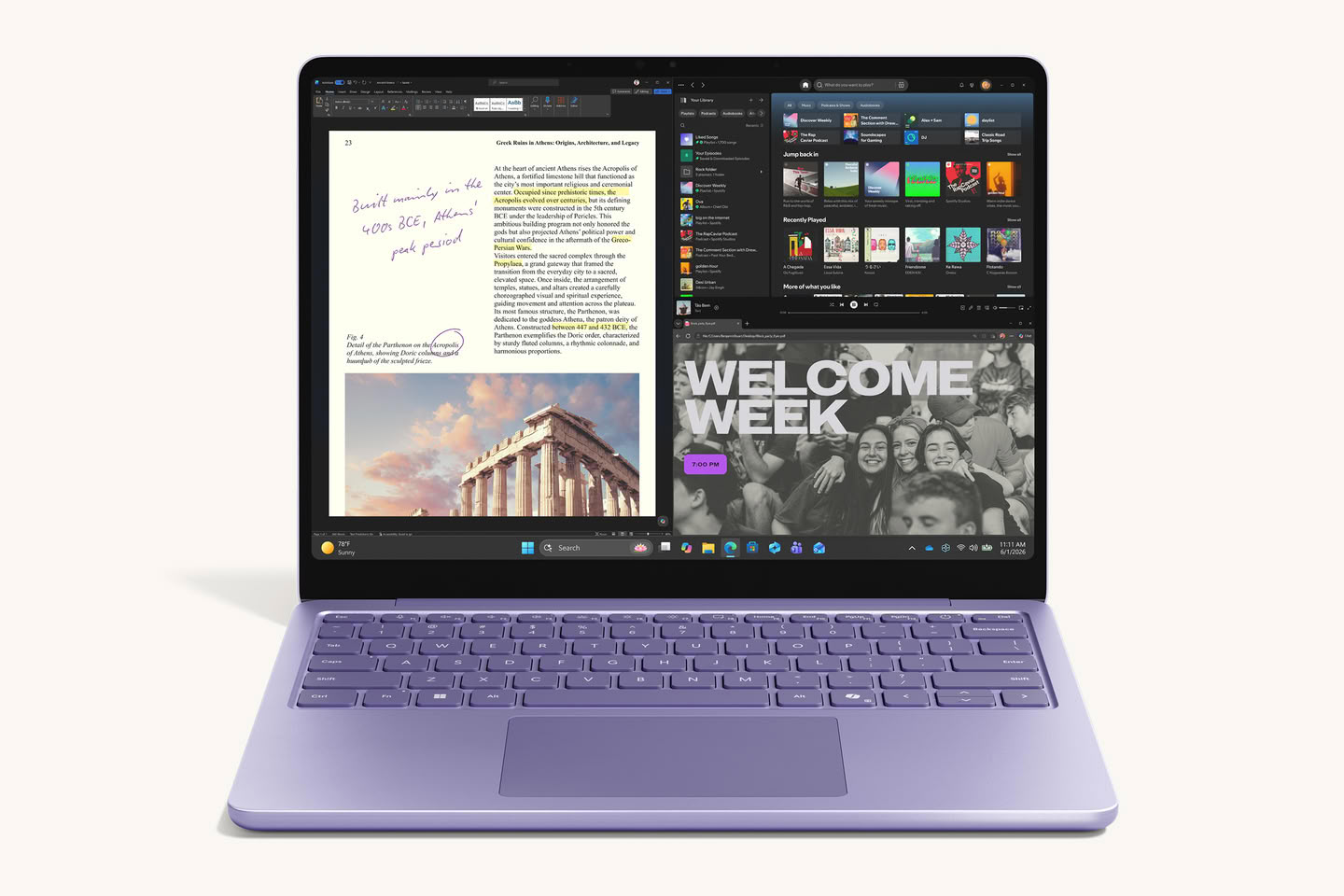
AMD's processors are notoriously missing from Microsoft's latest Surface device line-up, despite there being more CPU options in Microsoft Surface PCs than ever before, including an upcoming NVIDIA SKU. In a recent statement to Windows Central, Microsoft's Surface Corporate Vice President, Brett Ostrum, explained that this absence is deliberate, although not malicious, stating that Microsoft has a limited portfolio and needs to make smart choices about its offerings.
We love working with AMD. We have a limited portfolio, and so we have to make our choices pretty wisely in terms of what we're doing and where we're doing.

The Witcher 3 Remastered Tops 120,000 Concurrent Steam Players, Beating Its All-Time Record

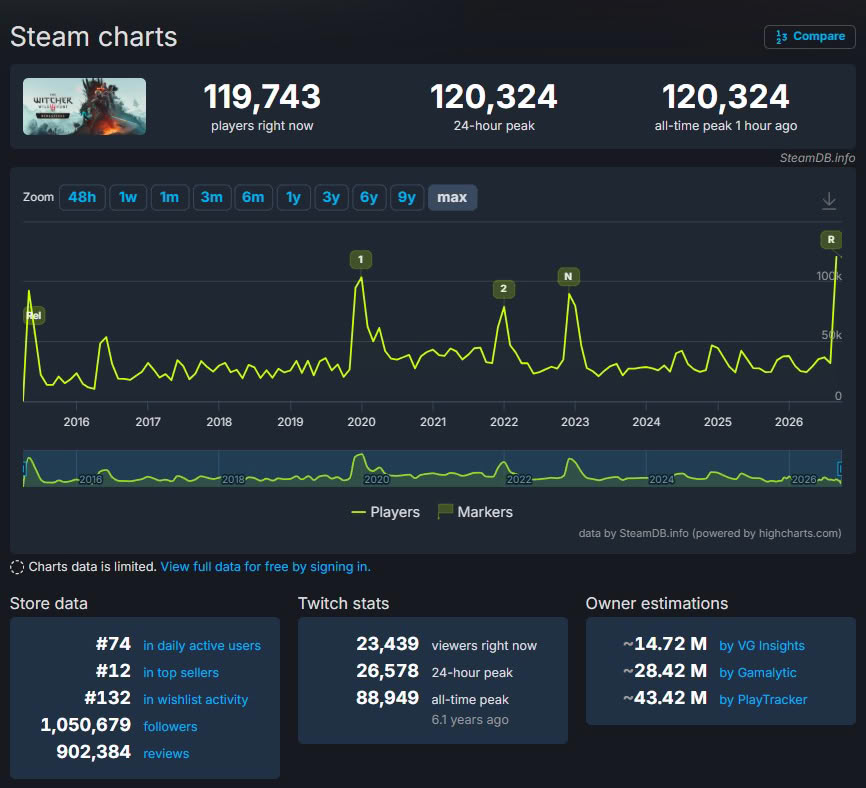
The Witcher 3: Wild Hunt Remastered launched today, and it has already set a new all-time Steam concurrent player record for the game. SteamDB showed a peak of around 120,000 players at the time of writing, and the number was still climbing. The previous record was 103,329, set in January 2020 shortly after Netflix's The Witcher premiered. The original's launch peak in 2015 was roughly 92,000. CD Projekt Red announced the remaster at Gamescom with upgrades to visuals, performance, and gameplay, and said it wants the game to feel like a 2026 release.

It is a free update for existing owners on PC, PS5, Xbox Series X|S, and Switch 2. The updated PC requirements now start at a Core i5-8400 or Ryzen 5 2600 with a GTX 1660, and scale all the way up to an RTX 5080 if you want the full path tracing experience. Apparently that didn't scare anyone off from jumping back onto the Path. Steam is the only platform with public player counts, so the total across consoles, GOG, and Battle.net is probably a lot higher. Since the peak was still rising, the upcoming weekend could push it further. The Songs of the Past expansion is due in 2027, so interest may stay healthy for a while, though I wouldn't expect this level to last.

TSMC to Scale 2 nm Production to 120,000 Wafers per Month by the End of 2026

TSMC has reportedly started expanding its manufacturing capacity as demand continues to outpace supply. According to a recent report from UDN, TSMC aims to increase its 2 nm manufacturing capacity at the N2 node, targeting an output of about 120,000 wafers per month by the end of 2026. This represents a 20% increase from the early August target of 100,000 wafers per month by the end of the year, indicating strong customer interest in the latest silicon technology. Even in the early stages, the company confirmed that the N2 node has four times the number of tape-outs compared to its previous leading-edge 3 nm N3 node. With the ramp-up of N2 production underway, the 20% increase suggests that customers are seeking more capacity, even as TSMC continues to scale production, indicating that demand isn't slowing down anytime soon.

At the end of the second quarter of 2026, the N2 node accounted for only 3% of TSMC's revenue, while the 3 nm node held 30%, and the 5 nm node secured the top spot at 33%. However, as we approach the end of Q3, we should see a significant shift in these figures, strongly favoring the N2 node. Until official data is released, we can't be certain of N2's exact revenue contribution, but it is expected to increase significantly based on several factors.

Microsoft Copilot+ Branding Disappears from Latest Surface PCs

Microsoft's recent Snapdragon-powered Surface Laptop and Surface Pro launch was surprisingly absent the usual Copilot+ branding, aside from as a callout to the inclusion of the actual AI assistant on the devices. Apparently, this was an intentional branding change, according to Surface Corporate Vice President, Brett Ostrum, in a new interview with Windows Central.
The purpose for Copilot+ PCs was to be able to deliver experiences. So it was to define a certain category of devices with a certain bar and metric, like for example, a 45 TOPS NPU... So from that perspective, it's more offering the same experiences, probably without just using [Copilot+] terminology now."

Quake Champions Ditches Free-To-Play Model As Id Software Ends Development

It was announced in July that Xbox would be laying off swathes of its staff at studios like id Software, notably leaving id Software's VFX team with "one single artist with no lead or producer," and it now seems as though the fallout for Microsoft's mass layoffs have continued. As detailed in a Steam update, id Software has confirmed that Quake Champions Point Release 1.31 will be its last planned content update, and the game will officially be transitioning to a paid game, instead of the free-to-play model it was previously sold under.
The changes are summarized as follows:
Quake Champions has moved to a paid ownership model available on Steam. Now, anyone who has Quake Champions in their Steam library can select any of the Champions, weapon skins, and cosmetic options without additional in-game purchases. As part of this update, the Microsoft Store version has been retired, and the game is now available only through Steam. Player skill stats will continue to reflect gameplay progress, so you can keep focusing on your Champion progression and enjoying the cosmetic features included with the game.

Activision To Take Over Halo Franchise After Halo Studios Layoffs Become Official

Mere hours after it was leaked that Xbox would be continuing its recent slew of layoffs, Xbox Wire published an internal email, officially confirming those layoffs and providing a glimpse into the future of the Xbox game development landscape. As a result of the layoffs, which will see 268 employees out of work, there also will be changes to several studios at Xbox, including Activision, Bethesda, King, Playground, and Turn 10.

It seems as though all of the layoffs this time around came out of the Halo Studios team, and Microsoft has left Activision in charge of the next Halo game as a result. Xbox says that a small team at Halo Studios will remain in order to support Activision in the franchise's development. Meanwhile, Ninja Theory, which was previously in negotiations on deals to exit Xbox's ownership, will officially close down instead of being bought. The Hellblade/Senua franchise will seemingly be developed by another studio at Xbox, following the closure of Ninja Theory. Xbox claims that two separate buyout deals had fallen through. For the time being, it seems as though Blizzard has escaped its anticipated layoffs.

More Blizzard Layoffs "Imminent"

Following the recent news of unionization at Blizzard, which is slated to cover 1,900 workers at the Xbox-owned studio, and a handful of announcements at the recent BlizzCon, including Diablo V and StarCraft, video game journalist, Jason Schreier has broken the news that more layoffs are potentially coming at Blizzard.

Speaking on a recent 8-4 Play podcast episode about all the announcements Blizzard made at BlizzCon, Schreier replied to some speculation that Blizzard announced more projects than usual at BlizzCon in order to avoid layoffs and turn the consumer sentiment against Microsoft rather than Blizzard if the in-progress projects ended up being affected by layoffs. Schreier, however, confirms the layoffs, but argues that they are a continuation of the layoffs that hit Blizzard as a result of the Xbox Reset that will result in as many as 3,200 total job losses at Xbox before the end of the fiscal year.

Samsung to Double HBM4 and HBM4E Capacity in 2027 Amid Strong Demand

Samsung is reportedly increasing its orders for materials to boost high-bandwidth memory (HBM) production, with plans to double the production capacity of its current HBM4 and HBM4E manufacturing by 2027. According to SE Daily, the manufacturing capacity for HBM4 and HBM4E is expected to grow from around 20,000 wafers per month in 2026 to 50,000 wafers per month in 2027. This data is derived from the use of glass carriers, which are temporary glass panels placed over thin DRAM wafers to prevent warping or breaking as they are prepared for packaging. Since HBM involves stacking many thin DRAM modules, glass carriers stabilize these wafers until the packaging process begins and the glass is removed. As the unit is one glass carrier per wafer, this provides an estimate of how many HBM4 and HBM4E wafers are produced each month.

Additionally, Samsung's overall HBM production, which includes older generations like HBM3 and HBM3E, currently averages around 180,000 wafers this year and is expected to grow to about 250,000 HBM wafers next year, with 80% dedicated to HBM4 and HBM4E. Samsung began mass production of HBM4 on its sixth-generation 10 nm-class 1c node in February, with HBM4E customer samples available by mid-2026. Future production increases will focus on HBM4 and HBM4E, as customers seek higher densities and bandwidth for their AI accelerators.

Evil Empire and Konami's Castlevania: Belmont's Curse Demo Launches in October

It was announced in February 2026 that Evil Empire and Motion Twin, the indie studios behind the massively successful Dead Cell franchise, is working with Konami on Castlevania: Belmont's Curse. Ahead of the game's October 15 launch, Konami just announced in a Tokyo Game Show livestream that it would be releasing a demo for Castlevania: Belmont's Curse on October 1.

The demo will be available on all platforms on which the game is planned to launch—that is to say PC, PlayStation 5, Xbox Series X|S, and Nintendo Switch, and the demo will allow players buying the game on the same platform they played the demo on to keep their progress if they buy the full game. The demo will run at 60 FPS on PC and full-size consoles, but only 30 FPS on the Switch, and content and features will be restricted in the demo version. The full livestream with the demo details is available below (in Japanese).

Acer Expects PC Prices to Rise by Up to 20% in Q4, Peak Around Mid-2027

Acer Chairman and CEO Jason Chen says PC prices could rise by another 5% to 20% in the fourth quarter of 2026, according to Taiwan's Economic Daily News. Chen reportedly said that DDR4 and DDR5 memory are no longer in short supply and that CPU supply is mostly fine, with only some low-end and mid-range chips still tight. Prices haven't followed this change, though. Memory and SSD costs are still high, so systems with more RAM or storage will probably see bigger increases. Chen expects the average selling price of PCs to peak around mid-2027, with a possible drop in the second half of that year.

Even if component costs fall earlier, it takes several months for cheaper parts to reach finished PCs. Chen also reportedly said suppliers keep pushing through price increases, some of which he considers hard to justify. He also pointed to expanding Chinese memory production, and by the sound of it, he doesn't think the shortage can run until 2030, as many in the industry have claimed. That capacity is still ramping up, though. Chinese giant CXMT is reportedly preparing to enter the NAND flash market with an R&D line, and YMTC is expanding with new fabs.

GTA VI Online Tipped for 2027 Launch

It's long been known that Grand Theft Auto VI would initially launch as a single-player game when it arrives in November 2026, and there has been no indication of when an actual GTA VI Online would launch. However, recently, Dan Clancy, CEO of Twitch, revealed in an interview with Bloomberg that he expects a "big bump with GTA 6, but then an even bigger one next year when they launch multiplayer," suggesting that GTA VI Online will launch in 2027.

The executive explains that he had spent time "talking with Rockstar about their plans," which doesn't necessarily mean that the information is 100% accurate—and even if it were, we've seen GTA VI's launch date move several times, by now—but it is a reasonably credible source for the information. In a previous interview with IGN, Take-Two's Strauss Zelnick suggested that the original GTA Online would receive support long into the future, even if GTA Online 2, as it were, was already released.

Apple Weighs Return to Server Market with NVIDIA Networking Technology

Apple is reportedly considering a return to the server market, where the company was once active with its Xserve rack technology. According to The Information, Apple is developing AI-focused M-series chips, which could incorporate several NVIDIA components, including the NVLink Fusion portfolio of technologies and IP. This includes the possibility of interconnecting two or four Apple M8 Ultra chips using NVIDIA NVLink for socket-to-socket communication, while NVIDIA NVLink-C2C manages die-to-die interconnection. Currently planned for launch in 2029, this product would mark Apple's first entry into the server space since debuting Xserve in 2002 and discontinuing it in 2011. Nearly two decades later, Apple's server offering might be making a comeback, building on the success that the Mac mini and Mac Studio are experiencing among AI developers.

For instance, Apple's Mac lineup achieved a record $10.4 billion in sales last quarter, with strong demand from the AI community. Enterprises are even constructing custom racks, mounting multiple Mac Studios to set up local AI inferencing efforts. For the new server design, Apple would delegate every interconnect question to NVIDIA NVLink Fusion, while it focuses on the actual system-on-chip as before. The new rack design would target enterprises and governments, who may already be running Mac clusters locally.
Return to Keyword Browsing
Nov 19th, 2026 21:32 CST change timezone

New Forum Posts

Popular Reviews

TPU on YouTube

Controversial News Posts