News Posts matching #Intel

Return to Keyword Browsing

Erying Debuts Intel Core Ultra 200H APU-powered MoDT Micro-ATX Motherboard Range

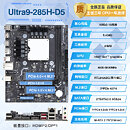
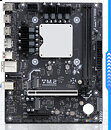
Erying, a Chinese PC hardware manufacturer, specializes in Mobile on Desktop (MoDT) motherboards. TechPowerUp has covered the emerging OEM's past efforts; notably an Intel "Alder Lake-H" APU-powered range. Yesterday, the company introduced its second generation "Ultra MoDT" product line. As is tradition, these desktop format mainboards are based on mobile silicon—normally utilized in laptops/notebooks (BGA platforms). This hybrid configuration has proved popular across international budget-conscious PC building communities, due to attractive price points and "all-in-one" convenience. Erying's latest release seems to be marketed with "young" customers in mind. Their late 2025 release has launched as a Micro-ATX-sized board, featuring Intel Core Ultra 200H "Arrow Lake-H" processors.

A JD.com listing immediately defaults to Erying's range-topping variant, carrying Team Blue's 16-core Core Ultra 9 285H chip. Priced at 2699 RMB (~$381 USD), this option could form the basis of a fairly potent compact gaming system. The entry-point model—tagged with 1799 RMB (~$254 USD) price point—runs on a Core Ultra 5 225H processor. Erying's two middle ground alternatives are based on Ultra 5 235H and Ultra 7 255H APUs—priced at 1899 RMB and 2199 (respectively). The company has released initial gaming and production benchmark results, in written article form (in Mandarin) and on YouTube (see below).

SK Hynix Showcases Advanced AI Memory From HBM4 to Next-Gen Storage at SC25

SK hynix showcased advanced memory technologies for the era of AI and high-performance computing (HPC) at Supercomputing 2025 (SC25), held in St. Louis, the U.S., from November 16-21. Held annually since 1988, SC is the world's largest global HPC conference. It brings together experts from industry, academia, and research institutions to share the latest trends, create opportunities for collaboration, and discuss the future direction of technological advancement. At this year's event, the convergence of AI and HPC emerged as a central topic. Under the theme "Memory, Powering AI and Tomorrow," SK hynix presented its innovative memory lineup set to lead the AI and HPC markets and shared a new technological vision to accelerate data analysis in computing systems.

Innovative Products and Tech Driving AI and HPC Performance
At the event, SK hynix presented core products including HBM, DRAM, and eSSD solutions. Visitors to the booth could also see demonstrations of the products in AI and HPC environments, highlighting the company's technological competitiveness. At the front of the booth, SK hynix displayed its latest HBM products including the 12-layer HBM4 which it developed as a world-first in September 2025. HBM4 features 2,048 input/output (I/O) channels, twice that of the previous generation, delivering a significant increase in bandwidth. Also offering more than a 40% boost in power efficiency, HBM4 is the most suitable solution for ultra-high-performance AI computing systems. In addition, the 12-layer HBM3E, the highest performing commercialized HBM currently available on the market, was presented with NVIDIA's next-generation GB300 Grace Blackwell GPU.

Intel "Arrow Lake-S" Sees 9% Speed Gain and 15% Lower Power After a Year of Optimizations

Intel's "Arrow Lake" Core Ultra 200S series of processors were launched over a year ago, and Phoronix recently conducted Linux tests to compare their original performance and power consumption to the current situation. The results are promising for Intel's CPUs, which have not been particularly popular among DIY PC builders. According to the geometric mean of all benchmarks, Phoronix found that the high-end Intel Core Ultra 9 285K has shown a noticeable performance improvement of approximately 9% after a year of software optimizations.

What's particularly interesting is that this performance gain was achieved while using only 85% of the power that was consumed in October last year, representing a 15% reduction. This suggests that Intel has optimized the software to not only reduce power consumption and heat output but also to extract an additional 9% performance from the "Arrow Lake-S" silicon. In these Linux tests, no workload experienced any regressions, indicating consistent results across a wide range of use cases, including code compilation, compression, web performance, HPC, simulation, and many others. We hope that the same optimizations are trickling into Windows software, so more gamers can enjoy everyday performance optimizations

Intel Xeon 696X "Granite Rapids-WS" CPU Basic Specs Outed by Benchmark Entry

A list of unannounced Intel Xeon "Granite Rapids-WS" processors turned up online two weeks ago; as a result of momomo_us's detective work. Team Blue's supposed next wave of high-end desktop (HEDT) workstation CPUs are expected to be introduced at CES 2026, but unofficial details have already spread across PC hardware discussion communities. The mid-month leak provided an early look at eleven possible 600-series SKU candidates (supported by the W890 platform), complete with basic specifications—clock speeds and L3 cache capacities. A fresh discovery, again courtesy of momomo_us, grants further insight into the desktop family's sub-flagship chip: "696X."

Lately, a test system entry has turned up on the SiSoftware Official Benchmark Ranker database. The "Xeon 696X" model appears to feature 64 cores, and 128 threads. The lowest measured clock speed was 4.4 GHz, going up to 4.6 GHz (averaging at 4.51 GHz). A 2.4 GHz base clock was listed by momomo_us, a fortnight ago. A 350 W TDP rating was picked up by SiSoftware Sandra's suite. The latest leak reaffirms a presence of 336 MB L3 cache. A total of 128 MB L2 cache is shared across the processor's 64 cores (so 2 MB each). Intel's rumored forthcoming re-entry into HEDT territories could carry Xeon 6 family branding, albeit sporting an added "W"—denoting workstation applications.

Intel Sees 5,000 W GPUs Possible with Integrated Voltage Regulators

If the performance requirements for new AI or HPC tasks demand maximum performance density regardless of power or heat constraints, Intel has a project presentation scheduled for the ISSCC conference in February 2026. One of the topics will be a 5,000 W GPU design utilizing integrated voltage regulators (IVRs). While this may seem extreme, Intel plans to leverage advanced packaging technology, specifically the Foveros-B variant, to deliver 5 kW GPUs by 2027. As accelerators scale to support larger AI and HPC workloads, traditional board-level regulators are hitting limits in current density and transient response.

Moving voltage regulation into the package shortens current paths and reduces delivery losses. Intel Foundry and its packaging division are already exploring high-density power delivery and kW-class integrated voltage regulators. Intel's Foveros roadmap targets production-ready integrated power elements by 2027, enabling customers to evaluate IVR-enabled assemblies at scale very soon. While Foveros-B is a 2027 product, customers could potentially evaluate multi-kilowatt designs with IVRs next year. Intel is not a singled-out player with multi-kilowatt designs, as NVIDIA "Rubin" silicon is rumored to have a TDP of up to 2.3 kW for highest-end models, leading to rack-level power consumption exceeding 250 kW.

Insider Theorizes Four Unlocked Intel "Nova Lake-S" SKUs, Bolstered with bLLC

Two days ago, Jaykihn claimed that an unannounced Intel "Nova Lake-S" SKU would carry 144 MB of bLLC (Big Last Level Cache) cache. In theory, this generous supplementary provision could elevate Team Blue's placement in the gaming desktop CPU market—where AMD has enjoyed plenty of success, courtesy of their 3D V-Cache-laden offerings. Yesterday, kopite7kimi weighed in with additional insider information. Specifically, they proposed that Intel is readying four individual "unlocked" SKUs—as part of the late 2026 "Core Ultra 400" CPU family—that will feature implementations of bLLC. Experts believe that this stash of cache will be bunged onto the "Nova Lake-S" design's compute tile.

Hours later, kopite7kimi replied to a query regarding possible differing compute die configurations. They outlined the potential existence of dual-tile options, alongside expected single-tile alternatives. Rumors of a 52-core engineering sample emerged at the start of September—leveraging a dual-tile configuration, comprised of two 8+16 layouts, plus 4 low power cores. This week, experts posit that a variant could launch with 144 MB of Big Last Level Cache implemented on each tile, thus granting a total of 288 MB bLLC within that package. kopite7kimi warned that this information was not completely concrete, and threw in another quick forecast: "(I am) not 100% sure yet. The power supply design of the new platform will be a challenge for motherboard manufacturers." The other dual-tile option could make do with a lesser core count: comprised of two 8+12 tiles.

AEWIN Introduces BIS-5132 Series 2U High-Performance General-Purpose Servers Powered by Intel Xeon 6 Processors

AEWIN unveils the BIS-5132-2U, a versatile 2U general-purpose server powered by Intel's latest Xeon 6 processors built on Intel 3 process technology. Featuring a single Intel Xeon 6700/6500-series CPU, the BIS-5132 delivers exceptional compute density with up to 86 P-cores or 144 E-cores for demanding workloads. Designed for scalability, the platform accommodates 12 large form factor (3.5") drive bays and up to 8 PCIe expansion slots address a wide range of deployment scenarios.

2U High-Performance General-Purpose Servers
The BIS-5132-2U features 8x DDR5 RDIMM modules running at speeds up to 6400 MT/s. Leveraging up to 136 PCIe Gen 5 lanes enabled by the Granite Rapids-SP RIS architecture, the system provides up to 8 PCIe expansion slots for flexible configurations including high throughput NICs, storage adapter cards for high-speed NVMe SSDs, and advanced GPU/FPGA accelerators to deliver outstanding I/O performance and scalability.

Intel "Nova Lake" Could Get 144 MB Cache Boost from bLLC

According to one of the most reliable Intel leakers, the upcoming Intel "Nova Lake" desktop processors will carry 144 MB of bLLC cache to boost their already existing cache configuration and give Intel an equivalent to AMD's 3D V-Cache for enhanced gaming. Intel already uses bLLC in its "Clearwater Forest" server processors as a passive interposer, where local cache integrates beneath active tiles, so its inclusion in a standard gaming chip could deliver a significant performance uplift. As the new leak notes, bLLC implementation will be made on the compute tile, so it is close to the massive core cluster Intel is preparing to debut.

The 52-core top SKU is a tiled design that pairs two compute tiles with a single SoC tile. Each compute tile houses eight P-Cores based on "Coyote Cove" and 16 efficient E-Cores based on "Arctic Wolf," while the SoC tile contributes four low-power Arctic Wolf LPE-cores. That gives Nova Lake-S a 16 P-Core, 32 E-Core, and 4 LPE-Core configuration totaling 52 cores for the top SKU, with single-tile variants offering a 28-core option. Since there are two compute tiles, we have to wonder if Intel will implement a single 144 MB bLLC block for the entire dual-tile group, or if it will come as two 72 MB blocks.

Intel's Alleged Flagship "Panther Lake-H" Ultra 9 386H Chip Gets Geekbenched

An intriguing Intel Core Ultra 9 386H mobile processor has turned up on Geekbench Browser, as spotted by early morning risers. Today's reports have focused on details produced by an "Acer Predator PHN16S-I51" test subject; presumably a next-gen Helios gaming laptop. The plucky system—sporting 64 GB of memory—was put through the Geekbench 6.50 wringer, running a Windows 11 Pro 64-bit OS combined with a Balanced power plan. Fundamental frequencies and core counts were leaked at the start of this month: 4 P-Cores, 8 E-Cores, 4 LPE-Cores. Presently, this supposed 16-core engineering sample (ES) has racked up impressive single and multicore scores: 2849 and 15434 (respectively). According to Notebookcheck, this data places the Ultra 9 386H ES chip just above the performance range of Team Blue's current-gen "Arrow Lake-H" Core Ultra 9 285H APU.

Crucially, this forthcoming premium component surpasses AMD's Ryzen AI Max+ 395 "Strix Halo" SoC (by a small margin) in single-core performance stakes. Team Red's mobile 16-core Zen 5 flagship remains top of the multicore table. Intel's Core Ultra 300 family is pencilled in for an official launch at CES 2026, but a plethora of leaks have disclosed all manner of pre-launch material. Late last week, photos of an alleged Core Ultra 3 "Panther Lake-H" qualification sample ended up online, alongside CPU-Z-generated diagnostics.

Memtest86+ 8.0 Gets Support for Latest Intel/AMD CPUs and More Improvements and Fixes

The popular RAM testing utility, the memtest86+, has been updated to the new 8.0 version, adding support for latest AMD and Intel CPUs as well as plenty of other improvements and fixes, like temperature reporting for DDR5 DIMMs, faster detection of CPUs with high core count, optional Dark Mode, fixed DDR5 XMP 3.0 issue, improved Loongson architecture support and more.

The newest memtest86+ 8.0 version also adds CLang/LLD support, and now ships as a single binary for both UEFI and legacy boot. It also brings better BadRAM support and reporting as well as better SPD detection for early ICHs, and better support for VTxxx serial console. The complete changelog can be found below.

Gigabyte's Z890 Aorus Tachyon ICE Shatters Another World Record at DDR5-13530

GIGABYTE TECHNOLOGY Co. Ltd, a leading manufacturer of motherboards, graphics cards, and hardware solutions, proudly announces another historic breakthrough in the world of extreme overclocking. In a spectacular demonstration of engineering excellence and collaborative innovation, elite overclocker Sergmann, together with GIGABYTE's legendary overclocker HiCookie, have obliterated the DDR5 memory speed world record, pushing past the 13,000 MT/s threshold to achieve an extraordinary 13,530 MT/s—the fastest memory speed ever achieved on the planet. This groundbreaking milestone was powered by GIGABYTE's revolutionary Z890 AORUS TACHYON ICE motherboard, paired with cutting-edge Corsair memory modules and Intel Core Ultra processors (Series 2), creating the ultimate trifecta of extreme performance technology.

"The Z890 AORUS TACHYON ICE represents the pinnacle of motherboard engineering—a testament to our relentless pursuit of performance perfection. This world record validates our vision: when you refuse to compromise on design, power delivery, and innovation, you don't just compete for records—you own them." said Jackson Hsu, Director of Motherboard Division at GIGABYTE.

AI Boom Drives Demand for Ultra-Large Packaging as ASICs Expected to Shift from CoWoS to EMIB

TrendForce's latest investigations reveal that the rapid expansion of AI and HPC is increasing the need for heterogeneous integration, positioning advanced packaging as a strategic priority. TSMC's CoWoS platform is currently the leading solution in this area. However, as CSPs accelerate their in-house ASIC development to accommodate more complex functions, their packaging size requirements are growing substantially. As a result, some CSPs are contemplating a switch from TSMC's CoWoS to Intel's EMIB.

TrendForce notes that CoWoS connects compute logic, memory, and I/O dies via an interposer, which mounts them on a substrate. The technology has expanded to include CoWoS-S, CoWoS-R, and CoWoS-L. Demand has been strongly shifting toward CoWoS-L, which incorporates a silicon interposer into the package, as NVIDIA's Blackwell platform approaches mass production in 2025. This trend is expected to continue with NVIDIA's upcoming Rubin architecture, which will boast even larger reticle sizes.

Intel "Arrow Lake Refresh" Brings 7,200 MT/s DDR5 Memory Support

Additional confirmations regarding the launch of "Arrow Lake Refresh" have emerged, as Intel has updated its processor SKU support matrix for DDR5 technologies. The "Arrow Lake Refresh" processors will support faster DDR5 memory. Intel confirms that ARLR will ship with native support for DDR5 memory speeds reaching 7200 MT/s on CUDIMM modules. This enhanced speed rating applies only to DDR5 modules equipped with integrated clock driver circuits, commonly known as CUDIMMs, which improve signal integrity at higher frequencies. Standard UDIMMs and CSODIMMs will continue to operate within their existing specifications at 5600 MT/s and 6400 MT/s, respectively.

Intel attributes the speed boost to a refined integrated memory controller and subtle platform-level optimizations for LGA-1851 motherboards, not a new chipset. Core platform constraints, including the two-DIMMs-per-channel limit, remain unchanged, meaning the improvement simply provides additional headroom for compatible memory. Beyond memory improvements, select middle-class SKUs will gain extra efficiency cores or modest clock speed increases. Combined with the CUDIMM support, these changes should deliver measurable gains in specific workloads, though they will not dramatically shift Intel's competitive position. Overclocking enthusiasts can still exceed official speeds through manual tuning. Scheduled to debut in early 2026, just a few months before "Nova Lake," the update is primarily a refinement of Intel's existing technology rather than a completely new architecture. The fully new architecture is reserved for "Nova Lake-S."

Intel W890 Workstation Platform Details Leak Ahead of "Granite Rapids-WS" Launch

Intel's W890 workstation platform, the foundation for its upcoming "Granite Rapids-WS" HEDT workstation Xeon processors, has been leaked. The platform introduces a new Socket E2 design with 4,710 LGA pins built to support CPUs with TDP ratings reaching 350 watts. Intel is taking a two-tier approach with distinct "Expert" and "Mainstream" configurations: Expert-class implementations unlock 112 PCIe lanes (96 PCIe 5.0 lanes plus 16 PCIe 4.0 lanes), while the Mainstream tier delivers 80 PCIe 5.0 lanes. This will support a XCC-based "Granite Rapids-WS" processor with 86 cores and 172 threads, achieving single-core boost speeds near 4.8 GHz with 336 MB of L3 cache.

Memory capabilities mark a significant evolution from previous workstation platforms. The W890 chipset supports registered DDR5 modules, with RDIMMs validated for speeds up to 5,200 MT/s. In a quad-channel configuration with two DIMMs per channel, systems can address up to 2 TB of memory per processor socket. The connectivity suite includes a 2.5 Gigabit Ethernet controller, numerous USB 3.2 and USB 2.0 ports, multiple SATA III interfaces, and dual SlimSAS connectors that each provide PCIe 4.0 x4 bandwidth. Server-grade management infrastructure includes an ASPEED AST2600 BMC and a Nuvoton system supervisor, while power delivery provisions mandate a standard 24-pin ATX connector alongside support for up to four supplementary 8-pin CPU power headers.

GMKtec Teases EVO-T2 Mini-PC with Intel's Upcoming Panther Lake CPU

GMKtec has previewed the EVO-T2, its next compact mini-PC and the first system the company has shown built around Intel's upcoming Panther Lake platform. The system was shown at Intel's 2025 Technology Innovation and Industry Ecology Conference in China and is planned for release in early 2026. The EVO-T2 is based on the "Panther Lake H 12Xe3" mobile processor, which GMKtec lists as an Intel 18A part with a configurable TDP of up to 80 W. The chip carries 12 Xe3 GPU cores, likely the same Arc B390-class iGPU used in other high-end Panther Lake laptop parts and is rated for up to 180 TOPS of combined AI compute. GMKtec also mentions that the system will ship with Intel's "AI PC" software stack preinstalled. Memory support goes up to 128 GB of LPDDR5X running at 10,677 MT/s. Storage is handled by two M.2 slots: one PCIe 5.0 and one PCIe 4.0, with a stated maximum of 16 TB across both drives.

Up front, the system includes three USB-A ports, one USB-C port, and a 3.5 mm audio jack. Full rear-I/O details and final pricing are still pending. The EVO-T2 follows the EVO-T1 launched earlier this year, which shipped with a Core Ultra 9 285H and multiple SSD options including OCuLink and USB4 for external GPUs. The T2 effectively replaces it as GMKtec's high-end Intel offering and moves the lineup into Intel's next-gen architecture. GMKtec says more information, including final specs and launch date will be announced in Q1 2026.

AAEON Unveils HPC-ARHm, Intel Ultra COM-HPC Mini for High-Performance Edge AI

AAEON,, a leading designer and manufacturer of Computer-on-Modules, today announced the release of the HPC-ARHm, a COM-HPC R1.2 Mini module with both Series 1 and Series 2 Intel Core Ultra Processors (formerly Meteor Lake and Arrow Lake, respectively). Based on the COM-HPC R1.2 Mini form factor, the HPC-ARHm measures just 95 mm x 70 mm and weighs 80 grams. Despite its small size, the module supports 28 W CPUs from across both Intel Core Ultra Series 1 and Series 2 Processors, with up to 64 GB of soldered LPDDR5 allowing users to leverage the integrated Intel AI Boost NPU and desktop-class Intel Arc GPU capabilities of each Intel Core Ultra platform for up to 96 TOPs of AI performance, depending on the SKU selected.

The module hosts up to 256 GB of onboard NVMe storage, while also offering flexible expansion options for applications that require low-latency processing of large datasets, such as healthcare imaging, IC testing equipment, or AI-driven robotics. These additional storage options take the form of one PCIe Gen 4 (x8) and a PCIe Gen 3 (x4) slot - two lanes of which are co-layed to offer two SATA interfaces, which are available via BIOS and BOM configuration. The module also offers four PCIe Gen 3 (x1) slots, primarily intended to support less-demanding peripherals.

Qualcomm Says 90% of Games Run on Snapdragon X2 Elite, Outperforming Intel and AMD

Qualcomm is ready to push its Snapdragon X2 Elite and Elite Extreme SoCs into a sector that was previously dominated by x86 SoC makers, and that is gaming. The company now claims that its SoC can run more than 90% of the most played games available on the market on the initial launch. However, this is not the only striking claim, as Qualcomm has benchmarks that prove that its Adreno X2 iGPU is 50% faster than the iGPU inside Intel Core Ultra 9 288V "Lunar Lake" and 29% faster than the iGPU on AMD Ryzen AI 9 HX 370 "Strix Point," under the same graphics settings. This is of course, no small win, and Qualcomm expects to win hearts of gamers with its next-generation platform.

The new chip delivers frame rates up to 2.3x higher than its predecessor while supporting many popular Windows games. Its architecture uses four processing blocks that give the flagship X2 Elite Extreme an edge over competing integrated graphics. Each block efficiently processes graphics work before passing it to shader processors organized around two micro-units. These units each contain 128 KB of memory feeding 128 ALUs. The design supports multiple precision formats, employs a more efficient execution model, and can process two instructions at once to maximize its 128-ALU groups. In total, the GPU has eight shader processors and 2,048 ALUs running at up to 1.85 GHz, backed by 21 MB of on-chip memory, 2 MB of cache, and 228 GB/s of memory bandwidth on the flagship model.

abxylute Claims World's First Glasses-Free 3D PC Gaming Handheld with 3D One

abxylute officially launches 3D One, the world's first, and currently the only PC gaming handheld capable of running modern titles in native, glasses-free 3D. Powered by a custom 11-inch electronic-raster (parallax barrier) display, next-generation real-time eye tracking, and the Intel Core Ultra 7 Processor 258V, 3D One brings a completely new visual dimension to PC gaming. At a time when glasses-free 3D has nearly vanished from mainstream consumer electronics, the 3D One revives and significantly modernizes the technology with a purpose-built hardware-software system designed specifically for high-definition, low-latency 3D gameplay.

"Rendering glasses-free 3D video is easy; gaming is extremely hard. Within a single second, the system must break down each frame into dozens of interlaced perspectives, which requires massive computing power," said CEO Donald Zhang. "We believe today's advancements in display tech, content availability, and AI acceleration finally make high-quality glasses-free 3D gaming not only possible, but genuinely exciting."

Silicon Power's XPOWER Storm DDR5 RGB Wins Taiwan Excellence Award 2026

XPOWER, the high-performance gaming brand of global memory leader Silicon Power (SP), has been honored with the Taiwan Excellence Award 2026 for its Storm DDR5 RGB UDIMM. Recognized for its outstanding performance, innovative engineering, and compelling aesthetic design, the XPOWER Storm delivers the speed, stability, and visual flair that today's gamers and PC enthusiasts demand.

High-Performance DDR5 Meets Reliability
The XPOWER Storm stands out with its impressive performance, reaching speeds of up to 8000 MT/s with low-latency configurations from CL28 to CL38. Its advanced architecture delivers exceptional responsiveness for high-demand gaming, multitasking, and content creation workloads—pushing the limits of what modern systems can achieve. Operating at a low voltage of 1.35 V to 1.45 V, the XPOWER Storm maintains outstanding efficiency while sustaining extreme performance. With built-in PMIC power management, On-Die ECC, and full support for Intel XMP 3.0 and AMD EXPO, users can unlock maximum speed with effortless, stable overclocking.

TOP500: El Capitan Retains #1 as JUPITER Becomes Europe's First Exascale System

The 66th edition of the TOP500 list of the world's most powerful supercomputers was announced today at the SC25 Conference in St Louis, Missouri. The new list reflects continued U.S. leadership in high-performance computing (HPC), historic European milestones, and growing global diversity across architectures and energy-efficient design.

El Capitan Extends Leadership Across Benchmarks
The El Capitan system at Lawrence Livermore National Laboratory (LLNL) remains the undisputed leader of global HPC. Based on the HPE Cray EX255a architecture, powered by AMD 4th Gen EPYC CPUs and AMD Instinct MI300A accelerators, El Capitan achieved 1.809 Exaflop/s on the HPL benchmark—a significant remeasurement that further strengthens its position as the fastest computer in the world. El Capitan also dominates the HPCG benchmark, delivering 17.41 HPCG-Petaflop/s, making it the #1 for real-world application performance. On the HPL-MxP mixed-precision benchmark, it recorded 16.7 Exaflop/s, confirming its versatility in AI and data-driven workloads. With 11.34 million cores and an energy efficiency of 60.9 GFlops/Watt, El Capitan exemplifies the current generation of exascale computing.

Intel Brings Cindy Stoddard as Senior Vice President and Chief Information Officer From Adobe

Intel Corporation today announced the appointment of Cindy Stoddard as senior vice president and chief information officer (CIO), effective December 1. Stoddard will report directly to CEO Lip-Bu Tan and lead Intel's global IT organization as the company accelerates its digital transformation and modernizes its technology infrastructure.

"The CIO role has become increasingly strategic for Intel as we modernize our legacy systems, strengthen our operational backbone, and build deeper partnerships with AI platform companies," said Intel CEO Lip-Bu Tan. "Cindy is a proven enterprise technology leader whose expertise in large-scale digital transformation will be instrumental as we build Intel's foundation for long-term success."

MSI Accelerates AI and Data Center Innovation with Next-Gen Server Solutions at SC25

MSI, a leading global provider of high-performance server solutions, showcases its next-generation computing and AI innovations at SuperComputing 2025 (SC25), Booth #205. MSI introduces its ORv3 rack solution and a comprehensive portfolio of power-efficient, multi-node, and additional AI-optimized platforms built on NVIDIA MGX and desktop NVIDIA DGX, designed for high-density environments and mission-critical workloads. These modular, scalable and rack-scale solutions are engineered for maximum performance, energy efficiency, and flexibility, enabling modern and next-generation data centers to accelerate deployment and scale with ease.

"Through close collaboration with industry leaders AMD, Intel, and NVIDIA, MSI continues to drive innovation across the data center ecosystem," said Danny Hsu, General Manager of the Enterprise Platform Solutions at MSI. "Our goal is to deliver scalable, energy-efficient infrastructure that empowers customers to accelerate AI development and next-generation computing with performance, reliability, and flexibility at scale."

Apple, Broadcom, and Qualcomm May Tap Intel Advanced Packaging

Apple, Broadcom, and Qualcomm might soon become customers of Intel Foundry, but not for the typical reasons. These giants are considering Intel Foundry for its advanced packaging technologies, which could allow Intel to significantly increase its foundry revenue without manufacturing the actual silicon. Job listings from Apple, Broadcom, and Qualcomm highlight Intel's Embedded Multi-die Interconnect Bridge (EMIB) as a key requirement for packaging engineer positions. This suggests they are keen on hiring engineers familiar with Intel's EMIB technology to help design their next-generation products.

Interestingly, Qualcomm's CEO recently stated that "Intel is not an option today," but expressed a desire for Intel to become a viable choice. He noted that Intel's current foundry node, likely the 18A, is not suitable for their mobile chips. The main focus of the 18A node is not on mobile, low-power system-on-chips (SoCs), but rather on mid-range and high-power solutions. As the CEO put it, "We design all of our chips assuming there's a battery on the other side, not plugged into the wall." However, 18A node is not what seemingly attracts customers like Qualcomm. It is the packaging that Intel offers. Last year, Broadcom tested the 18A node but expressed disappointment. However, the situation is now evolving differently, with Intel's advanced packaging emerging as a promising alternative to TSMC's CoWoS and other packaging types.

Supermicro Showcases the Future of HPC Clusters and AI Infrastructure at SC25

Super Micro Computer, Inc. (SMCI), a Total IT Solution Provider for AI/ML, HPC, Cloud, Storage, and 5G/Edge, will showcase its latest AI Factory, HPC, and liquid-cooled data center innovations at Supercomputing 2025 (SC25) in St. Louis, Missouri. This broad portfolio, ranging from desktop workstations to rack-scale solutions, demonstrates Supermicro's commitment to powering the next generation of high-performance computing, scientific research, and enterprise AI deployments.

"Supermicro continues to lead the industry in delivering complete, next-generation infrastructure solutions in close collaboration with our technology partners," said Charles Liang, president and CEO of Supermicro. "At SC25, we are demonstrating our high-performance DCBBS architecture, direct liquid cooling, and rack-scale innovations, which empower customers to deploy AI and HPC workloads faster, more efficiently, and more sustainably."

ASUS Unveils Comprehensive Storage Solutions at SC25

ASUS today announced an all-new lineup of enterprise and AI/HPC-optimized storage and infrastructure solutions at Supercomputing 2025 (SC25). Recognizing the escalating demands of scaling AI models and memory-intensive workloads, ASUS storage solutions are now a strategic imperative, critical for sustaining efficient AI data processing and managing rapidly expanding datasets. This launch further solidifies the company's position as a total infrastructure provider, delivering an integrated ecosystem spanning compute, storage, networking, and services. ASUS, through its robust global supply chain and logistical capabilities, ensures consistent, reliable product delivery, establishing itself as a trusted partner for organizations deploying resilient and scalable AI environments.

ASUS delivers a full spectrum of storage solutions across block, file, object, and software-defined systems—ensuring flexibility from edge to cloud, and from enterprise applications to AI and HPC workloads. The portfolio supports storage for Enterprise and AI/HPC needs, providing resilient data foundations and scalable performance for data-driven environments.
Return to Keyword Browsing
Nov 17th, 2026 13:45 CST change timezone

New Forum Posts

Popular Reviews

TPU on YouTube

Controversial News Posts