News Posts matching #Intel

Return to Keyword Browsing

AAEON Adds Four New UP Edge PCs to the AAEON UP Edge System Lineup

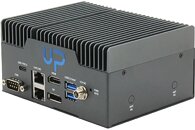
AAEON's UP brand, has announced the release of four new additions to its UP Edge system product line, each designed to offer distinct advantages for different industrial automation project needs. The new releases include two credit card-sized devices, the UP TWL Edge and slimmer UP TWLS Edge, which are catered towards applications such as IoT gateways and central industrial controllers, respectively.

Meanwhile, the UP Squared TWL Edge's specifications focus on connectivity, with a design intended to allow legacy systems to modernize control, monitoring, and visualization tasks. The final offering, the UP Squared Pro TWL Edge, is positioned for more advanced industrial solutions, leveraging the device's expansion options for the integration of AI accelerators for applications such as machine vision and predictive maintenance. While their specifications and intended deployment scenarios differ, the new Mini PCs all come with the option of Intel Core 3 Processor N355, Intel Processor N250, or Intel Processor N150 CPUs (formerly Twin Lake).

Upcoming Flagship "Panther Lake" APU Geekbenches Above AMD's Best Ryzen AI Mobile Chip

The upcoming "Panther Lake" mobile processor series seems to consist of (at least) fourteen distinct SKUs, according to a major mid-October and November leaks. Since then, a bunch of these elaborately named models have been fleshed out in greater detail—courtesy of benchmark data appearing across online repositories. The supposed flagship option—"Core Ultra X9 388H"—has appeared again; courtesy of a mysterious "Default string Default string" test system posting results and basic specifications onto the Geekbench Browser database. Almost two months ago, the not-yet-launched Core Ultra X9 388H chip's integrated graphics solution seemed to do quite well in 3DMark Time Spy tests.

Looking at intriguing Geekbench 6.5 info, a 16-core CPU design—hosted on an "NM14PTL" board—scored (overall) 3057 points in single-core stakes, and 17687 points in multicore scenarios. These tallies seem to place the next-gen "flagship" above the "Arrow Lake-H" Core Ultra 9 285H APU, with an approximate 15 to 19% performance advantage over the "direct predecessor." The leaked Core Ultra X9 388H candidate seems to perform in the region of Team Blue's beefier "Arrow Lake-HX" Core Ultra 9 275HX model. Looking at current-gen competition, AMD's "Strix Halo" range topper—Ryzen AI Max+ 395—about matches the forthcoming "Panther Lake" flagship in terms of multicore, but Team Blue's futuristic design seems to win in the realm of single core performance. Additional "Core Ultra X9 388H" fundamentals include a measured 5.078 MHz maximum frequency, 4.0 GHz base frequency, and 18 MB of L3 cache. Cluster 1 consists of four cores, presumably "Cougar Cove" Power units. Cluster 2 sports twelve cores in total; official slides designate "Darkmont" architecture across eight E-cores and four LP-E cores.

"Core Ultra 7 270K Plus" SKU Gets Benched, "ARL-S Refresh" CPU Boosts Up to 5.4 GHz

Intel "Arrow Lake Refresh" processor leaks continue to flow; the latest NDA-busting information comes from a test build's Geekbench 6.4 (on Windows 11 64-bit) scores and diagnostics. The evaluation platform utilized a Gigabyte Z890 EAGLE WIFI7 mainboard, paired with 64 GB DDR5-4800 SDRAM (four channels). Yesterday's database entry fleshes out a "Core Ultra 7 270K Plus" SKU's fundamentals and early performance figures. Team Blue's upcoming "Core Ultra 200K Plus" (unlocked) product stack is expected to consist of three models; reportedly prepped to outperform vanilla "Arrow Lake-S" desktop equivalents.

The freshly debuted Core Ultra 7 270K Plus option seems to be positioned as a clear upgrade over the familiar Core Ultra 7 265K 20-core CPU. According to Geekbench Browser, the newer design sports an extra complement of cores—specifically, four efficiency units. In general, industry experts reckon that "ARL-S Refresh" E-core base and turbo clocks have been elevated by 100 MHz. On average, the newer chip seemingly outperforms its natural predecessor by a small margin: 5.6% in single-core stakes, and 4.2% in multicore. Larger margins—in Geekbench—are anticipated in the near future, due to other test platforms taking advantage of greater memory transfer rates. A related late November leak described improved DDR5 memory support: 7200 MT/s transfer rates on CUDIMM modules.

Intel "Arc B370" iGPU Sample Tested in FurMark, 36 W Max. TDP Reported

A mysterious "OneXPlayer X1 i" handheld gaming device has leaked out via benchmark result databases. Pre-launch leaks indicate the presence of an Intel "Core Ultra 5 338H" APU within evaluated hardware. PC hardware news outlets have focused on an intriguing FurMark 2 diagnostic—published around mid-November, but brought to light by momomo_us this week. Driver information points to "Panther Lake-H" processor test subjects being engineering samples, and quick interpretations of benchmark data demonstrate performance lagging behind previous-gen equivalents. Tom's Hardware compared the leaked results to archived "Lunar Lake" (Xe-LPG+) and "Arrow Lake" (Xe2-LPG) scores in GPU Magick's database.

"Xe3 iGPU scoring 2383 points in Furmark's benchmark test at a reported max boost clock of up to 2300 MHz, and up to 36 watts of power—possibly for the entire APU. However, the GPU is outperformed by Intel's outgoing Arc 140V and 140T counterparts, with the 140 V scoring 2736 points and the 140T scoring 2398 points, respectively...Both 140-series iGPUs operate at between 10 and 12 watts (below the next-gen design's 35 W TDP), making the B370 worse on energy efficiency as well." The Arc B370 integrated solution is touted as being part of an entry-level package. Curiously, Intel's official slides—from two months ago—only outline a "smaller four-Xe-core GPU tile" and a "larger twelve-Xe-core version." The early "Core Ultra 5 338H" candidates seem to leverage a "somewhere between" 10-core iGPU design. The Arc B370's apparent "B-series" designation adds extra confusion—"B" is normally associated with the "Battlemage" generation, but recent Team Blue declarations have "Panther Lake" Xe3 iGPUs not categorized as using next-gen "Celestial" graphics architecture.

Intel and Tata Electronics Announce Strategic Alliance to Establish Silicon and Compute Ecosystem in India

Tata Group, a global enterprise headquartered in India and Intel Corporation announced a strategic alliance to explore a collaboration focused on consumer and enterprise hardware enablement, and semiconductor and systems manufacturing to support India's domestic semiconductor ecosystem. This collaboration marks a pivotal step towards developing India-based geo-resilient electronics and semiconductor supply chain.

As part of the Memorandum of Understanding ("MoU"), Intel and Tata intend to explore manufacturing and packaging of Intel products for local markets at Tata Electronics' upcoming Fab and OSAT (Outsourced Semiconductor Assembly and Test) facilities, as well as a collaboration for advanced packaging in India. In addition, Intel and Tata intend to explore the opportunity to rapidly scale tailored AI PC solutions for consumer and enterprise markets in India, which is projected to be a global top five market by 2030. This collaboration would leverage Intel's AI compute reference designs, Tata Electronics' industry-leading Electronics Manufacturing Services (EMS) capabilities, and broad access to the Indian market through Tata Group companies.

IBM to Acquire Confluent for $11 Billion to Create an Enterprise Smart Data Platform

IBM (NYSE: IBM) and Confluent, Inc. (NASDAQ:CFLT), the data streaming pioneer, today announced they have entered into a definitive agreement under which IBM will acquire all of the issued and outstanding common shares of Confluent for $31 per share, representing an enterprise value of $11 billion. Confluent provides a leading open-source enterprise data streaming platform that connects, processes and governs reusable and reliable data and events in real time, foundational for the deployment of AI.

IDC estimates that more than one billion new logical applications will emerge by 2028, reshaping technology architectures across industries. To fuel meaningful outcomes and drive productivity in operations, these applications, as well as AI agents, need access to connected and trusted data - in real time. IBM and Confluent will enable end-to-end integration of applications, analytics, data systems and AI agents to drive intelligence and resilience in hybrid cloud environments.

Next-gen OneXPlayer Handheld Spotted, Listed w/ Core Ultra 5 338H "Panther Lake" APU

A mysterious unreleased "OneXPlayer X1 i" device has turned up as a test subject across multiple Geekbench browser database entries—as discovered by Gray/Olrak29. The NDA-busting info dumps appeared last Friday (December 5), signalling the Chinese manufacturer's evaluation of pre-launch units. Normally, OneXPlayer products have shipped with AMD APUs onboard, but the latest leaks allude to a surprising diversification. Geekbench and (mid-November) FurMark results were generated by next wave "Panther Lake" SoCs; specifically the "Core Ultra 5 338H" SKU.

A supplementary finding—courtesy of momomo_us—indicates that this forthcoming processor utilizes an "Arc B370" integrated graphics solution. It is believed that this a 10-core iGPU, based on Xe3 "Celestial" architecture. Geekbench 6.5 diagnostics show key "Core Ultra 5 338H" specs: (overall) 12-cores, maximum 4.7 GHz boost clock, and 18 MB of shared L3 cache. The leaked chip's core configuration breakdown reads as: four Performance, four Efficient, and 4 Low Power-Efficiency units. This information aligns with an older leak, when a significant "Panther Lake" mobile product stack seeped out.

MSI's Next-gen Prestige Laptops Demoed in NYC, with Intel "Panther Lake" APUs Onboard

Late last month, MSI and Intel held a special preview event in New York City. Members of the press, influencers, and other important figures were invited to take a closer look at a next-gen laptop products—with emphasis placed on a Prestige 2026 lineup. Placards and company representatives confirmed that demo units—aimed at business and productivity—were running on codename "Panther Lake" processors; produced via Intel Foundry's 18A process. Team Blue's Core Ultra 300 series is due for a proper unveiling at next month's CES trade show, but a lucky few have already taken early samples for a spin, including ETA Prime. The PC hardware YouTuber shared his experience (his video report can be viewed below) online; surmising that "Panther Lake" mobile performance exceeds preceding hardware generations, especially in the area of integrated graphics.

MSI's brand-new Prestige designs offer 13, 14 and 16-inch screen sizes. Customers can consider premium OLED panels (over standard IPS), granting high brightness levels and refresh rates. Accompanying literature outlines touch screen and pen support. The Taiwanese manufacturer has opted for a lightweight magnesium-aluminium chassis setup; a distinct upgrade over past Prestige material choices. Up to 13.9 mm slim profiles are matched with pleasing weight estimates: under a kilo for the 13-inch model, below 1.4 kg on the 14-inch option, and beneath 1.6 kg for the 16-inch configuration. Ultra-long battery life—a claimed 24+ hours—is touted as a standout feature. ETA Prime alluded to the development of a "Panther Lake"-powered next-gen MSI gaming handheld, but company reps would not officially confirm this mystery device's existence. MSI has remained relatively loyal to Intel regarding selections of gaming chipsets—earlier this year, a Team Blue exec engaged in some hyping up of "Panther Lake" and "Arrow Lake" capabilities within this market segment.

Intel Arc "Battlemage" B770 Could Carry a 300 W TDP

As we receive official software confirmation from Intel, shipping manifests are reinforcing the presence of the Arc "Battlemage" B770 GPU. This GPU is expected to have a 300 W TDP, marking Intel's highest-ever rating in the consumer Arc discrete GPU sector. A 300 W board-level rating significantly exceeds Intel's recent mainstream offerings. Previous high-end cards, like the Arc "Alchemist" A770 and several B-series "Battlemage" models, have board power figures ranging from approximately 190 to 225 W. The consistent bracket code across multiple entries indicates that this is an intentional hardware component undergoing testing. Records list a consumer-style part number, N38341-001, and repeatedly describe a "TASDK 300 W GPU BRKT."

Intel also recently confirmed that the BMG-G31 die is now officially supported by the latest VTune Profiler software update. This BMG-G31 "Battlemage" part will be packaged as the B770 SKU, equipped with roughly 32 Xe2 cores and 16 GB of GDDR6 memory on a 256-bit interface. The design is reported to offer a full PCIe 5.0 x16 connection and will be available in multiple SKUs, allowing Intel to cater to both gamers and professional users. A workstation-oriented Arc Pro variant could further expand memory capacity for single-GPU configurations.

Intel Arc "Battlemage" BMG-G31 GPU Emerges in Official Software Support

The fate of Intel's long-rumored big "Battlemage" graphics card may not be entirely sealed, as Intel has quietly placed the name of its "BMG-G31" SKU into a VTune Profiler software update. This is so far the clearest signal yet that a formal product announcement may be approaching. The VTune entry lists support for both the BMG-G31 GPU and Intel Core Ultra 3 processors based on "Panther Lake", which is already scheduled for a public debut at CES 2026. That co-listing increases the likelihood that Intel will time a "Battlemage" reveal to coincide with or follow closely after the "Panther Lake" debut at CES 2026.

This BMG-G31 "Battlemage" part will get packaged as B770 SKU, equipped with roughly 32 Xe2 cores and 16 GB of GDDR6 memory on a 256-bit interface. The design is reported to offer a full PCIe 5.0 x16 connection and to be offered in multiple SKUs, which would allow Intel to segment parts for gamers and professional users. A workstation-oriented Arc Pro variant could further expand memory capacity for single-GPU configurations. However, a launch this late in the "Battlemage" family cycle might be questionable from gamer's standpoint, as Intel is already shipping Xe3-based new iGPUs inside "Panther Lake."

BIOSTAR Introduces BIW88-AHS Industrial Motherboard

BIOSTAR, a leading manufacturer of edge computing solutions, industrial motherboards, graphics cards, and storage devices, today introduces the BIW88-AHS industrial motherboard, designed for intelligent infrastructure requiring high-speed computing and smart system management. Built to support a broad range of industrial and AI-driven deployments, the BIW88-AHS combines strong performance with versatile expansion and reliable connectivity.

The BIW88-AHS is an ideal platform for system integrators who need a dependable foundation for customer information systems, transaction management, and communication workflows. Its extensive expansion options and stable connectivity provide the long-term reliability that SI projects depend on, ensuring smooth operation and efficient workflow management. For AIOT applications, the BIW88-AHS offers the expansion and interface support required to integrate communication modules and AI accelerators. Support for dual graphics cards via two PCIe 5.0 x16 slots and multiple PCIe interfaces enables efficient interaction with AI processors, bringing analytics and machine intelligence closer to the devices generating real-time data.

BIOSTAR Introduces BIW88-AHS Industrial Motherboard

BIOSTAR, a leading manufacturer of edge computing solutions, industrial motherboards, graphics cards, and storage devices, today introduces the BIW88-AHS industrial motherboard, designed for intelligent infrastructure requiring high-speed computing and smart system management. Built to support a broad range of industrial and AI-driven deployments, the BIW88-AHS combines strong performance with versatile expansion and reliable connectivity.

The BIW88-AHS is an ideal platform for system integrators who need a dependable foundation for customer information systems, transaction management, and communication workflows. Its extensive expansion options and stable connectivity provide the long-term reliability that SI projects depend on, ensuring smooth operation and efficient workflow management.

ASRock H610M COMBO Motherboard Accepts DDR5 & DDR4 DIMMs

ASRock's Vietnamese website has added an intriguing new microATX motherboard to its portfolio of Intel H610 chipset products. Uniko's Hardware stumbled upon this low-key addition earlier today—their social media post expressed excitement about the young SKU's unique RAM setup. They proclaimed: "a new LGA 1700 H610M motherboard that supports DDR4 and DDR5—but not at the same time! Six DIMM slots on this mobo = two for DDR4, and the other four support DDR5, both in dual channel mode...ASRock saving our ass!" In-depth investigations reveal that the H610M COMBO's first BIOS release is tagged with a June 2025 publication date.

This basic board design's hybrid slot system—targeting office and industrial applications—offers refreshing flexibility. Over the past couple of weeks, computer memory prices have escalated. In particular, mainstream DDR5 product costs of ownership have hit unreasonable heights. Fortunately, the H610M COMBO can accept cheaper DDR4 sticks. Uniko's Hardware recalls that an obscure ONDA H610M+ board offered a similar system three years ago, albeit restricted to one slot per DDRx type (single channel). It is encouraging to see a mainstream manufacturer release a more capable "combo" design, but the new model's specifications and feature set outline entry-level operations—no pricing information or retail availability has emerged online. Hardcore gamers and overclockers will likely sniff at the H610M COMBO SKU's basic capabilities.

MSI IPC Unveils Powerful New Edge AI System MS-C910E

MSI IPC announces the launch of its latest edge AI system, the MS-C910E, a high-performance industrial computer engineered for robust AI inference, demanding I/O tasks, and real-world industrial deployments. The MS C910E is built on the LGA 1700 Intel R680E platform and supports up to Intel Core Processors (Series 2) for strong and scalable performance. It offers 2 DDR5 SO- DIMM slots for up to 96 GB memory with ECC for reliable data handling. The system supports 4 independent displays through 2 HDMI and 2 DP outputs and delivers fast networking with four 2.5 GbE LAN ports for demanding AI and industrial tasks.

The MS C910E is built for reliability with strong resistance to vibration and shock and supports wide range DC input from 12 to 48 volt. It operates in environments from -10 °C to 40 °C, making it ready for harsh industrial conditions.

Intel Arc GPU Graphics Drivers 101.8331 WHQL Released

Intel today released the latest version of its Arc GPU Graphics Drivers for Arc A-series and B-series discrete GPUs, and the iGPUs of Core Ultra 1-series and 2-series processors. Version 101.8331 WHQL. The drivers address an issue specific to "Battlemage" graphics architecture powering Arc B-series discrete GPUs, and the iGPU of Core Ultra "Lunar Lake" processors. "Battlemage" powered graphics solutions were exhibiting display corruption in underwater scenes of certain multiplayer maps of "Battlefield 6." This has been fixed with this release. There are no other fixes or optimization, but Intel took the opportunity to identify a handful new issues that will be addressed in future releases.

DOWNLOAD: Intel Arc GPU Graphics Drivers 101.8331 WHQL

Intel to Keep Networking and Edge Unit, Rules Out Sale

Back in July, Intel was considering spinning off its Networking and Edge Group (NEX). However, Intel has changed its mind about selling NEX and decided to keep the unit within the company. "After a thorough review of strategic options for NEX—including a potential standalone path—we determined the business is best positioned to succeed within Intel," said the company in an email exchange for Bloomberg, adding that "Keeping NEX in-house enables tighter integration between silicon, software and systems, strengthening customer offerings across AI, data center, and edge."

It looks like Intel will increase investment in the NEX unit and prepare it for the scale that spans various forms of AI data centers and edge processing. In early November, Intel's chief technology and AI officer, senior vice president, and general manager of the Network and Edge Group (NEX)—Sachin Katti—left the company to join OpenAI. He was originally the one to send an internal company memo about the NEX group spinoff, so his departure possibly put an end to the effort to divest from NEX.

Intel 4-Core "Panther Lake" Xe3 iGPU Outperforms AMD Radeon 840M by 26%

Intel recently added another "Panther Lake" engineering sample to public benchmarking records. Geekbench reported a Core Ultra 7 366H processor featuring a four-core Xe3 integrated GPU built on the Intel 3 node. The system achieved a Vulkan API score of 22,813, placing this compact Xe3 configuration within the entry-level discrete GPU category. This score is roughly 26% higher than the 4-core AMD Radeon 840M and slightly surpasses the mobile GTX 1050 Ti, though it remains below the 8-core Radeon 860M. This indicates that Intel is now reaching performance levels similar to AMD's "Krackan Point" APUs with RDNA 3.5, making it suitable for gaming on the go.

The processor details in the listing match previous leaks. The Core Ultra 7 366H has a 16-core design, which includes 4 performance cores, 8 efficient cores, and 4 low-power efficient cores. It operates at a base clock speed of 2.00 GHz and can boost up to 4.8 GHz. The processor also includes approximately 18 MB of L3 cache. The Xe3 GPU increases its L2 cache to 4 MB in the 4-core configuration and 16 MB in the 12-core configuration, equating to 1 MB per core on the smaller tile and 1.5 MB per core on the larger tile. Additionally, Xe3 features updated ray tracing units with faster bounding-box traversal and a larger BVH cache, enhancing performance consistency in hybrid-rendered games. Nonetheless, this is an interesting preview of the upcoming "Panther Lake" Xe3 iGPU, and we expect to see more at CES 2026.

Reviewer Performs Teardown on Maxsun Arc Pro B60 Dual-GPU Sample Card

Intel's elaborate "Project Battlematrix" all-in-one inference platform has turned up in a noted reviewer's test lab. This multi-graphics card setup is based on Team Blue's fairly fresh Arc Pro B60 "Battlemage" model. On Monday (December 1), Storage Review's Divyansh Jain published an early hands-on impression of this potent AI-crunching array. Interestingly, one of the sample Maxsun 48 GB cards was subjected to a teardown—this exposé granted a close-up look at a dual-GPU configuration. Months ago, members of the press handled fully assembled workstation-grade examples at Computex 2025. Maxsun's dual-slot thick "Turbo Fan Edition" card design utilizes a blower-style cooling solution. Two months ago, the Chinese firm revealed a slimmer "Liquid Edition" alternative.

The evaluated "Project Battlematrix" platform runs four of Maxsun's conventional ""Turbo Fan Edition" B60 professional cards. Storage Review outlined some of the system's technical necessities: "unlike traditional dual-GPU designs that bridge chips to act as a single GPU, each B60 GPU presents as a discrete device to the system, requiring motherboard support for PCIe x8/x8 bifurcation. A single x16 slot splits electrically into two x8 connections, with each GPU receiving dedicated bandwidth." Following close analysis of the dissected Maxsun sample unit, they reported: (this) dual-card configuration measures 300 mm in length, occupies two slots with blower-style cooling, and draws 400 W total board power via a single 12V-2×6 connector rated for 600 W." Given that single GPU B60 24 GB board partner cards seem to cost roughly $599, doubled up variants could sport $1200+ price tags. It is possible that current memory supply trends could bump up cost of ownership in the near future.

Intel Completes "Project Pelican" Malaysia Packaging Fab for EMIB and Foveros

Intel has officially entered the final phase of its "Project Pelican" advanced packaging complex in Malaysia. The company will invest an additional $200 million to complete the site, which is already 99% finished, as announced by Malaysian Prime Minister Anwar Ibrahim. Intel values the project at approximately $7 billion and aims to establish Malaysia as a major regional hub for its advanced packaging operations. This completion follows years of shifting plans and fluctuating demand for high-end packaging, which led Intel to scale back some earlier projects. The new Pelican building is set to significantly increase packaging throughput, potentially doubling the capacity originally planned for Intel's New Mexico campus.

The new Malaysia site will be equipped for die sort and die prep operations and will support both EMIB and Foveros packaging flows, enabling Intel to respond more quickly to customer needs. Intel is also expanding its EMIB packaging capabilities by partnering with long-time OSAT partner Amkor. This move is part of Intel's strategy to rapidly increase production volumes to meet unexpected market demand. According to earlier news, Intel has started EMIB assembly at Amkor's facility in Incheon, South Korea, to manage the surge in orders from large AI customers.

Intel Arc Discrete GPUs Hit 1% Market Share for First Time

Jon Peddie Research has released a new report on the market share of discrete GPUs, noting that Intel achieved its first single-digit percentage breakthrough since the launch of its Arc "Alchemist" GPUs for gamers. This is not a small win, as Intel historically had around half a percent share among dGPUs. Intel's late entry into the overall dGPU market has caused it to gain market share glacially slowly. It hasn't been able to disrupt the already established group that includes AMD and NVIDIA, which are commanding the remaining 99% of the market. However, despite it being only a 1% share, Intel's breakout is notable for the first time, giving Intel dGPU gamers and team blue hope to continue investment in this market.

For the remaining 99%, AMD and NVIDIA split the market a bit differently now. AMD's market share increased by 0.8% from last quarter to 7% in Q3 2025, while NVIDIA remained at a strong top with a decrease of 1.2%, putting it at 92% of the overall AIB market share. Market dynamics such as availability and pricing are all impacting the buyer decision-making process, so a slight inventory adjustment from AIBs could translate to a big increase or decrease in market share from quarter to quarter, as we see with NVIDIA here. Hence, smaller fluctuations and market share "exchange" between AMD and NVIDIA are happening often, while smaller players like Intel seem to be rising.

Intel and Amkor Team Up to Scale EMIB Packaging Production

Intel is expanding its EMIB packaging capabilities by partnering with long-time OSAT partner Amkor. This is a part of Intel's strategy to quickly increase production volumes to meet unexpected market demand. According to ET News, Intel has begun EMIB assembly at Amkor's facility in Incheon, South Korea, to handle the surge in orders from large AI customers. Outsourcing to Amkor allows Intel to boost output immediately, avoiding delays associated with internal expansions. Some of Intel's EMIB capacity might be reserved for its own upcoming products, making the partnership with an external packaging provider advantageous.

This initiative shows just how much of a capacity crunch for advanced heterogeneous packaging is happening right now, as hyperscalers and AI chip companies place large orders for CoWoS and similar services. While TSMC has been a primary choice for many high-density assemblies, growing interest in Intel's EMIB and Foveros options has led partners like MediaTek, Google, Qualcomm, and Tesla to consider alternatives. Although Intel has packaging capabilities in the United States, shifting production to Amkor reduces lead times and positions EMIB as a significant external revenue source ahead of Intel's next process node launches. This builds on the Intel-Amkor partnership announced in late May of this year.

Insider Claims Intel Already Planning Refresh of "Wildcat Lake" Budget CPU Family

In modern times, Intel has a propensity for "Refreshed" releases of existing CPU families. A fresh leak suggest that this pattern will continue, with the not-yet-released budget-focused "Wildcat Lake" mobile chip range. Earlier today, Jaykihn claimed that an upgraded variant will leverage an extra two power cores and two additional Low-Power efficient (LPE) units—previous leaks projected a deployment of "Cougar Cove" P-cores, and "Darkmont" low-power island cores for vanilla "Wildcat Lake" silicon. The July rumor mill produced evidence that Intel engineers were toiling away on an entry-level 6-core CPU design, supplemented by a low power iGPU (running two Xe cores), based on Arc Xe3 "Celestial" architecture.

A segment of desktop PC enthusiasts are eagerly awaiting the arrival of Team Blue's mildly updated "Arrow Lake-S" (ARL-S) processor series. Despite navigating a rocky path to launch—rumors of numerous stops and starts abound—the latest refreshed product line is expected to tumble out at CES 2026. It seems bizarre to pick up on "Wildcat Lake Refresh" inside track info at such an early stage; perhaps many months before Intel's supposed loose first or second quarter 2026 launch of non-upgraded "Core Series 3" units. Jaykihn outlined two "Wildcat Lake Refresh" core configurations—"2+0+4 and 4+0+4"—and an overall chiplet-based design.

ASRock Expands Mini PC Line with DeskSlim Intel B760 & AMD X600 Variants

Leaked marketing material indicates that ASRock is readying a new branch of Mini PCs, that will exist alongside already launched DeskMeet, DeskMini, and Jupiter ranges. Yesterday afternoon, a specification sheet was shared online—by well known hardware sleuth momomo_us. The Taiwanese manufacturer seems to have an Intel-flavored DeskSlim B760 model prepared for imminent release. This system is centered on Team Blue's familiar LGA 1700 platform, covering 12 to 14th generations of Core processors. Fittingly, an Intel B760 chipset controls proceedings. Alternatively, customers can choose X600 variants—AMD hardware is housed in the same DeskSlim enclosure; a compact sub-5 liter prospect.

According to the leaked ASRock specification sheet, their Team Red variant—based on an X600 chipset, utilizing the AM5 platform—can accommodate Ryzen 7000, 8000 and 9000 series CPUs. Early analysis posits that the Intel and AMD systems will be sold as barebones products. Users can add their own appropriately-sized graphics cards—maximum would be a dual-slot low profile design, 200 mm in length. A standard 240 W external power adaptor is listed as a bundled-in item, but the spec sheet mentions a more potent 330 W optional unit. VideoCardz believes that ASRock will reveal official details next week; with brand new DeskSlim products actively listed across web presences.

Former TSMC Executive Reportedly Joins Intel with Sub-2nm Process Data

Former TSMC Senior VP Wei-Jen Lo has reportedly joined Intel as VP of R&D, according to a Liberty Times report cited by TrendForce. Lo is said to have started in late October, a move that has surprised many in the semiconductor industry. The report also claims that before retiring in July, Lo asked subordinates to brief him on and copy internal documents covering TSMC's 2 nm, A16, A14, and other next-generation process technologies. At the time, the requests appeared routine for someone at his level, but TSMC is now investigating and considering possible action. Local media say the case may draw scrutiny under national-security laws if the allegations hold up. If confirmed, this would be TSMC's second major 2 nm leak in recent months. On August 27, Taiwan's High Prosecutors Office indicted three TSMC engineers for stealing core technology files tied to the company's 2 nm development, seeking 7-14 years in prison. The concerns around Lo's move come as Intel pushes its 18A node into mass production this year and targets 14A production in 2027. TSMC, meanwhile, plans to begin mass production of A16 in the second half of 2026.

Lo worked at TSMC for 21 years and played a key role in building its technology portfolio. Commercial Times notes that the team accumulated more than 1,500 patents during his tenure, including about 1,000 in the U.S. He also had the trust of founder Morris Chang and stayed in his role until age 75, well past TSMC's typical retirement age of 67. Liberty Times reports that Lo's position at Intel involves overseeing advanced equipment and module development from R&D through pre-production, a role closely tied to yield improvement. The report also raises questions about whether Lo was bound by TSMC's usual 18-month non-compete agreement, with some sources suggesting he may not have signed one.

Update Nov 29th: Taiwan investigators raided the homes of former TSMC executive Wei-Jen Lo on Wednesday, seizing computers, USB drives, and other evidence under a search warrant, prosecutors said. On Thursday, a court approved the seizure of his shares and real estate. Today, Taiwan authorities have now frozen over NT$2 billion (US$64 million) worth of Lo's assets, including NT$1.8 billion in TSMC stock, China Times reports. Intel continues to deny TSMC's allegations and said it fully supports its new hire.

Intel Could Manufacture Apple M-Series Chips in 2027 with 18A-P Node

According to one of the analysts closest to the Apple supply chain, Ming-Chi Kuo, Intel is expected to manufacture Apple's advanced M-series of chips by 2027. According to Kuo, Apple has used version 0.9.1 of process design kit (PDK) designed for Intel 18AP node. With performance, density, power, and every other metric going according to plan, Intel could become Apple's source of advanced node production in 2027. Additionally, Apple is reportedly waiting for Intel to release 18AP PDK version 1.0 or 1.1, which is scheduled for Q1 of 2026. When that gets released, Apple will start with lowest-end M-series chip, used by MacBook Air and iPad Pro devices.

Interestingly, Intel expected customers to adopt more of the refined 18A nodes—like 18A-P and 18A-PT—and later 14A nodes, than its current vanilla 18A. The 18A-P node enhances Intel's 18A by incorporating RibbonFET and PowerVia technologies, which offer better performance and energy efficiency. Compared to the regular 18A node, these improvements include newly designed low-threshold voltage components, optimized elements to reduce leakage, and refined ribbon width specifications, all aimed at boosting performance-per-watt metrics. Apple's designs are very similar to Intel's "Lunar Lake," which includes compute and memory on a single package. This is made using the "Foveros" advanced packaging, which we covered here.
Intel-made Apple SoC
Return to Keyword Browsing
Nov 17th, 2026 14:01 CST change timezone

New Forum Posts

Popular Reviews

TPU on YouTube

Controversial News Posts