
News Posts matching #Leak

Return to Keyword Browsing

$700 PS6 Still Possible but Chances Are Slim with $800+ Xbox Incoming

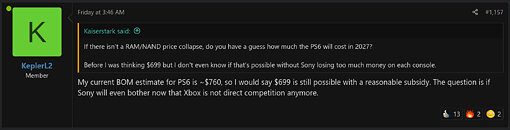
Microsoft recently revealed that Xbox Project Helix would be its next-gen gaming console and that it would play both PC and Xbox games, however, previous leaks tipped a rather high price tag for the upcoming console generation—some expect it to be upwards of $800. While this may have its effects on Microsoft's sales, it also has bigger implications for the wider console and gaming hardware market itself. According to notorious hardware leaker, KeplerL2, on the NeoGAF forums, the reduced pressure from Microsoft may be enough for Sony to raise prices on the PS6. There have also been rumors that Sony is planning a PlayStation 6 Portable, which would be a standalone device and could theoretically fill the gap left by Sony in the more affordable console space if this price prediction is true.

The leaker explains that their "current BOM estimate for PS6 is ~$760, so I would say $699 is still possible with a reasonable subsidy. The question is if Sony will even bother now that Xbox is not direct competition anymore." These comments come at a time when hardware prices have skyrocketed, and availability is low, thanks to the ongoing DRAM crisis largely caused by increased demand from the AI industry. This bill of materials cost estimate also assumes that there will be no decrease in memory or hardware costs, which is currently an unknown, with all the talk about AI being a bubble. Those same hardware shortages and price increases have been the justification for predictions of console delays and numerous cancellations by PC hardware manufacturers. It also recently came to light that Sony will be scaling back its PC port efforts, meaning fewer Sony exclusive games will end up on PC, giving players more of an incentive to buy the PS6, even if prices are somewhat inflated.

New Xbox Game Pass Tier Appears in Leak With Only Xbox Studios Games

It was recently revealed that Xbox's new CEO, Asha Sharma, is planning to announce a new Game Pass subscription tier in order to draw in more gamers, and, although there has been no official announcement from Xbox itself, it seems as though those rumors have been confirmed by Better xCloud, an open-source service that adds features to Xbox Cloud Gaming, in a recent analysis of the Game Pass update code.

According to a post by the Better xCloud official X account, there is a new Game Pass tier that uses the codename "Triton" in the Game Pass update code, and all of the games in the new tier are from first-party Xbox Game Studios, as opposed to regular Game Pass, which features games from third-party developers as well. The exact pricing Xbox will use for the new Game Pass tier is still unknown, but there has been speculation that it will be an ad-supported free or low-cost subscription. This first-party approach could theoretically allow Microsoft to keep costs down, effectively eliminating licensing costs from the equation. It would also be a way for Microsoft to leverage the numerous studio acquisitions it has made during the last few years. There have also been talks of a partnership between Xbox and Netflix for bundled subscriptions, so this may be the groundwork for that.

Intel Arc Pro B70, B65 Battlemage GPUs To Launch March 25 With 32 GB ECC VRAM

Intel's Battlemage BGM-G31 GPUs have shown up in leaks and rumors before, although an exact launch date was previously unknown. Now, though, according to VideoCardz, Intel will launch the Arc B70 Pro and B65 Pro as early as March 25. The outlet claims that the information comes directly from Intel press packets, and that it confirms the base specifications for both the Arc B65 Pro and B70 Pro. The new workstation GPUs will apparently be available in both Intel-branded versions as well as third-party designs.

The leak also purports to confirm the previously leaked specifications of the B70 Pro and B65 Pro, which means the B70 Pro will have 32 Xe2 cores and 32 GB of ECC GDDR6 and a 256-bit memory bus with a 160-290 W TGP range. Intel's TBP for the reference design will be 230 W. The B65 Pro, on the other hand, will supposedly launch with the same VRAM configuration, but it will feature only 20 Xe2 cores, making it effectively a B60 Pro with more VRAM. The B65 Pro will also supposedly have a 200 W peak TGP.

Ubisoft's Cost Cutting Continues With 105 Jobs Cut as Red Storm Relegated to Support Studio

Red Storm Entertainment, the long-standing game studio that previously worked on titles in the Tom Clancy, Ghost Recon, and Rainbow Six franchises, has been officially transitioned to a support-only studio by Ubisoft. Red Storm had been working on The Division Heartland until that was cancelled in 2024, even after having been through a number of playtests. According to sources who spoke to GameIndustry.biz, Ubisoft will lay off as many as 105 workers at Red Storm, while the remaining staff will be dedicated to supporting Ubisoft's other studios in IT, customer relations, and development work on the Snowdrop engine.

The layoffs come after Ubisoft announced its recent cost-cutting measures and studio restructure, which would see the gaming giant reorganized into five "creative houses," all individually responsible and accountable for the games and properties under their management. The ensuing changes and announced cost-cutting measures, which aimed to save €200 million over two years, have already resulted in a number of layoffs at other studios and a massive strike across Ubisoft's international locations.

Intel Core Ultra 3 205T Makes First PassMark Appearance

Following the recent early performance benchmarks of the Intel Core Ultra 5 250K Plus, Intel's Arrow Lake-S Core Ultra 3 205T has broken ground on PassMark, and it's giving the Core Ultra 5 255 and Core Ultra 5 255T a run for their money, at least in single-core benchmarks. Multithreaded benchmarks paint something of a grimmer picture for the Core Ultra 3 205T, though—likely due to the reduced core and thread count of the 205T, which features just eight cores and eight threads, likely four P-cores and four E-cores.

The Core Ultra 3 205T scored a respectable 4,561 points in the single-core benchmark, beating out the Core Ultra 5 255 and 255T by 3.2% and 6.6%, respectively. When it comes to multithreaded tasks, however, the Core Ultra 3 205T falls behind. In PassMark's benchmarks, the 205T was nearly 15% behind the Core Ultra 5 225. Still, the Intel Core Ultra 3 205T comes in ahead of the AMD Ryzen AI 5 435 by a significant margin in both single- and multi-core tests, and the Core Ultra 3 205T seems to have been tested at a peak TDP of 35 W, all of which may make it worth considering for lower-end office builds.

GTA VI Hacker Claims Game Source Code Still in the Open, Is "Surprised" It Hasn't Leaked Yet

During the development of GTA VI, Rockstar was hacked and had its data—much of it related to GTA VI—stolen by the aforementioned hacker, and although the hacker was arrested and is currently serving time for the hacks of both Rockstar and numerous other companies, he claims that the GTA VI source code he obtained during his raid is still being kept by someone external to Rockstar. According to @videotechuk_ on X, the hacker who cracked Rockstar's security in 2022, Arion Kurtaj, has managed to smuggle a smartphone into the UK prison where he is being held and has been using it to communicate with the outside world via WhatsApp. In one message thread, Kurtaj claims that the Grand Theft Auto VI source code was successfully stolen and is still being held by "someone" external to Rockstar.

The hacker is apparently surprised that the source code has not yet been made public—the hacker, aka Lapsus$, stole 90 unreleased GTA VI clips, some of which were released, but he never did publish the game's source code. Rockstar and its parent company Take-Two Interactive have been taking aggressive measures to prevent leaks surrounding GTA VI, with it being speculated that the company's recent return-to-office mandate and a series of contested layoffs were both attempts to catch or prevent leaks of the hotly anticipated installment in the GTA franchise.

Xiaomi Book 14 Leaks With Panther Lake CPU, 32 GB RAM, Arc B390 iGPU

Xiaomi's upcoming Book 14 laptop has leaked online, revealing the expected specifications for the upcoming thin-and-light productivity laptop. According to Digital Chat Station on Weibo, the Xiaomi Book 14 will feature Intel's Panther Lake Core Ultra Series 3 CPUs, specifically the Core Ultra 5 325 and Core Ultra X7 358H, with either 24 GB or 32 GB of memory and 1 TB of storage. This means that the Xiaomi Book 14 will be available in at least one configuration with Intel's impressive new Arc B390 iGPU, which has proven itself in both gaming and creative workloads aside from the usual productivity fare.

Following DCS's post, Aura Pig also posted on Weibo about the upcoming MacBook competitor, stating that the both the build quality and battery life of the Xiaomi Book 14 were impressive. The 14-inch display is also touch-enabled, although the laptop is purportedly squarely in the premium category, suggesting a high price. The current-gen Xiaomi Book 14 tops out at 16 GB of memory and is only available with Intel's 12th-Gen CPUs and up to 512 GB of storage, so the new model will be a significant upgrade in terms of performance and convenience if the leaked specifications are any indication. Weight on the new Book 14 will be slightly lower than the old model, at around 1 kg compared to the 1.37 kg in the current Book 14.

Seagate's FireCuda X Series of NVMe SSDs Leak Ahead of Official Launch

Following Sandisk's new naming scheme for NVMe SSDs, it now looks like Seagate is ready to announce a shift to a new naming for some of its SSDs as well. In a leak that at least in part appears to be thanks to a spec sheet uploaded by Best Buy, Seagate's upcoming FireCuda X series has leaked and the first model in the new series looks to be the X1070. That's a pretty big jump in model numbers, as Seagate's current top of the range FireCuda NVMe SSD is the 530R. Unlike the Barracuda 540, the FireCuda X1070 isn't a PCIe 5.0 drive and it does in fact not even trump the FireCuda 530R in terms of performance, despite the new model name suggesting it would.

The X1070 offers a max sequential read speed of 7200 MB/s, down from 7400 MB/s for the 530R and max sequential write speed of 6000 MB/s for the 1 TB SKU and 6500 MB/s for the 2 and 4 TB SKUs, where the 530R ranges from 6800-7000 MB/s. The random IOPS are also lower at around 900k vs. 1.3 million. The TBW rating is also about half that of the 530R, somewhat depending on the SKU, but Seagate still offers a five year warranty. The only good news is that the power usage is down by around 3-4 W, again depending on SKU, but this suggests we might be looking at a DRAM-less model here. We'll have to wait for the actual launch to find out the pricing, but it looks like the current FireCuda 530R is a better option over the X1070, unless you need an SSD that is more power efficient and hopefully produces less heat.

Razer Viper V4 Pro Gaming Mouse Leaks in Physical and Online Stores

Leaks about an upcoming Razer Viper V4 Pro have been circulating for a while now, with multiple e-sports pros seemingly using the new mouse in competitive tournaments. Now, though, the new wireless mouse has effectively been confirmed by two separate posts showing off early retail appearances of the Viper V4 Pro. First, a Reddit user posted in-store images of the Viper V4 Pro retail packaging that had seemingly accidentally been put in the storefront ahead of launch, and although the post was subsequently deleted by the r/MouseReview subreddit user, it didn't stop the images from showing up on X. For the most part, it seems like an iterative update to the existing Viper V3 Pro, as was expected, given the specs of the DeathAdder V4 Pro.

The aforementioned retail box gives us a good idea of what to expect from the Viper V4 Pro—that is, a minor sensor update to the Razer Focus Pro 50K, new Razer Optical Gen 4 switches, a Razer optical scroll wheel, and a 49 g total weight. Notably, the sensor is a slight improvement over even the Razer DeathAdder V4 Pro, although much of the rest of the mouse's specifications are practically identical. As expected, the Viper V4 Pro adopts the same more efficient and lower latency dome-shaped wireless receiver as the DeathAdder V4 Pro, replete with 8K polling and a claimed 180-hour battery life. According to Danish computer store, ComputerSalg, where the Viper V4 Pro was prematurely launched as well, although without any photos, the mouse will also be available in white at launch, and it will cost a staggering $199 (DKK 1,290 converted excluding VAT). This is significantly more expensive than both the existing Viper V3 Pro and the DeathAdder V4 Pro, so it's likely a pre-launch placeholder or the price of some special edition colorway. All of this indicates that the Viper V4 Pro is likely to launch within the next few weeks, but it will have to contend with both the new tech in the Logitech G Pro X2 Superstrike and the slew of Chinese gaming mice with similar hardware specs and much lower pricing.

PlayStation 6 Leak Tips 4K 120 FPS "In Most Games" With 6-12× RT Performance of PS5

Given the current state of the gaming industry, rumors have started to emerge about the next-gen gaming console launches, with previous rumors claiming that the PlayStation 6 would launch alongside a new standalone PlayStation Portable gaming handheld, and that the PS6 would have less graphical processing power than the upcoming Xbox console. In a new post on YouTube, ubiquitous leaker and industry insider, Moore's Law is Dead, claims that the PS6 Orion—the living room console—will feature 2.5-3× the rasterization performance of the PS5 and 6-12× the ray tracing performance of the PS5, or 3-6× faster ray tracing than the PS5 Pro and roughly twice the raster performance of the PS5 Pro. This is thanks to a significantly faster RDNA 5 GPU with 52-54 CUs running at around 2-3.6 GHz and delivering around 34-40 TFLOPS of theoretical performance.

The leaker also shot down rumors that recently surfaced claiming that the PlayStation 6 may be delayed to as late as 2029 due to the ongoing memory crisis, stating that the nature of memory and APU fabrication contracts make it unlikely that the PS6 will be delayed that long. Instead, we may see a brief period of increased pricing or scarcity at launch. Apparently, according to his sources, Sony has a contract with TSMC to start mass-producing the PS6 as early as Q2 2027. MLID also mentions the AMD "Canis" APU slated to arrive in the PS6 handheld console, claiming that it will feature four Zen 6c cores, two Zen 6 LP cores (for running the operating system), and 16 RDNA 5 CUs running at 1.6-2 GHz with a 15 W total board power, all being fed by LPDDR5X memory over a 192-bit bus. All of this will allegedly be targeting 1080p gameplay with a significantly higher power limit when docked. He also speculates that the handheld will feature "vastly better" ray tracing than the PS5.

Ubisoft Reworks Assassin's Creed Hexe Combat Deep Into Development, 2027 Launch Likely

Ubisoft has been clear that it is working on "several" new games in the Assassin's Creed franchise. One of those games is Assassin's Creed Hexe, a new open-world AC game that has been in development at Ubisoft Montreal in some form or another since 2022. Now, according to Tom Henderson on the Insider Gaming podcast, the combat for Assassin's Creed Hexe is being reworked, with a contortionist coming in to record the motion capture scenes. He also adds that the game looks to be launching sometime in 2027, despite the combat reworks. Ubisoft Montreal, the studio in charge of Hexe, was also leading the development of the recently cancelled Prince of Persia: Sands of Time remake, although it seems unlikely that Hexe would be cancelled this late into development, especially since it seems to follow the established Assassin's Creed format rather closely.

Recent teasers released by Ubisoft suggest that the new game will feature themes of witchcraft and sorcery, with a distinct horror influence, and it seems like it will be set in Germany. Hexe was being directed by Clint Hocking, of Far Cry 2, Watch Dogs: Legion, and Splinter Cell: Chaos Theory fame, but recent changes to Ubisoft's structure resulted in his departure from the company and the project. Despite this, Ubisoft has assured gamers that Hexe has survived the tumultuous reshuffling that has seen so many other projects delayed. However, the news of the reworked combat may mean that it will need more time in the oven than originally intended.

Lenovo Leak Tips "ThinkBook Modular AI PC" for MWC Showcase

We recently reported on a Lenovo MWC leak that claimed Lenovo would show off a Legion Go Fold at Mobile World Conference in Barcelona in early March. Now, a new leak shared by evleaks on X has shown off what Lenovo will apparently call the "ThinkBook Modular AI PC Concept." The leaker didn't provide much information other than the name and two images of the device, but the combination of the word "modular" in the name and the clues from the images provide a pretty clear idea of what's going on.

From the looks of it, the ThinkBook concept will have a traditional clamshell design, but the space where the keyboard deck would usually be on a traditional laptop will instead be a space for modular accessories. The accessories shown off in the leaked renders of the device are a laptop keyboard and a display equal in size to the main display in the top of the clamshell. This looks to be an iteration of devices like the Lenovo ThinkBook Flip, although the ThinkBook Modular AI PC Concept could achieve a similar effect, especially in terms of screen real-estate and possibly ergonomics, although likely with significantly lower costs, thanks to a simpler design without a flexible OLED panel. The new concept would also offer users more flexibility—you could just leave the lower display at home or pack both displays and a mechanical keyboard and mouse for better ergonomics and all the other benefits better peripherals offer.

Early AMD FSR 4.1 DLL Update Reportedly Leaks with Minor Visual Improvements

Early access to AMD Radeon Software's "Vanguard" driver testing program has reportedly revealed a new Radeon FSR 4.1 DLL file, which is the next update for AMD's FSR 4 technology. According to the latest leak, AMD is preparing the FSR 4.1 update, which should bring some visual or performance enhancements, or both. Some Reddit PC enthusiasts are applying workarounds to run the file on RDNA 3 hardware, even though AMD officially doesn't support FSR 4 on the RDNA 3 generation due to some missing instructions on the older microarchitecture. Running these files can produce visible quality gains but are experimental, varying widely by title and system setup. Even when a leaked DLL carries a digital signature, running unofficial binaries can trigger instability, break driver integrity checks, or conflict with future official updates.

However, the enthusiast community has run the experiment and confirms that early side-by-side comparisons show small improvements in fine detail and edge definition when the leaked FSR 4.1 binary is forced into titles that previously used FSR 4.0.3. Testers describe sharper foliage and fabric textures and less ghosting. Other users report inconsistent results and artifacts, suggesting that the update is still a work in progress. We could have expected the update to land alongside AMD Software Adrenalin 26.2.2 WHQL drivers that launched today, as the DLL file was found in the beta test of the 26.2.2 driver, but since the update is still experimental, maybe the next Adrenalin update will bring the FSR 4.1 update as an official package.

Foldable Lenovo Legion Go Gaming Handheld Concept Appears in Leak

Despite recent concerns about driver updates, Lenovo's Legion Go has been a staple in the handheld gaming space since it launched, thanks to a large 8.8-inch display and the detachable controllers. Still, that large display can't compete with devices like the 11-inch OneXPlayer 2-in-1 devices as a portable general computing device. A new foldable Legion Go concept, leaked by Windows Latest, may be in development to potentially address users who want a handheld that can pull double duty as a handheld gaming device and a laptop. According to the leak, the Legion Go Fold will use a foldable POLED display that unfolds from a 7.7-inch form factor to 11.6-inches. The controllers will also allegedly connect wirelessly, enabling the display to be used in 7.7-inch mode in landscape mode or in either portrait or landscape mode while attached to the controllers in 11.7-inch mode—such a portrait mode display could conceivably be split to function somewhat like a Nintendo DS. Of course, there will also be a detachable keyboard accessory to use the Legion Go Fold as a mini laptop in 11.7-inch mode.

The specifications for the Legion Go Fold will also be nothing to sneeze at, featuring an Intel Core Ultra 7 258V, 32 GB of memory, and a 48 Wh battery. Lenovo will also keep the vertical FPS mode from the Legion Go and Legion Go 2 for the Legion Go Fold Concept. While the Legion Go Fold may launch as nothing more than a concept, Lenovo is one of a few laptop makers that brings these foldable compute concepts to market, with recent examples of this including the Lenovo ThinkBook Plus Gen 6 Rollable. So it's not entirely impossible that Lenovo will bring something like a Legion Go Fold to market at some point. That said, it would be a niche within a niche, so it doesn't seem entirely likely that we will see a commercial version of the foldable handheld at any point soon. Regardless, Lenovo will allegedly show off the concept at MWC 2026 on March 2, 2026.

AMD "Gorgon Point" Desktop APUs Tipped for Early 2026 Launch

AMD announced its Ryzen AI 400 series "Gorgon Point" mobile APUs based on Zen 5 and Zen 5c cores at CES 2026 earlier this year, simultaneously showing off the AM5-based Ryzen AI 400-branded desktop APUs at the same show. Now, according to a new leak by Moore's Law is Dead on X, AMD will allegedly launch the new Ryzen AI 400-series desktop processors for AM5 in the first half of 2026. MLID adds that the launch may even happen as early as Q1. He also released what he claims to be a short promotional video of an AMD Ryzen AI 400 Pro processor in an AM5 socket to lend credence to his leak.

Exact specifications for the AM5 APUs are unconfirmed, but if they're anything like the laptop counterparts, it is expected that the new APUs will launch with the same silicon as Strix Point but with adjusted power management and increased clock speeds. This means we can expect to see the Ryzen AI 400 desktop processors top out with a 12-core (4× Zen 5; 8 × Zen 5c) CPU cluster tied to a 16 CU RDNA 3.5 iGPU, and a 60 TOPS NPU.

Capcom Acts on Resident Evil Requiem Gameplay Leaks, Asks Community for Help

With the launch of Resident Evil Requiem merely a week away, it's expected that gameplay and story leaks would start to show up online and subsequently be shared online. Capcom, however, has taken to social media platform, X, to decry the early gameplay and story leaks, asking players not to share the leaks. The gaming giant says that it wants "everyone to enjoy the game's story and experience as much as possible." Capcom adds that its legal department is working to issue DMCA take-downs of any leaks posted online, "in order to preserve your day-one experience."

The gameplay leaks in question have revealed major plot points and twists, as well as potential endings to the latest installment in the Resident Evil franchise. One Reddit thread—which fortunately is covered with spoiler tags—has collated the vast majority of the leaks, including gameplay footage of part of the game's ending. It's easy to see why a game studio would want to keep a lid on such extensive leaks about a story-driven game. Another post in the subreddit was removed by the moderators, so it looks like Capcom's take-down requests or social media plea has had some effect already.

Intel's "Bartlett Lake-S" Core 200E Family Leaks: Up to 12 P-Cores and 5.9 GHz ST Boost

Thanks to a new table specification matrix published by a known leaker Jaykihn on X, we are seeing the final specifications of Intel's long-rumored "Bartlett Lake-S" Core 200E family of CPUs with P-Cores only. This platform is designed to fit inside Intel's LGA-1700 socket, but from a consumer standpoint represents a non-existent product that will not reach their hands, as Intel has abandoned the plan to launch this highly anticipated gamer CPU. Instead, Intel will only offer it for its edge and embedded products. At the top of the stack is the Core 9 273 PQE SKU, which is a 12 P-Core variant with 24 threads and a base frequency of 3.4 GHz. This model can boost all of its 12 cores to 5.3 GHz, while a single thread can go up to 5.9 GHz independently for tasks that require intensive single-threaded performance. It is equipped with 36 MB of L3 cache and an integrated GPU with 32 EUs of Xe-LP graphics.

Interestingly, the entire lineup is separated into three categories. One is a high-TDP PQE with a base power of 125 W, while the middle PE models are 65 W designs with lower clocks. The weakest models are the PTE SKUs that have a TDP of 45 W, which are more ideal for edge deployments where power/efficiency is the most important factor. Across the lineup, there are versions with 8, 10, and 12 cores, all with Hyper-Threading for 16, 20, and 24 threads. Some SKUs from the PE and PTE lineups do not enjoy Intel vPro and ECC memory support, while the PQE high-power SKUs are all equipped with vPro and ECC memory support. You can check out the complete table comparison and product segmentation below for more specific information on different models.

Valorant Pro Confirms Razer Viper V4 Pro Imminent

The Razer Viper V4 Pro has already shown up in previous rumors, with what is thought to be a camouflaged version of the mouse showing up at a Valorant tournament. Now, the successor to the Viper V3 Pro has once again been confirmed, this time by Valorant pro, Canezerra, in a livestream (via BestGamers on X). Allegedly, the Viper V4 Pro is also being used by two other Valorant players. Prosettings.net also lists League of Legends pro, Myrwn, as using the Viper V4 Pro.

The current consensus is that the Viper V4 Pro will use the same or similar internals to the DeathAdder V4 Pro, but with the symmetrical shape of the Viper V3 Pro. This means it will likely feature the new dome receiver of the DeathAdder V4 Pro with a Nordic 54 series MCU, Gen-4 Razer Optical Mouse switches, a Razer Focus Pro 45K Gen 2 sensor, a slight decrease in weight, and minor physical changes, like a new coating and slight shape tweaks. The current-gen Razer Viper V3 Pro was released in April 2024, while the DeathAdder V4 Pro was launched in July 2025; by that logic, we can expect the Viper V4 Pro to launch sometime in Q2 2026 or shortly after.

[Editor's note: Our in-depth review of the Razer DeathAdder V4 Pro is now live]

Apple's Rumored "Low-cost MacBook" Expected to Utilize New Shell Design

The alleged "low-cost" MacBook design could launch later this year, with mid-2025 reports suggesting that the even cheaper Apple notebook product tier will be powered by A-series chipsets. Industry trackers propose a sub-13-inch device that relies on an A18 Pro SoC—this particular chip is found in iPhone 16 Pro and Pro Max (2024) smartphone models. Currently, Apple's entry-level MacBook Air range uses M-series APUs—for example, the 2025 lineup of 13 and 15-inch options are based around the ubiquitous 10-core M4 processor. Bloomberg's Mark Gurman continues to predict the "low-cost MacBook" model's deployment of A18 Pro hardware and a mere 8 GB of unified system memory, likely in a bid to take on Google's Chromebook line. In his latest "Power On" newsletter, the veteran Apple soothsayer believes that the North American giant's engineering design team is exploring a new type of aluminium shell, reserved for the cheaper notebook range.

Leaks from last year described a bright and colorful selection of casing options. Gurman proposes ongoing experiments with light yellow, light green, blue, pink, classic silver, and dark gray schemes. He notes that some colorways are not expected to reach market; possibly as early as next month (within Q1 2026). The budget shell design has reportedly warranted a fresh manufacturing approach; the "Power On" scribe thinks that a swifter and more cost-effective production process has been implemented in recent times. Previously, industry insiders had picked up on whispers regarding an intriguing graphite-clad aluminium substructure—akin to what is used for the iPhone 16 Pro's thermal-wicking internals. A dedicated "Low-cost MacBook" launch event is anticipated; tipsters posit Apple leadership marking a March date on company calendars.

Fully Unleashed "Nova Lake-S" 52-core HEDT CPUs Only Supported by Certain Motherboards?

Earlier last week, more details emerged regarding Intel's rumored top-level 52-core "Nova Lake-S" processor model. According to recent leaks, this flagship Core Ultra Series 4 design is expected to feature a 16 P-core, 32 E-core, and 4 low-power island E-core configuration, paired with big last-level cache (bLLC). An unprecedented 700 W power consumption figure (under full load) was floated by kopite7kimi, with Jaykihn weighing in about the "NVL-S" series' TJMax (Thermal Junction Maximum) not being offset. Also, they mentioned that "thermal throttling cannot be disabled." Days later (on February 13), Jaykihn issued another "preliminary" prediction: "only some (motherboards) will support the full-power 52-core (52C) platform. Other boards will limit the performance and power of the 52C platform." When poring over this information, VideoCardz connected dots between the very best "Core Ultra Series 4" dual-tile options to a speculative and new "Core X" HEDT product lineup.

In theory, the highest level models could bear "Core X9" designations; akin to the recently launched flagship "Panther Lake-H" chip (Core Ultra X9 388H). Normally, Intel's workstation-focused Xeon processor families have occupied the HEDT segment. As a fallback hypothesis, VideoCardz envisions the "X" marking being applied exclusively to bLLC-augmented variants—likely specifying advertising elevated gaming performance; similar to AMD's "X3D" naming scheme. In their past weekend report, the popular online publication has dismissed rumors about Team Blue nixing the single-tile (with bLLC) side of the "Nova Lake-S" series. Instead, VideoCardz envisions two "mainstream" single-tile SKUs arriving—later in the year—pipped to take on equivalents within Team Red's Ryzen 7 and 9 desktop processor tiers. Two larger siblings, in premium dual-time form (with bLLC), are anticipated as forming a new HEDT line.

Latest Intel Arc Pro Driver Patch Notes Devoid of Unreleased "B70" Model

Online detectives continue to sift through various Team Blue repositories, in search of any hint of new "Big Battlemage" GPU developments. Late last month, the somewhat mysterious Arc Pro "B70 and B65" workstation cards were rumored as supplanting the "BMG-G31"-based Arc B770 16 GB consumer-grade/gaming model. Mid-way through this week (February 11), Intel released its "Graphics Driver 32.0.101.8314 WHQL (Q4.25) for Intel Arc Pro Series Graphics" generic driver. VideoCardz has pored over the latest update information, and found no utterances next-gen hardware; most notably the "B70." A compatibility list only reaches the upper levels of familiar Arc Pro B60 24 GB and Pro B50 16 GB desktop GPUs—both utilizing the "BMG-G21" GPU die.

The "leaked" Intel Arc Pro "B70 32 GB" model could arrive at retail within the first quarter of this year, so web detectives are anticipating an increase of pre-launch activities in February and March. Members of the Intel Arc subreddit were not discouraged by VideoCardz's slightly disappointing investigation of patch notes—one member, WizardlyBump17, suggested that interested parties check out "the binary for mentions of G31." They themselves had found an official yet accidental "B70 commit" within Team Blue's ai-containers 0.14.1 changelog. Days later, this promising "validation" information was scrubbed and replaced with a cleaned up description. Additionally, WizardlyBump17 observed the non-professional "B770" model being wiped from an official GitHub commit—appropriately, yesterday's modification was titled "Cleanup Unwanted BMG Codenames."

Lenovo's Surface Pro-esque "ThinkPad X13 Detachable Gen 1" Leaked

Lenovo seems to be returning to new-gen ThinkPad Detachable pastures this year, according to a major leak. Windows Latest has managed to acquire a set of promotional renders of the speculative "ThinkPad X13 Detachable Gen 1" model, finished in "Eclipse Black." As implied by the "X13" designation, early conjecture points to a 13-inch display surrounded by thinner bezels—clearly a size/design upgrade over Lenovo's second-gen ThinkPad X12 Detachable SKU. The latter has been surpassed—technologically—by various rival device ranges; namely Microsoft's Surface Pro 11 and 12 lines, in x86 and Arm flavors. When analyzing the watermarked ThinkPad X13 Detachable Gen 1 image set, web sleuths have focused on the presence of USB-C ports labelled with lighting bolt symbols. Thunderbolt 4 capabilities would imply that the unreleased device has some sort of modern Intel APU onboard.

Windows Latest's exclusive report envisions Lenovo's selection of a Core Ultra 3 "Panther Lake-H" mobile processor. Upon launch back in 2024, the ThinkPad X12 Detachable Gen 2's Core Ultra 100U "Meteor Lake" series processors were considered to be underpowered, even with the Core Ultra 7 164U (with vPro)-powered option. It is anticipated that the slightly larger successor will be introduced at next month's Mobile World Congress event, in Barcelona (MWC 2026, March 2 to 5). ThinkPad enthusiasts will be pleased to see the brand's familiar keyboard layout, a TrackPoint nub, physical right and left click buttons, and a circular fingerprint reader. So far, Lenovo's ThinkPad Detachable products have not sacrificed these major fan favorite features; normally reserved for traditional professional laptop/notebook designs.

Qualcomm Reportedly Received Samsung LPDDR6X Samples - Linked to AI250 Accelerator

Late last October, Qualcomm revealed its AI200 and AI250 chip-based accelerator cards, and racks. Oddly, the company's press material mentioned the utilization of Low-Power DRAM (LPDDR) memory rather than in vogue High Bandwidth tech (HBM)—the latter has quickly become the de facto choice for cutting-edge AI-crunching enterprise platforms. Modern types of LPDDR memory are normally found in portable devices powered by Qualcomm chipsets, but the San Diego-headquartered fabless semiconductor firm seems to be exploring the deployment of LPDDR6X modules in server-grade equipment. According to inside track information—published by The Bell South Korea—Samsung Electronics has reportedly sent prototype LPDDR6X samples of to the House of Snapdragon chips.

One of The Bell's anonymous industry sources opined that this move was a little bit out of the ordinary; given that the LPDDR6 (non-X) standard received official JEDEC certification not that long ago (Q3 2025). The still in-progress Samsung LPDDR6X development project has been linked to Qualcomm's 2027 launch of the AI250 inference-focused server platform. The publication's official contact believes that a tight AI200-series release roadmap has prompted the very early supply of LPDDR6X modules. Last month, rumors emerged about the AI200 and AI250 inference accelerators being sized up with SOCAMM2 in mind. In December, the Samsung Memory Product Planning Team divulged forthcoming branches of non-X tech—most notably that "low-power DRAM technologies such as SOCAMM" are being spun-off from "AI-focused module solution(s) leveraging LPDDR6 architecture."

CXMT Reportedly Plans to Dedicate 20% of Mass Production Capacity to HBM3 Line in 2026

According to fresh news reports ChangXin Memory Technologies (CXMT) has just announced the initiation of HBM3 module mass manufacturing activities. The Chinese computer memory maker is slowly catching up with more mainstream international rivals—most notably, South Korean companies started full production of fourth-generation high-bandwidth memory (HBM3) products back in 2023. Over the past year, CXMT has demonstrated improved capabilities across a promising range of (mostly) commercial lines—for example, their proprietary DDR5 and LPDDR5X designs were showcased in preview form, last November. By early February (2026), the likes of ASUS, Acer, Dell, and HP were reportedly weighing up the sourcing of CXMT consumer-grade memory products.

The first signs of CXMT's diversification into the development of "homegrown" HBM3 modules were divulged by industry insiders, last May. By early autumn, a joint venture—involving YMTC—seemed to pave the way for an acceleration of the Chinese industry's overall HBM manufacturing footprint. Huawei's newest/futuristic Ascend AI accelerator relies on "in-house" HBM tech, due to global sanctions preventing the supply of cutting-edge Micron, Samsung, SK Hynix components to Chinese firms. An MK South Korea reports cites recent information disclosed by an anonymous source, regarding a secret partnership: "Huawei, which is leading the development of AI semiconductors in China, is developing HBM together with CXMT. It is expected to enter mass production despite (talk of) low yield(s)." Further inside track info posits that CXMT is planning a per month output of 60,000 wafers for "HBM3 production." This impressive guesstimate allegedly accounts for about 20% of the memory maker's total manufacturing capacity of 300,000 wafers per month, at least for 2026.

Samsung Exynos 2700 Mobile SoC Could Reach Mass Production Phase in H2 2026

Samsung is readying its Exynos 2600 application processor (AP) for a late February debut in next-gen Galaxy S26 smartphone models. Recent promotional fanfare has focused on the South Korean semiconductor giant's 2 nm GAA process (SF2), but early 2026 leaks have suggested work continuing on two futuristic fronts—a more advanced manufacturing process (SF2P), and the mysterious Exynos 2700 mobile processor design. Earlier today, Park Yu-ak of Kiwoom Securities made a bold prediction about Samsung's next-gen AP design: "the Exynos 2700 will enter full-scale mass production in the second half of this year using Samsung Foundry's SF2P process and will record a market share of around 50% in the Galaxy S27."

Currently, smartphone industry experts believe that Exynos 2600 chipsets will only deploy in 25% of the soon-to-be-launched Galaxy S26 series. The remaining share will be powered by Qualcomm's Snapdragon 8 Elite Gen 5 "for Galaxy" SoC. Samsung leadership is very likely pursuing a more favorable spread of in-house technologies, as future Exynos designs become more competitive in a bustling market. Mixed rumors of 2 nm GAA node production yields have somewhat dampened expectations of the South Korean megacorp's foundry business, but the latest Kiwoom Securities forecast outlines a cool operating profit of 1.8 trillion won by 2027 for Samsung Electronic's non-memory division. Within the past month or two, industry insiders have whispered about potential SF2 and SF2P deals being signed in the same sentence as AMD, Qualcomm, and Tesla.
Return to Keyword Browsing
Nov 24th, 2026 03:54 CST change timezone

New Forum Posts

Popular Reviews

TPU on YouTube

Controversial News Posts