News Posts matching #Leak

Return to Keyword Browsing

NVIDIA Reportedly Informed AIBs About GeForce RTX 50-series SUPER GPU Delay

The non-appearance of GeForce RTX 50-series "Blackwell" SUPER graphics cards at CES 2026 came as a major shock for portions of the PC hardware community. Normally, NVIDIA sticks to a fairly regular release cadence—barring a few hiccups here and there—with the launches of new gaming products and mid-gen refreshes. Unfortunately, current market conditions have affected a wide swath of manufacturers—prompting price hikes, supply chain adjustments, launch postponements, and rethinks of next-gen technology strategies. As laid out in TechPowerUp's recent top five "biggest no-shows of CES 2026," Team Green's much-anticipated current-gen GeForce product refresh gets top billing.

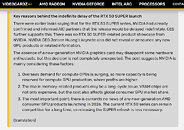
Last Thursday (January 8), members of the Board Channel community engaged in speculative talk of NVIDIA's alleged indefinite delay of GeForce RTX 50-series SUPER GPUs. One participant outlined three main reasons behind this disappointing postponement, reportedly extracted from a brief issued to board partners. According to this leak, the first factor is production capacity being adjusted to favor compute GPU lines—current demand, especially overseas, needs to be satisfied. Most importantly, greater profit margins are being pursued in the extremely lucrative AI server segment. The second bullet point focuses on a long-term forecast for escalating memory-related product costs—a serious problem for modern graphics cards that utilize fancy GDDR7 VRAM modules.

Intel "Nova Lake" Xe3P iGPUs Could be 25% More Powerful Than Xe3 Models

Intel has officially launched its first wave of "Panther Lake" mobile processors; as Core Ultra Series 3 products for deployment in laptops, notebooks, and mini PCs. A good chunk of the North American giant's CES 2026 presence was dedicated to their first AI PC platform built on the 18A process. A main talking point was the very best of "Panther Lake-H" integrated graphics solutions: Arc B390. Utilizing "Xe3" architecture, this 12-core iGPU will compete with older RDNA 3.5-based AMD equivalents for the foreseeable future. Looking further along Intel's Arc roadmap, the more mysterious "Xe3P" technology is expected to debut within "Nova Lake" processors. Almost a year ago, Raichu linked "Xe3P" to next-gen Arc "Celestial" dGPUs.

Throughout 2025, leaks showed this architecture popping up in upcoming "Nova Lake" desktop and mobile processors, as well as "Crescent Island" data center accelerators. Last week, Raichu weighed in with another "Xe3P" prediction—proposing a 20-25% performance uplift over vanilla "Xe3." Additionally, they reckon that Intel's next-gen 12-core integrated graphics solution—presumably present in top "Nova Lake" APUs—could take things further, performance-wise. Raichu did not make a distinction between desktop and mobile parts; instead identifying "Nova Lake" as an overall processor family in a brief social media post. Interestingly, a July 2025 "Nova Lake-S" tape out-related leak suggested an unusual hybrid setup—with next-gen desktop processors supposedly utilizing Xe4 "Druid" architecture for "media and display duties."

AMD "Ryzen 9 Pro 9965X3D" Model Leaked, Document Describes 16-core CPU & 170 W TDP

PC hardware detectives are still searching online for more evidence of AMD's not-yet-released Ryzen 9 9950X3D2 desktop gaming processor, but the latest discovery has shifted some focus onto Team Red's "Ryzen PRO" product line on the AM5 platform. Earlier today, Gray/Olrak29 shared an intriguing screenshot of yet another partial NBD shipping manifest. A mid-November entry outlines a previously unmentioned Ryzen 9 PRO 9965X3D SKU. Only very basic details are visible in late 2025 shipping information; namely a 16-core configuration and 170 W TDP rating. The two leaked credentials seem to align with specs applied to the readily available Ryzen 9 9950X3D model; Team Red's current flagship "Granite Ridge" gaming CPU.

Half-way through last year, AMD announced three new Ryzen PRO products that would expand their "Zen 5" range of mainstream desktop processors. At the present moment, their most potent "PRO" level option on the AM5 platform is the 12-core Ryzen 9 PRO 9945 SKU. Naturally, the just leaked Ryzen 9 PRO 9965X3D model is expected to take top billing—if it launches later this year. Based on model naming convention, early reportage posits that the not-yet-released PRO flagship will be blessed with only a single provision of third-gen 3D V-Cache, rather than a highly-anticipated dual configuration. This pioneering setup—for modern mainstream gaming rigs—could debut with an eventual arrival of Ryzen 9 9950X3D2 CPUs.

Intel Driver Package Reportedly Contains Arc B770 "BMG-G31" BIOS Update

Many Team Blue enthusiasts were looking forward to a potential unveiling of a larger "Battlemage" gaming graphics card model at CES 2026, but keynote presentations and showroom floor exhibitions were devoid of fresh "Xe2 dGPU" content. Past weekend TechPowerUp reportage positioned the heavily speculated Arc "Battlemage" B770 design as the fifth greatest "no-show" at the recently concluded Las Vegas-based trade event. The "BMG-G31" GPU die codename has popped up regularly—via official sources and leaks alike—in recent times; leading to theories of an imminent product reveal. Late last week, web sleuths stumbled upon a downloadable folder that contained a "BMG-G31" firmware update. Apparently, an Intel driver package—relating to an HP-made "Panther Lake" laptop—was thoroughly examined.

Several PC hardware news outlets have broached the "B770" topic with Team Blue contacts at CES 2026, but no further details—of a notable unreleased product—were disclosed during the busy work week. Within the first half of January, Intel's "Panther Lake" mobile chips have taken precedence, although the adjacent "Wildcat Lake" APU was introduced in an extremely low-key way. The latest leak indicates the readying of drivers for some sort of consumer-level "BMG-G31" graphics product. The fourth quarter 2025 rumor mill pointed to a possible 300 W TDP-rated "B770" mainstream gaming card, leveraging 32 Xe2 cores and 16 GB of GDDR6 VRAM—a significant step-up from the over-a-year-old Arc B580 12 GB model.

GeForce RTX 60-series Linked to Mysterious "GR20x" GPU Dies, 2H'27 Launch Predicted

A sizeable gap—not occupied by NVIDIA's heavily rumored, and possibly tenuous GeForce RTX 50 SUPER-series—has been noticed at this week's CES trade show. During kick-off hours, the North American giant's GeForce social media quietly declared that "no new GPUs will be announced" within the four-day-long event. Graphics card industry observers have seemingly become tired of pursuing mid-generation product refreshments, and have set their sights further along Team Green's timeline. Yesterday, kopite7kimi fielded a number of queries regarding a futuristic GeForce RTX 6000 graphics lineup. Logically, these next-gen designs could leverage "Rubin" GPU architecture—already previewed as a well-known property in enterprise fields.

Speculation from last September—hinging on NVIDIA's official unveiling of their "Rubin CPX" GPU, that sports CUDA cores—lead to a theory that "GR10x" dies would form the basis of truly next-wave gaming graphics cards. In early 2026, kopite7kimi has proposed the utilization of a different set of GPU dies—identified as the "GR20x" group (or "GR200" family). Specifically, the PC hardware sleuth has pinpointed an alleged "GR212" model. They surmise that NVIDIA's "Rubin" architecture-based GeForce RTX 60-series will arrive within a second half of 2027 launch window.

Ryzen 9 9950X3D2: Alienware & Sytronix Feature it in Pre-built Systems

Not long after AMD's alleged confirmation of the "Granite Ridge" flagship 16-core Ryzen 9 9950X3D2 CPU's existence, web sleuths noticed that the not-yet-launched SKU being included in marketing material and new product descriptions. Most tellingly, Alienware China's Weibo account inadvertently mentioned a new Area-51 desktop system powered by Team Red's Ryzen 9 9950X3D2 processor. An accompanying short video was tagged with a "CES 2026" banner. As it turns out—to some online community disappointment—AMD only presented its 8-core Ryzen 7 9850X3D model during this week's North American trade show.

Sytronix, a UK-based PC workstation and server specialist, has advertised an "all-new" NexStation product, arriving soon through pre-ordering—apparently "powered by AMD's Radeon AI PRO 9700 (GPU) and Ryzen 9 9950X3D2 (CPU)." Elaborating on the chip's vaunted dual CCD setup, Sytronix's product page states that the design: "stacks massive L3 cache directly on the CPU, boosting memory bandwidth and cutting latency. Perfect for simulation, CAD, data science, and AI inferencing; anything that needs fast access to large datasets." Slightly older leaks show preview samples of the Ryzen 9 9950X3D2 being benchmarked—this pre-launch activity probably signals a rollout in the near-ish future; potentially months after the release of its 8-core sibling.

AMD Reportedly Hints About Later Launch of Ryzen 9 9950X3D2 CPU

According to a fairly fresh ComputerBase social media post, AMD has confirmed the existence—reportedly to a select group of journalists—of their unreleased 16-core Ryzen 9 9950X3D2 SKU. During CES 2026 proceedings, the German computer hardware news outlet was seemingly briefed about an upcoming second quarter launch of Ryzen AI 400 series desktop APUs, and were told to "stay tuned" for future updates regarding the rollout of Team Red's dual 3D V-Cache flagship gaming chip. Officially, AMD has already unveiled its 8-core Ryzen 7 9850X3D processor model at this week's highly important trade show. Since late last year, the two additional "Granite Ridge" products were mentioned multiple times via online leaks.

Past NDA-busting Ryzen 9 9950X3D2 information appeared less frequently; leading to speculation about it not being debuted at CES 2026. Despite a notable absence of concrete information, several members of the press did spot curious promo renders that showed a dual CCD design within Ryzen 7 9850X3D-related PR folders. Throughout late 2025/early 2026 PC gaming online communities have fretted over a possible uncertain future for AMD's Ryzen 9 9950X3D2 SKU, but the latest revelation (courtesy of ComputerBase) and recent benchmark database entries signal a promising path going forward.

Lenovo Legion Go 2 Gets SteamOS Support

The pre-Christmas 2025 rumor mill pointed to a possible unveiling of a Lenovo Legion Go 2 SteamOS variant—likely to take place at this week's CES trade show. Shortly before kick-off time, PC hardware news outlets have picked up on intriguing leaks. A marketing slide—seemingly sourced from a premature JD.com listing—indicates that a slightly revised flagship portable gaming device will "support SteamOS." Furthermore, a translated section states that the AMD Ryzen Z2 Extreme APU-powered handheld gaming PC features a "one button switch to Windows Xbox FSE." Originally, the Lenovo Legion Go 2 launched last October, with Windows 11 installed as standard—not the preferred operating system for a segment of discerning hardcore gamers. Instead, many would opt for some sort of Linux-based OS.

The Hong Kong-based manufacturer has released a "powered by SteamOS" handheld in the recent past, albeit utilizing lesser hardware—their Legion Go S model. The latest pre-event reports seem to outline the Legion Go 2 being shipped with Windows 11 pre-installed, but users could have the option to "officially" switch over to SteamOS—potentially via a recovery mode. Within the past day, a Gizmodo news piece alleged that the "powered by SteamOS Legion Go 2" was ready for unveiling in Las Vegas, but this article is not accessible at the time of writing.

Update Jan 7th: Lenovo has since confirmed (via Notebookcheck) that a Legion Go 2 SteamOS version—with otherwise identical hardware specifications—will be available starting in June 2026 at an MSRP of $1,199.99.

Patch Notes Reveal Separated CBB & IMH Tiles on "Diamond Rapids" Xeon 7 CPUs

Interesting details regarding Intel's upcoming "Diamond Rapids" Xeon 7 processor family have turned up in mid-to-late December patch notes. At the time, Team Blue's Linux team discussed the nature of the chipmaker's next-gen server-grade CPU series. When comparing the "Diamond Rapids" (DMR) design to a predecessor—"Sapphire Rapids" (SPR)—the engineers outlined several key differences and new additions. On a basic level, the two generations depend on discovery tables for uncore enumeration, but the plucky newcomer could feature: "two Integrated I/O and Memory Hub (IMH) dies, which are separate from the compute tile (CBB) dies. Each 'Core Building Block' (CBB) die and each IMH die has its own dedicated discovery table." Elaborating further, Intel's second bullet point notes that: "unlike prior CPUs that retrieve the global discovery table portal exclusively through either PCI or MSR, 'Diamond Rapids' uses PCI for IMH PMON discovery and MSR for CBB PMON discovery."

InstLatX64 has weighed in on last month's "insightful" Linux kernel patch updates. They propose that "Diamond Rapids" goes even further than "Clearwater Forest" (a next-gen efficiency-focused Xeon 6+ product line), due to its IMC being placed on the base tile. Within a lengthy list of new PMON (Performance Monitor) types, internal correspondence discloses support for PCIe 6.0—a very new standard, that was supposed to launch at some point last year. Last we heard, Intel's "Diamond Rapids" Xeon 7 lineup is expected to launch later this year, but with a reduced product lineup. At the time, 8-channel variants were cut, with 16-channel SKUs becoming the basis of the family's entire stack.

Leaks Predict $5000 RTX 5090 GPUs in 2026 Thanks to AI Industry Demand

It's no secret that gaming is suffering under something of an affordability crisis, with increased demand for AI-capable GPUs and DDR5 memory resulting in rising prices for gamers and other far-reaching side effects on the gaming hardware market. Now, though, fresh leaks suggest that things are only going to get worse in 2026. According to Korean publication, Newsis, both AMD and NVIDIA are planning to gradually and permanently increase GPU prices "over the next several months." This is expected to start as early as January 2026, when AMD is expected to increase prices. NVIDIA will allegedly follow suit in February.

If the publication's insider sources are correct, the NVIDIA RTX 5090, which launched at $1,999, will reach as high as $5,000 before the end of the year. No prediction has been made for AMD's RX 9000 series, but memory has already been said to take up as much as 80% of the average GPU BOM cost, and memory prices are expected to increase by as much as 40% by Q2 2026. We've already reported on the fact that instability and price increases in the DRAM market will likely affect launch windows for upcoming hardware, potentially reaching as far as next-gen console launches, and ASUS recently announced that it would be increasing hardware prices starting in early January 2026, despite also increasing DDR4 motherboard production in response to the changing market.

Riot Leaks 2XKO Console Launch Date Before Pulling Trailer Offline

2XKO is an upcoming 2v2 fighting game from Riot Games set in the League of Legends universe and featuring the same characters. While the game is already available in open beta on PC, it has not yet launched on console. Riot has previously confirmed that the game would launch for consoles in 2026, but an exact launch date had not yet been confirmed until Riot seemingly accidentally put out an announcement video on its YouTube channel. That video was later pulled from the platform, but a launch date was spotted by Wccftech before the video was taken down.

According to the apparent leak, which can be seen in a screenshot below, Riot plans to launch 2XKO as early as January 20, 2026, for both the PlayStation 5 and Xbox Series platforms. There has been no official word of a launch for the Nintendo Switch 2, so it seems unlikely that the fighting game is coming to Nintendo's handheld. It's also unclear why Riot has removed the video from public viewing, especially given how close to the apparent release date the video was published. It may be that the game will no longer release on January 20, but it could also be that Riot didn't want the announcement trailer to go unnoticed in during New Year's Eve celebrations.

GIGABYTE Removes Controversial Leaking Thermal Gel from Newer GPUs

GIGABYTE has updated its website for the GeForce RTX 5070 Ti WINDFORCE OC V2 graphics card to reflect a change in the usage of its controversial leaking thermal gel. The older website, courtesy of UNIKO's Hardware, had information about "server-grade" thermal conductive gel, which was slowly leaking from multiple GPUs including GeForce RTX 50 series and Radeon RX 9000 series that used the leaking gel. In the more recent past, we haven't seen reports about more leaking thermal gel from the community, indicating that GIGABYTE has either fixed the issue or used a completely new thermal solution.

When the issue arose a few months ago, GIGABYTE explained that the problem was due to an excessive application of gel in early production batches. They assured that the material could withstand temperatures up to 150°C without melting. While they acknowledged the cosmetic issue of the gel appearing to drip or separate, GIGABYTE maintained that this did not impact the performance, reliability, or lifespan of the cards. They stated that later production runs had been adjusted to apply the correct amount of gel, but no recall was issued for the affected units.

Exynos 2600 SoC Could Power Galaxy Z Flip 8, Report Suggests Considerable NPU Performance

Hours ago, Samsung Semiconductor's website was updated with an extensive Exynos 2600 splash page. This low-key addition provides a fairly detailed rundown of the forthcoming smartphone application processor's credentials. A marketing campaign kicked off at the start of December, but certain industry observers were confused by this initial wave of promo activity. At the time, questions were raised about the South Korean foundry service's 2 nm GAA (SF2) production schedule. The rumored late start of mass production could lead to a delayed deployment of Galaxy S26 products, but the latest inside reports suggest stabilization of foundry performance and yields. According to The Bell SK, satisfactory progress has the emerging Exynos 2600 AP positioned for possible deployment in a next-gen Galaxy Z Flip device. An industry insider reckons that internal tests have produced positive impressions; enough to warrant consideration beyond a debut in Galaxy S26 phones.

Given Samsung's new product release cadence, a Galaxy Z Flip 8 model could arrive at retail by next summer. Bell SK posits that the speculated Galaxy Z Fold 8 smartphone has been linked to Qualcomm's Snapdragon 8 Elite Gen 5 mobile chipset, reaffirming past whispers of Samsung's MX and System LSI departments weighing up mixed selections of in-house and third-party technologies (dependent on product tiers). The Exynos 2600 chip's 32K MAC NPU supposedly exceeded expectations when compared to rival hardware—internal evaluations indicated "AI engine" performance being about six times greater than on Apple's current flagship A19 Pro SoC. When compared to the omnipresent Snapdragon 8 Elite Gen 5 chipset, Samsung's proprietary design (allegedly) did better in NPU and iGPU test scenarios—up to 30% and 29% faster, respectively.

AMD Ryzen AI 7 445 Samples Get Geekbenched, Feature 2x "Zen 5" & 4x "Zen 5c" Cores

A fairly unique "Gorgon Point" mobile processor has turned up multiple times within the Geekbench Browser database. Instead of discovering the usual Geekbench 6.x-based entries, Olrak29 put a spotlight on scores and diagnostic data produced by Geekbench AI 1.5 benchmark sessions. Six Fujitsu Client Computing test systems posted results on December 9, all featuring an unreleased Ryzen AI 7 445 APU. So far, leaks of slightly refreshed "Strix Point" and "Krackan Point" designs have been compared to direct predecessors, but the leaked Ryzen AI 7 445 SKU seems to be an outlier—in terms of nomenclature and core configuration. The closest forebear would be Team Red's Ryzen AI 5 340 "Krackan Point" mobile chip; sporting a mixture of "Zen 5" and "Zen 5c" cores.

The current-gen 6-core design consists of three standard cores, and three "compact" alternatives. When looking at Geekbench browser entries, the forthcoming Ryzen AI 7 445 model sports two "Zen 5" cores (in cluster 1) and four "Zen 5c" units (in cluster 2). Geekbench AI 1.5 diagnostics do not provide a comprehensive set of specifications, but base frequency was tracked at 2.00 GHz, and the detected integrated graphics solution was AMD's RDNA 3.5-based Radeon 840M. As mentioned earlier, the not-yet-launched CPU's unusual core configuration was not copied from any readily available/current processor products—Team Red could be readying the Ryzen AI 7 445 APU for eventual deployment in efficiency-oriented platforms.

Intel Arc Xe4 "Druid" Data Center GPU Turns Up in Backdated Shipping Manifest

We have not heard much about Intel's still in-progress Arc Xe4 "Druid" graphics architecture in 2025—most recently, this futuristic IP was linked to an eventual "media and display" (not graphics rendering) deployment in "Nova Lake" SoCs. Earlier today, a curious shipping manifest—bearing an erroneous(?) September 12, 2023 publication date—indicates Xe4 hardware being readied for enterprise applications. X86 is dead&back's recent social media post highlights a CPU-less motherboard component/part that features an "INTEL DATA CENTER GPU XE4 SUBSYSTEM." Presently, Team Blue is attempting to release larger Arc Xe2 "Battlemage" desktop products, whilst moving onto the Xe3 "Battlemage-adjacent" generation.

Oddly, their next-gen Xe3P architecture is now identified as "Celestial." Around mid-October, Intel unveiled its "Crescent Island" data center AI accelerator design. This Xe3P-based platform is expected to launch later on in 2026, with wider availability opening up by 2027. Given that timeline, data center-grade Xe4 accelerators seem to be very distant prospects. One of Team Blue's latest "Battlemage"-centric GPU IP and products roadmap does not mention anything new beyond Xe3P. "Celestial" is simply described as being the "next Arc family."

Leaker Believes Samsung Exynos 2600 Mobile Chip Will Feature AMD "JUNO" iGPU

Earlier in the month, Samsung's marketing team initiated their Exynos 2600 promotional campaign. At the time, official teaser material did not provide any substantial hints about the next-gen mobile chipset's technical underpinnings. Weeks later, a fresh leak has laid out the cutting-edge mobile processor's fundamentals. PhoneArt's social media post seems to confirm previous predictions about an overall 10-core design, and being based on an important in-house 2 nm node process. Today's prediction did not outline the Exynos 2600 SoC's cluster configuration, but previous outpourings have settled on a "1x Prime + 3x Performance + 6x Efficiency" internal setup. PhoneArt reckons that the prime core will reach a maximum clock frequency of 3.9 GHz. A commenter, Erencan Yılmaz, reckons that this figure should be reduced to 3.8 GHz, due to power consumption considerations when looking at a 2 nm GAA-based design.

Supposedly, max. performance core speed is 3.25 GHz, while efficiency-oriented units can only reach up to 2.75 GHz. In the past Samsung and AMD have co-developed various Xclipse integrated graphics solutions, for proprietary smartphone platforms. Industry observers expected this RDNA-based collaboration to continue into a new generation. The fresh mentioning of a mysterious "AMD JUNO" iGPU has caused some confusion—this new Team Red IP is said to be clocked at 985 MHz. Additionally, PhoneArt claims that "JUNO" supports modern APIs: OpenGL ES 3.2, OpenCL 3.0, and Vulkan 1.3. It is plausible that "JUNO" could be a codename for the speculated "Xclipse 960" integrated graphics processor.

Sub-Flagship "Nova Lake-S" CPU w/bLLC Could Sport 14 P-Cores

Late last month, kopite7kimi imagined a short list of upcoming unlocked "Nova Lake-S" desktop processor SKUs. At the time, speculation pointed to Intel readying products that will (eventually) compete with AMD's popular and highly-praised 3D V-Cache-augmented gaming products. Recent leaks have suggested that only next-gen "Core Ultra 400K-series" variants will be blessed with large pools of Big Last Level Cache (bLLC), potentially going up to 288 MB for beefier dual-compute tile configurations.

A theorized sub-flagship model was said to feature a 2x 8+12 (40 Cores + 4 LPE Cores) setup, but another soothsayer has weighed in with a slightly adjusted spec outlay. Yesterday, Haze (aka Haze2K1) largely corroborated previously leaked information, but listed a low number of performance cores when describing the second-best unlocked "Nova Lake-S" chip—bringing its total down to 42 (consisting of P, E, & LPE units). In revised form, each tile apparently contains seven performance-oriented units, instead of eight. Apparently, only the truly flagship-level design will be bestowed with twin 8+16 compute tiles—granting a grand total core count of 52.

European E-tailers Start Listing "Panther Lake" Chip-powered MSI Laptops

MSI seems to be leading the Intel "Panther Lake" mobile processor charge, as demonstrated by the company's November showcasing of sleek next-gen Prestige laptops/notebooks. Weeks later, preliminary retail listings have started popping up in Western Europe, indicating an imminent release of first batch hardware. Intel and its manufacturing partners are expected to fully unveil "Core Ultra 300 series" APU-based devices at CES 2026, but various pre-event leaks have already produced major spoilers. The ever watchful momomo_us has sniffed out unreleased MSI SKUs, bearing identifiers that could be associated with the brand's Prestige product line. Sitting atop the leaked stack, is a potential flagship 16-inch model (16i)—basic specifications include a 2.8K 120 Hz OLED display, 32 GB LPDDR5X of system memory, and a 2 TB SSD.

Crucially, Team Blue's rumored "Panther Lake-H" headliner—the 16-core Core Ultra X9 388H—is identified as this device's processor of choice. Likely placeholder pricing is in effect here, since the top-level MSI model bears a €3000+ (including VAT) tag. Two other SKUs seemingly make use of Intel's next-gen "4+8+4" core configured designs: powered by Core Ultra 386H and Core Ultra X7 358H processors. The cheapest option sports a Core Ultra 355 (non-H) unit, occupying the stack's budget-oriented "4+0+4" lineup. In addition, further sleuthing produced evidence of Walmart listing a not-yet-launched 16-inch HP OmniBook X Flip model—at $999—also based around Team Blue's forthcoming 8-core Core Ultra 355 mobile chip.

Half-Life 3 May Launch Alongside Steam Machine in Early 2026

Fans of the Half-Life game series have long been grasping at straws for any news about a potential Half-Life 3 release date, even over two decades after the launch of its would-be predecessor. Although there have been leaks and rumors about Half-Life 3 here and there throughout the years, none of those have yet panned out. The latest claim was that Half-Life 3 would be announced alongside the upcoming Valve Steam Machine, but that announcement has since come and gone without a peep, leading to speculation that the third installation in the game series would instead launch alongside the Steam Machine when the living-room gaming PC actually launches commercially in early 2026. Now, Mike Straw, a game journalist with a reputation for reporting on leaks from insider sources, has claimed in a recent appearance on the Insider Gaming Weekly podcast on YouTube that "everybody I've talked to are still adamant that this is a game that will be a launch title with the Steam Machine."

He also mentions that there are concerns that Valve has not finalized the price of the Steam Machine, largely due to the volatility and sky-high prices of DRAM. His comments also suggest that Valve has been feeding false launch dates—all of which have since passed with no announcements from Valve—to a number of games journalists to determine leak sources and potentially even obfuscate the actual launch date of Half-Life 3. Valve has not committed to a specific launch date for the Steam Machine, nor has it given any indication of pricing other than that it will launch in "early 2026," indicating Q1, and that it will be priced more in line with a similar DIY gaming PC.

Core Ultra 7 365 Test Sample Gets Geekbenched, Scores Indicate Generational Regression

As of this morning, a mysterious "Lenovo 4810X90100" test platform has produced slightly concerning benchmark scores. The freshly-archived database entry shows a next-gen laptop/notebook being driven by an unreleased Intel Core Ultra 7 365 "Panther Lake-H" mobile processor. Overall Geekbench 6.3 scores—2451 (single-core) and 9714 (multicore)—were swiftly noted down by keen trackers of emerging PC hardware. According to Geekbench browser data, Team Blue's upcoming mid-range SKU is an 8-core design, with two contained clusters consisting of four units (each). This leak seems to align with official Intel preview material that describes a generic product's 4 Performance-core + 4 Low Power-Efficiency-core configuration.

The leaked "Panther Lake-H" part's Geekbench tallies were compared to scores generated by similarly positioned predecessors: Core Ultra 7 268V and Core Ultra 7 258V. Surprisingly, the older "Lunar Lake-H" mobile CPUs—on average—outperform the younger sibling. When weighing up the differences between Core Ultra 7 268V and Core Ultra 7 365 SKUs, Wccftech acknowledged clock speed disparities and contrasting TDP ranges. Unfortunately, the leaked "Panther Lake-H" candidate trails behind in terms single-core and multicore of scores—6% and 7%, respectively. Notebookcheck reckoned that the evaluated Core Ultra 7 365 APU offers underwhelming "12th-gen-like performance." When cross-referenced against the Core Ultra 7 258V, Intel's newer chip lagged behind in both single-core (11%) and multicore scenarios (10%). It is plausible that the "Lenovo 4810X90100" prototype—sporting 64 GB of non-specific system memory—was set up with pre-release drivers, therefore putting its hosted Core Ultra 7 365 processor in a disadvantaged position.

AMD Ryzen AI 9 465 APU Geekbenched, "Gorgon Point" Offers Negligible Performance Bump

AMD's not-yet-launched "Ryzen AI 400 series" seems to be nearing finalized form, given an uptick of leaks across the latter half of 2025. Yesterday morning, an ASUS Vivobook S 15 (M5650GA) test platform posted further "Gorgon Point" details within the Geekbench browser database. The sort of next-gen ultra-thin laptop was driven by a Ryzen AI 9 465 APU. This particular SKU also turned up via a CrossMark entry, late last month. Looking at fresh Geekbench 6.5 scores, the evaluated ASUS device achieved overall 2780 (single-core) and 12001 (multicore) digits. When compared to a direct predecessor, the unreleased mobile chip only holds an advantage in single-core stakes.

It is possible that the Ryzen AI 9 465 mobile processor was put through its paces under unfavorable conditions—e.g. running on immature drivers and firmware. The direct forebear, Team Red's readily available Ryzen AI 9 365 "Strix Point" mobile processor holds a 474 point advantage in multicore scenarios. Industry observers reckon that the "Gorgon Point" generation will deploy with improved onboard XDNA 2 NPUs, albeit combined with familiar "Strix Point" credentials. The forthcoming Ryzen AI 9 465 SKU seems to share its predecessor's base specifications: 10 cores/20 threads, maximum 5.0 GHz boost/turbo clock, and a Radeon 880M iGPU. Amusingly, Geekbench has identified the leaked part as belonging to the "Strix Point" mobile family—it is widely believed that "Gorgon Point" will emerge as a mild refresh over the "previous" generation.

AMD "Ryzen AI 400 Series" Spotted in Official PMF Package

A fresh update of AMD's chipset driver package seems to contain a major reference to an unreleased mobile processor series. The "pmf_ryzen_ai400series" directory was found within Team Red's Chipset Software v7.10.02.711 release. By simple deduction, PC hardware news outlets reckon that the "Gorgon Point" family is ready for validation at OEMs. Related leaks have come from mid-year shipping manifests, and recent benchmark diagnostics. Industry observers believe that AMD will unveil this "refreshed" product lineup at next month's CES trade event. Attendees will likely witness a redeployment of trusted current-gen technologies: Zen 5 + Zen 5c CPU cores, RDNA 3.5 iGPUs, and XDNA 2 NPUs. Simply put, the "Gorgon Point" laptop/notebook-oriented processor lineup will likely arrive as a mild upgrade over readily available Ryzen AI 300 "Strix Point" forebears. Until "Zen 6" heads to mobile platforms later on in 2026, interim Ryzen AI 400 APUs are expected to drive a new wave of portable AI PCs.

Core Ultra 200K Plus SKUs Leaked by Shop, Listings Divulge "Arrow Lake-S Refresh" Specs

Prime ABGB, and Indian computer hardware store, has inadvertently revealed "Arrow Lake Refresh" desktop processor specifications several weeks in advance of a much-anticipated early 2026 launch. Details of Intel's upcoming "Core Ultra 9 290K Plus" and "Core Ultra 7 270K Plus" SKUs have mostly tumbled out from benchmark database entries, but momomo_us's latest discovery indicates a prepping of launch stock through retail channels. Prime ABGB's listings do not offer any pricing information, but comprehensive spec tables—kindly collated below, by VideoCardz—and renders of familiar black box designs are still present on the webstore (at the time of writing).

An overview of the unreleased flagship "ARL-S Refresh" chip states: "(this) first SKU is the Core Ultra 290K Plus, which will be replacing the current-gen Core Ultra 285K. It has the same 8P+16E core count, but the P-Core turbo has been bumped 100 MHz to 5.6 GHz, and the E-Core now turbos at up to 4.8 GHz, up from 4.6 GHz." The other overview seems to contain/retain placeholder information: "(the) 270K Plus appears to be part of the Arrow Lake-S Refresh for desktops from Intel. It is positioned as an enhancement over the existing 265K (and possibly 285K) models with higher core counts and faster memory support." According to recent whispers, a third "Arrow Lake-S Refresh" option—Core Ultra 5 250K—is expected to serve as a successor to the current/non-Plus generation's upper-mid-range Core Ultra 5 245K model. Given recent leak rate upticks, PC hardware news outlets reckon that the Core Ultra 200K Plus processor series will be released following an official introduction at CES 2026.

Leak Suggests Unlikely The Witcher 3 DLC Slated for The Game Awards

CD Projekt Red has previously openly stated that it would not be showcasing anything new at the 2025 The Game Awards show, but despite this, a wild rumor has started circulating claiming that the Polish game studio will introduce a new DLC for The Witcher 3. CDPR previously released a trailer for The Witcher 4 at The Game Awards 2024, so it stands to reason that there may be another announcement or reveal from the game studio at this year's The Game Awards. The rumors started because of a supposed leak that was revealed by Borys Nieśpielak in a Remigiusz Maciaszek podcast on YouTube. When the topic of a new Witcher 3 DLC came up, the YouTuber claimed that he had confirmed with multiple sources that the DLC would launch at The Game Awards 2025. This claim should, however, be taken with a grain of salt for a number of reasons, though.

For starters, at this point, The Witcher 3 released over a decade ago and has had multiple updates and expansions over the years. Additionally, aside from CDPR executives already confirming that there will be "no new content" at this year's The Game Awards show, CDPR has already announced the final update for The Witcher 3, although this has since been delayed to 2026. Perhaps the new DLC that is being referenced in the YouTube leak is a surprise content expansion planned to launch alongside the final update, which is slated to bring cross-platform mod support to the game. It should be noted that this is not the first time we're hearing about a potential 2025 DLC for The Witcher 3. Earlier this year, rumors claimed that there was a new DLC coming that would add story details and bridge the gap between The Witcher 3 story to date and what's to come in The Witcher 4.

Samsung's Proprietary "Heat Path Block" Tech Could be Adopted by Apple & Qualcomm

Samsung Foundry's "Heat Path Block" (HPB) technology is reportedly a key aspect featured within the upcoming Exynos 2600 application processor (AP). The South Korean's previous flagship mobile chipsets have often been beset with thermal issues, leading to the deployment of rival chipsets within certain generations of Samsung Galaxy smartphones. The South Korean seems to be pinning its hopes on the emerging Exynos 2600 across a number of fronts. Most notably as a confident "proof of concept" demonstration of the foundry business's cutting-edge 2 nm GAA process (aka SF2). According to a freshly-published ET News SK article, Samsung's innovative "semiconductor heat-suppressing technology" has already attracted interest from Apple and Qualcomm.

In the recent past, these VVIP clients have been on the order books for TSMC's best modern node processes. Samsung's SF2 line is seemingly being dangled as a carrot; designed to entice the return of former customers. Semiconductor industry trackers reckon that the Exynos 2600 SoC—enhanced with HPB tech—will serve as a strong demo of Samsung's 2 nm chip making capabilities. The foundry's in-house Heat Path Block is a copper heatsink that is packaged on top of a mobile AP. Heat dissipation is further maximized by moving DRAM to the side—previous Exynos layouts had this aspect placed atop APs. Insiders believe that a 30% improvement has been observed when comparing the Exynos 2600 to a predecessor. Samsung's System LSI division supposedly co-created the HPB design with an internal packaging development organization.
Return to Keyword Browsing
Nov 24th, 2026 03:54 CST change timezone

New Forum Posts

Popular Reviews

TPU on YouTube

Controversial News Posts