Tuesday, May 12th 2026

SiFive Launches RISC-V Performance P550 and P570 Gen 3 IP
SiFive, Inc., the gold standard for RISC-V computing, today announced the launch of the SiFive Performance P570 Gen 3, the most powerful and efficient out-of-order processor core in its class. Purpose-built for demanding edge AI, high-end consumer, and commercial IoT applications, the P570 Gen 3 delivers a large leap in performance compared to the popular P550 Gen 1, and also provides the most modern RVA23 ISA profile support.
This versatile IP can be used as the control processor in embedded IoT devices, running a full networking stack, or can be used as the main applications processor in consumer devices, running rich OSs, such as Android or enterprise-grade Linux. The high-performance vector unit supports running AI models and inference on edge devices.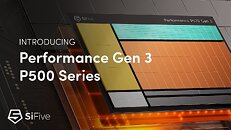
 "The P570 Gen 3 is built to meet the demands for today's most demanding consumer and commercial applications," said Krste Asanovic, SiFive co-Founder and Chief Architect. "With world-class RVA23 capabilities, the new P570 IP will meet next-generation customer requirements for high performance with leading area and power efficiency. This enables tremendous new possibilities coupled with the capability to work most of the major operating systems."
Industry-Leading Performance and Efficiency
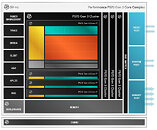
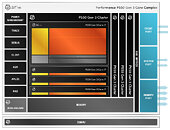
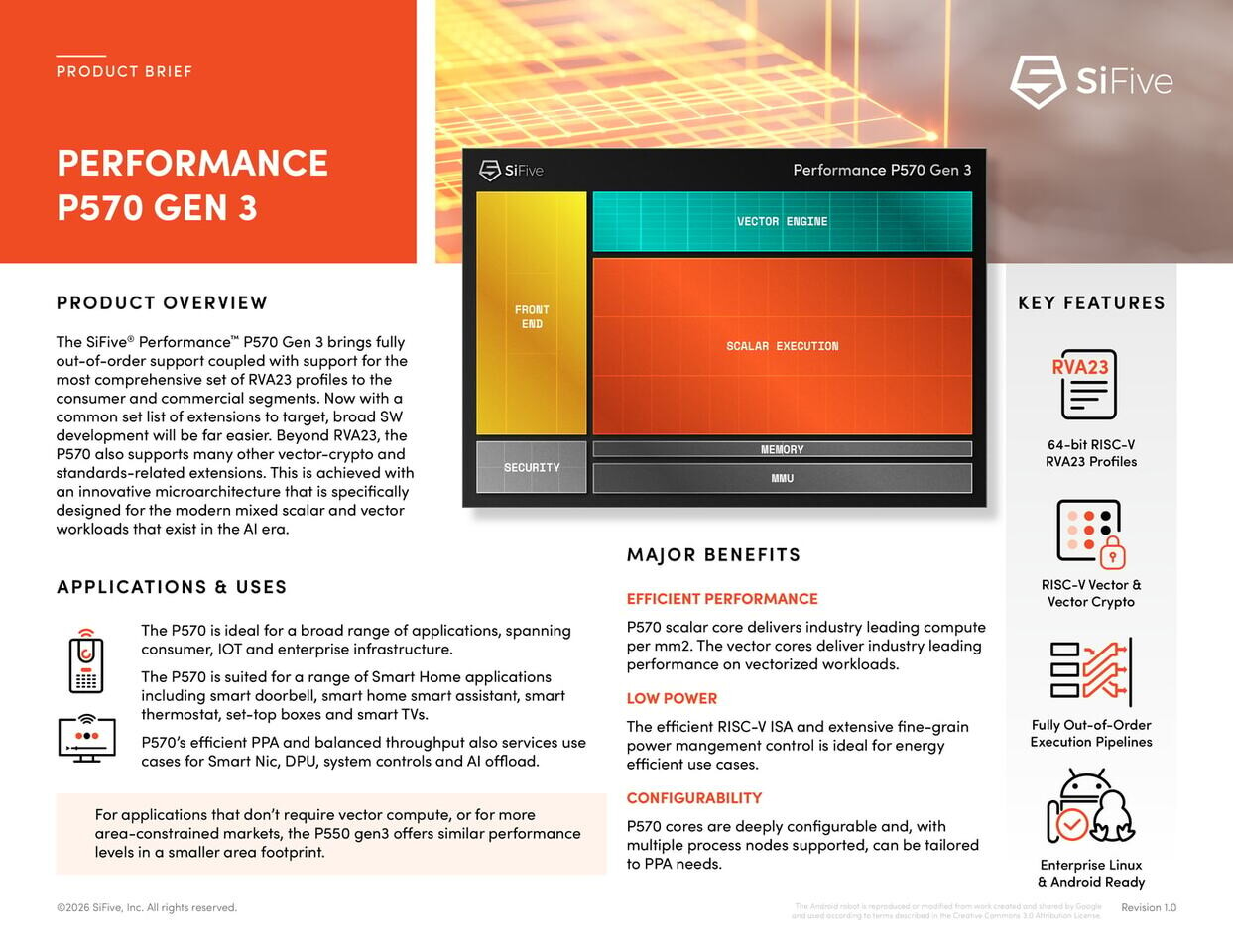
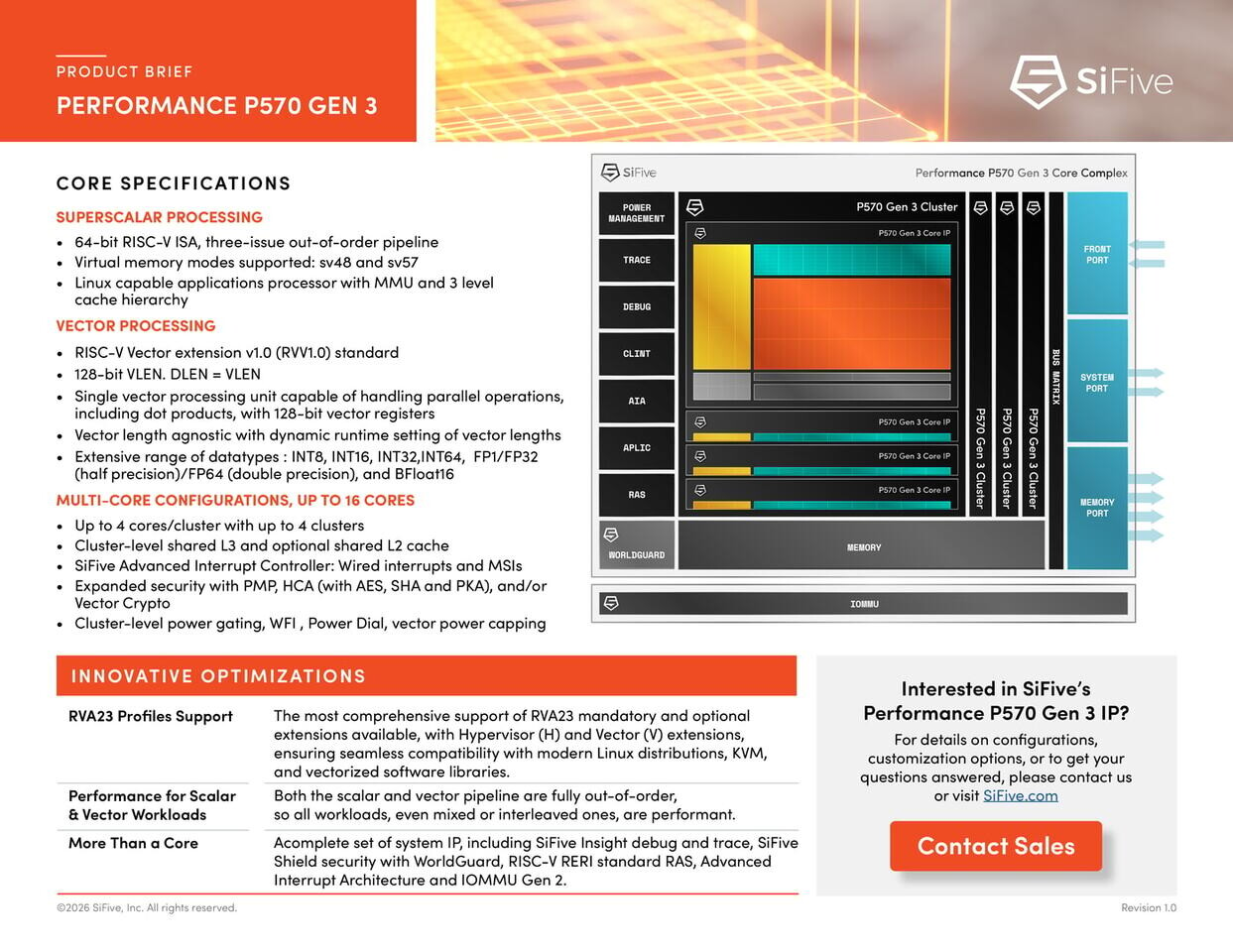
The P570 Gen 3 introduces significant architectural improvements, featuring a 3-wide, 13-stage fully out-of-order superscalar execution pipeline and an upgraded vector engine.
SiFive also provides a complete solution around the P570 core including system IP, such as the RISC-V standard-compliant advanced interrupt architecture (AIA), WorldGuard to support trusted execution environments on secure SoCs, and a second-generation RISC-V standard-compliant IOMMU. P570 Gen 3 is also scalable up to 16 cores in a compute subsystem.
A New Baseline for RISC-V Standardization
The P570 Gen 3 is fully compliant with the RVA23 profile (backed by major ecosystem players, including Google, Red Hat, and Canonical), providing software developers with a stable, consistent set of instructions and ensuring the P570 is ready for mainstream application development. As well as supporting all the RVA23 mandatory requirements, including the Hypervisor (H) and Vector (V) extensions, the P570 includes optional extensions for enhanced security and management, and support for FP16 and BF16 to accelerate modern AI workloads. The additional security features include secure branch prediction and RISC-V standard Vector Crypto (both NIST and SM) and Enhanced Protected Memory (smepmp) extensions.
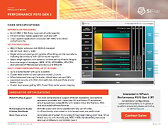
 The P570 is available today, and we are working with customers in several market segments.
The P570 is ideal for use cases requiring high-performance and power efficiency in a small area budget. For customers with very strict area constraints who don't require vectors, the updated P550 Gen 3 provides a highly efficient RVB23-compatible core.
Source:
SiFive
This versatile IP can be used as the control processor in embedded IoT devices, running a full networking stack, or can be used as the main applications processor in consumer devices, running rich OSs, such as Android or enterprise-grade Linux. The high-performance vector unit supports running AI models and inference on edge devices.


Industry-Leading Performance and Efficiency
The P570 Gen 3 introduces significant architectural improvements, featuring a 3-wide, 13-stage fully out-of-order superscalar execution pipeline and an upgraded vector engine.
- Traditional CPU workloads: 7- 13% performance improvement on SpecInt 2006-2017 combined with a 13% reduction in dynamic power vs. P550 Gen 1.
- Modern AI CPU workloads: The 128-bit VLEN vector pipeline delivers a 2X increase in Geekbench and up to 21X more performance in specific AI-relevant workloads vs. Gen 1, and up to 4.5X vs. Gen 2, utilizing specialized dot-product instructions to accelerate convolution and matrix-multiply operations.
SiFive also provides a complete solution around the P570 core including system IP, such as the RISC-V standard-compliant advanced interrupt architecture (AIA), WorldGuard to support trusted execution environments on secure SoCs, and a second-generation RISC-V standard-compliant IOMMU. P570 Gen 3 is also scalable up to 16 cores in a compute subsystem.
A New Baseline for RISC-V Standardization
The P570 Gen 3 is fully compliant with the RVA23 profile (backed by major ecosystem players, including Google, Red Hat, and Canonical), providing software developers with a stable, consistent set of instructions and ensuring the P570 is ready for mainstream application development. As well as supporting all the RVA23 mandatory requirements, including the Hypervisor (H) and Vector (V) extensions, the P570 includes optional extensions for enhanced security and management, and support for FP16 and BF16 to accelerate modern AI workloads. The additional security features include secure branch prediction and RISC-V standard Vector Crypto (both NIST and SM) and Enhanced Protected Memory (smepmp) extensions.
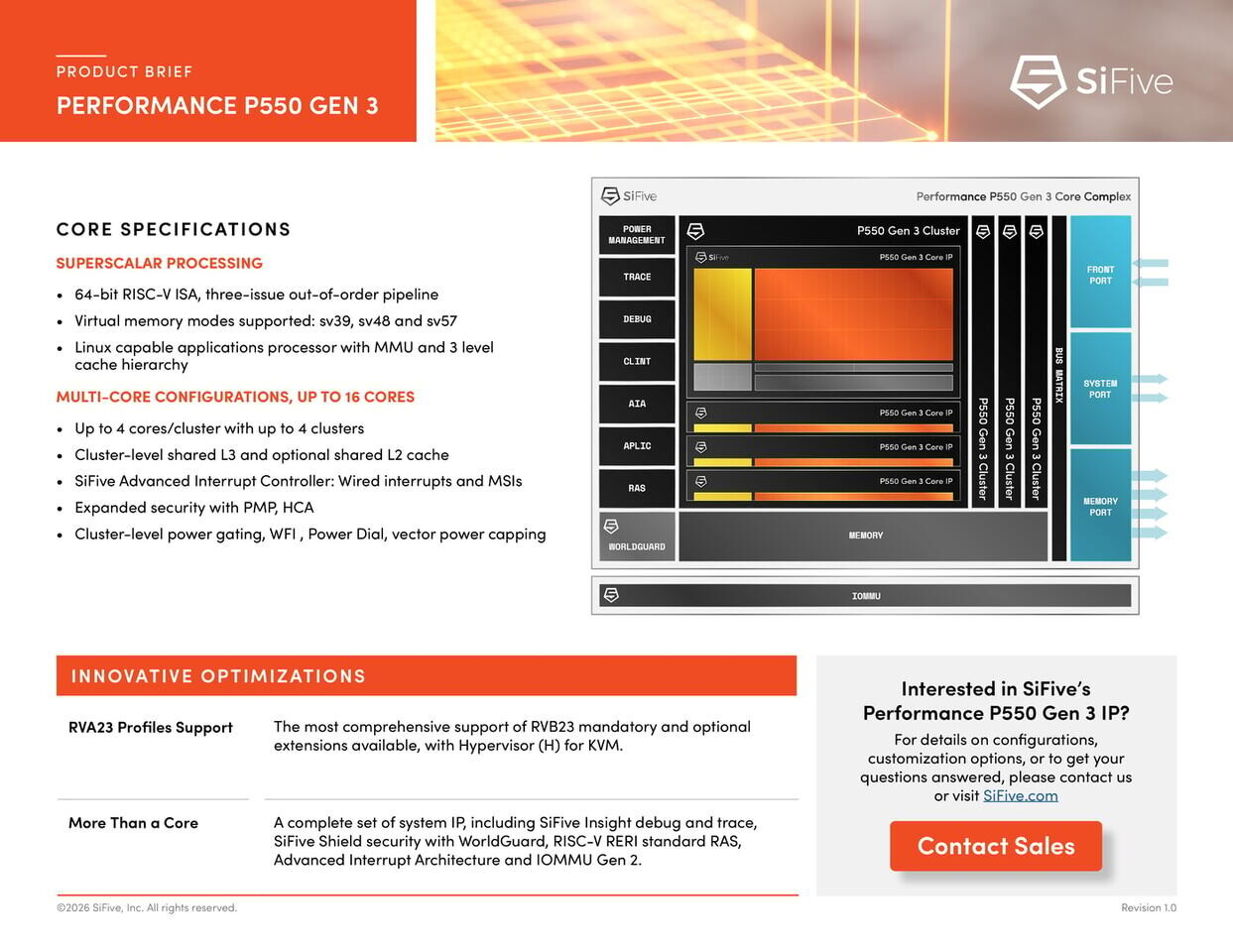
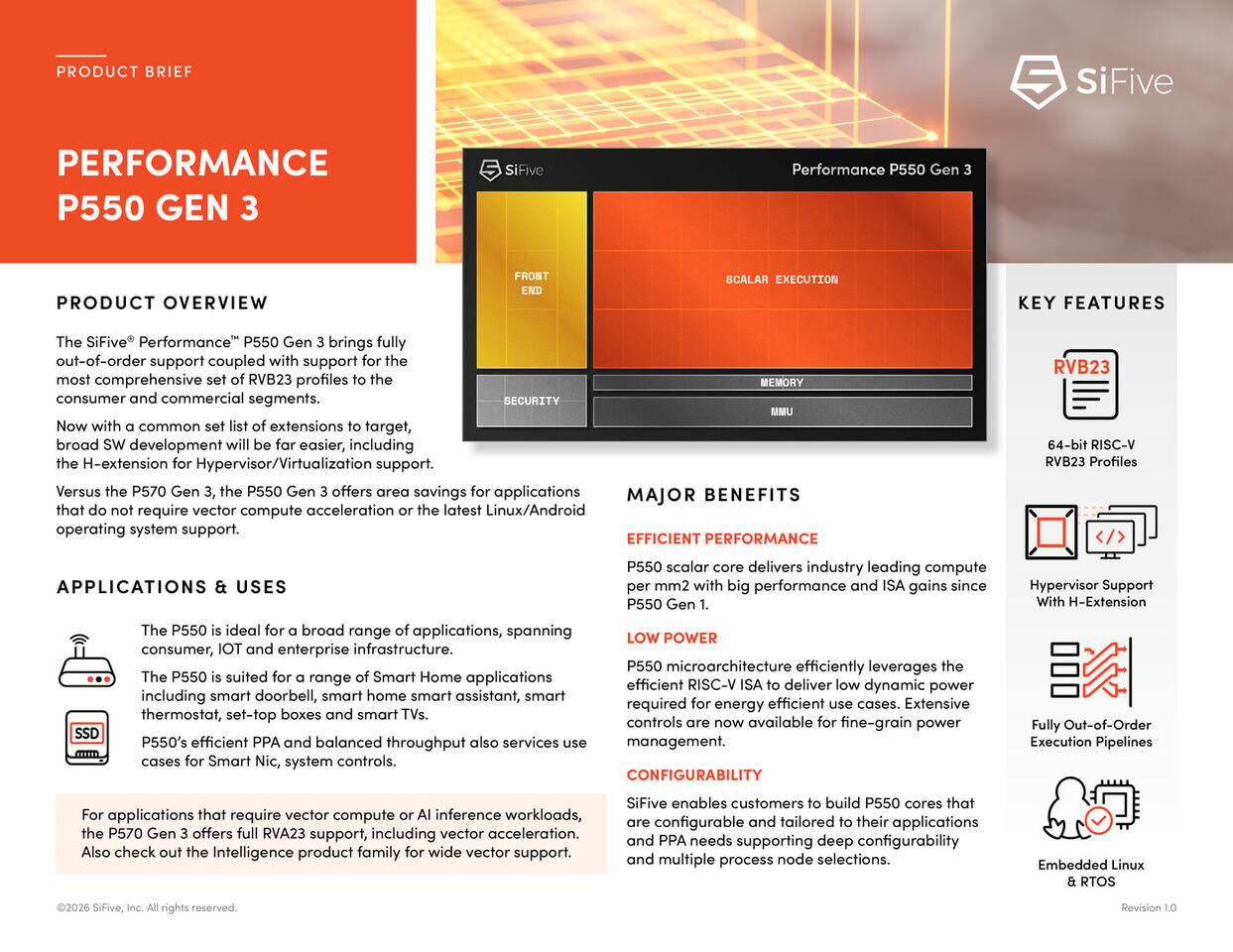
The P570 is ideal for use cases requiring high-performance and power efficiency in a small area budget. For customers with very strict area constraints who don't require vectors, the updated P550 Gen 3 provides a highly efficient RVB23-compatible core.
3 Comments on SiFive Launches RISC-V Performance P550 and P570 Gen 3 IP
Not 'really small core' at all for this class of devices.
Given their announced numbers, it doesn't seem like a really huge uplift from the previous gen, which was close in performance to the A72 cores in the Raspberry Pi 4.
Googling around, I found this C&C post which does the exact comparison to a A75 and says it actually feels closer to an A57:
chipsandcheese.com/p/inside-sifives-p550-microarchitecture
I must have had that in the back of my mind.