Wednesday, July 25th 2018

Rumor: AMD's Zen 2, 7 nm Chips to Feature 10-15% IPC Uplift, Revised 8-core per CCX Design
A post via Chiphell makes some substantial claims on AMD's upcoming Zen 2 microarchitecture, built on the 7 nm process. AMD has definitely won the core-count war once again (albeit with a much more decisive blow to Intel's dominance than with Bulldozer), but the IPC battle has been an uphill one against Intel's slow, but sure, improvement in that area over the years. AMD did say, at the time they introduced the Zen architecture, that they had a solid understanding on Zen's choke points and its improveable bits and pieces - and took it to heart to deliver just that.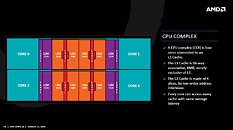 A 10 to 15% improvement should bring AMD close to Intel's Kaby Lake solutions in pure per-core, single-thread performance - with the possibility for higher performance in multithreaded workloads even at the same clocks and core counts, since AMD's SMT implementation and per-core communication seems to best that of even Intel's Coffee Lake chips. Add to that the sure clock increases AMD will bring to their Zen 2 parts - you can bet the power consumption and top frequency benefits for the 7 nm manufacturing process (some estimated 1.6X logic density, ~20% speed improvement, and ~40% power reduction compared to TSMC's 10 nm process) won't go to waste when they can be used for an even greater performance uplift.
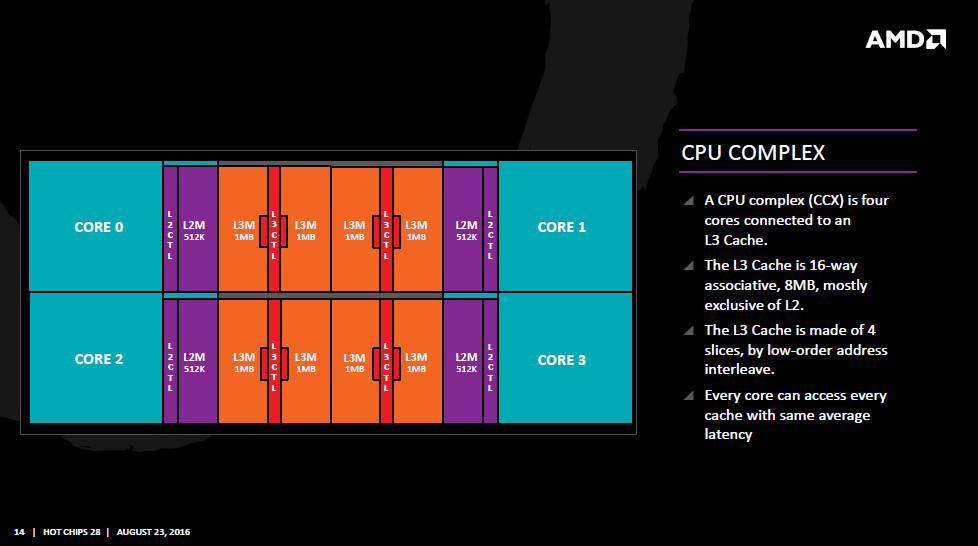
 Add to that the possibility -also posted via the Chiphell thread) of a per-CCX core-count increase of 8 cores per CCX (with 16-core parts being available for the consumer products) and a purely hypothetical claim for the performance crown now seems not only plausible, but likely.
Sources:
Chiphell, TSMC

108 Comments on Rumor: AMD's Zen 2, 7 nm Chips to Feature 10-15% IPC Uplift, Revised 8-core per CCX Design
Ah... and btw.. yield means how many fully functional cpu´s can obtain per waffer, it has nothing to do with power consumption.
They need to leave room for improvements year-over-year. In 2019 they will launch a 10-core i9 on 14nm they could have launched this year, they will keep the 8c/16t i9, and then they will make all i5's 8 and 6 cores with no hyperthreading. i3's will probably become 4/8 exclusively.
Then in 2020 they are desperately hoping they will have 10nm ready, if they don't - they will do drastic price cuts and slight clockspeed increases. But they can't go quite all-in now.With fast RAM AMD has a 15% IPC advantage already. Click on the attachment fanboy - that's a 2600 competing with an 8700K that costs twice as much (While also using half the energy). It's AMD that is holding back right now. Not Intel.
I mean really... Are you blind? AMD is HOLDING BACK THE 2800X! They are saving the 4.5GHz+ 8-core for when Intel is ready to compete (a little) this fall. LOL come on man!
Loving Intel 14nm++ yields with Coffeelake first round.
My 8700K @5.1GHz @1.41v 75c loads Cooled by EK. If you're wondering Cinebench 15 single core is 222 @5.1GHz.
So if AMD Zen 2 has 15% IPC performance gains should see similar Cinebench 15 results I would expect.
And i say it as a current 2600x owner.
I'm starting to think we might see a repeat of Netburst... seems like Intel is pushing high clock speeds to try to stay on top while AMD is catching up despite lower clock speeds. I wonder if AMD might bring back those comparative speed ratings... "Ryzen 8 6000+"Wouldn't have to if they were soldered in the first place. That shouldn't have happened, but it seems Intel has realized they've been shooting themselves in the foot by getting too comfortable while AMD was napping.
Intel way of marketing their products is as bad as AMD's PR and marketing.
I myself running 4133MHz CL17-17-17-37 on Maximus X FORMULA board... Intel Z370 benefits from higher MHz RAM.
Intel is now supporting 4800MHz CL17-17-17-37 using crazy Samsung 10nm B-die.
1 - IPC
2 - base / turbo speeds
3 - inability to have high memory speeds easily (think over 3600 MHz)
4 - low overclocking capabilitiy
The 2000 series brought us an increase in the 1st three categories (i don't count the 4th because the raise in the base / turbo clocks is also the raise of the overclocks.
While the IPC uplift that the rumor claims would be great, due to how Zen architecture works, i'd rather they work on having the ability to use rated RAM speed for high speed RAM, such as the one from the example in the post above from @ToxicTaZ . This alone would greatly increase Zen chips performance across the board. Managing to add like 3% - 5% IPC would be the cherry on top.
I wonder how that would effect AMD IPC if you throw CL40 into the mix?
CL40 is horrible if true.
Hey look in all seriousness I have a 6700K, and I got it for $300 2 years ago. It's fantastic. But I am also not blind!!!
Your CPU at those voltages is using 250w. Full stop. Meanwhile AMD Is about to launch a 32-core that will use the same amount of energy as your peasant 6-core, and their existing 6-core gets the same performance with fast RAM @150w @4.2GHz. Wake up.
My gaming Temps are 55, worst case scenario is 75 on mine. No water cooling needed...
I don't recommend stock boards...
As an experienced o/c guy as long as your load is not more than 75c without long periods of heat. Intel CPUs can handle going to 100c (boiling water) point before shutting down.
My RIG 8700K @5.1GHz 1.41v with Bios v1602
I'm using 1kW Gold PSU with 83A 12v+ Rail that drives my Coffeelake beyond 5GHz+ stability with all 6 cores AVX -2.
My 4133MHz 17-17-17-37 1.4v RAM is stock XMP profile settings on Maximus X FORMULA board Cooled by EK.
If you don't have good hardware and cooling system I wouldn't recommend ocing.
Same goes for AMD Rigs, I wouldn't push your 2700X more than 1.45v and 4.4GHz even with good hardware and cooling.
AMD Zen 2 on 7nm with a higher IPC will gain some heat pushing some benchmarks. 2019 going to be amazing next generation.
10-15% IPC increase will over take intel easily as there is only a 3% difference now, just clock speed is the more major issue but if you can get better IPC then the competition then clock speed doesnt mean as much.