Tuesday, April 16th 2019

MSI Issues Clarification on Next-Gen AMD CPU Support on 300-series Motherboards
It has come to our attention that MSI Customer Support has regrettably misinformed an MSI customer with regards to potential support for next-gen AMD CPUs on the MSI X370 XPOWER GAMING TITANIUM motherboard. Through this statement we want clarify the current situation.
At this point, we are still performing extensive testing on our existing lineup of 300- and 400-series AM4 motherboards to verify potential compatibility for the next-gen AMD Ryzen CPUs. To be clear: Our intention is to offer maximum compatibility for as many MSI products as possible. Towards the launch of the next-gen AMD CPUs, we will release a compatibility list of MSI AM4 motherboards. Below is a full list of upcoming BIOS versions which include compatibility for the next-gen AMD APUs for our 300-Series and 400-Series AM4 motherboards based on the latest AMD Combo PI version 1.0.0.0. These BIOS versions are expected to be released in May this year.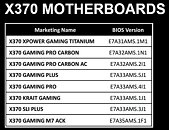
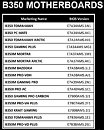
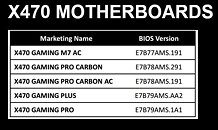
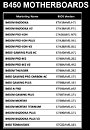
At this point, we are still performing extensive testing on our existing lineup of 300- and 400-series AM4 motherboards to verify potential compatibility for the next-gen AMD Ryzen CPUs. To be clear: Our intention is to offer maximum compatibility for as many MSI products as possible. Towards the launch of the next-gen AMD CPUs, we will release a compatibility list of MSI AM4 motherboards. Below is a full list of upcoming BIOS versions which include compatibility for the next-gen AMD APUs for our 300-Series and 400-Series AM4 motherboards based on the latest AMD Combo PI version 1.0.0.0. These BIOS versions are expected to be released in May this year.


158 Comments on MSI Issues Clarification on Next-Gen AMD CPU Support on 300-series Motherboards
It is obvious that some forum members ill-received the "bad" news but it seems there is light in the end of the tunnel for them. Storm in a tea cup then - let's move on :)
Of course they can't be expected to know everything, but in that case he should have said he didn't know.
Citing one wrong person and blowing it up into a news article is just as bad.
1201 maybe at later date?
Extremetech's Joel Hruska grabbed every pitchfork he could to complain about CTS doing what tech journalists are supposed to do: tell people about flaws in tech products rather than censor that information to benefit various 3rd-parties, such as the corporations selling the faulty products, their investors, insiders, spooks, crooks, corporations looking for more control and wealth than they already have (e.g. Google), et cetera. Yet, Hruska couldn't be bothered to spare a few words about Spoiler. He was far more concerned about the presentation of security flaws than talking about their existence — a hallmark example of what is known as concern trolling. (CT = The tone is more important than the content.) Worse than that was the problem that no one but me has ever seemed to grasp — that what he and the rest of the anti-CTS brigade were doing was advocating censorship of the tech press, the opposite of the watchdog free press that's supposed to fight for the consumer.
Not covering stories is a type of sensationalism because it promotes other stories, giving them more "sensational" importance than they deserve in context, the bigger picture. Extremetech can tell us again and again about Mazda selling diesels in the US — comparatively frivolous low-substance reporting — but, somehow, a CPU vulnerability isn't important nor relevant.
His response, most likely, would be "It's not important", forgetting the "to me" or "to my handlers" bit. I can infer this because the story simply was completely not covered.
Point here is that it's important to think about what isn't being talked about and why, not just what gets written about. Crying wolf is bad form (particularly when it's not an executive who is making a major claim) but I am often more concerned about what doesn't get covered at all.