Tuesday, September 24th 2019

AMD Could Release Next Generation EPYC CPUs with Four-Way SMT
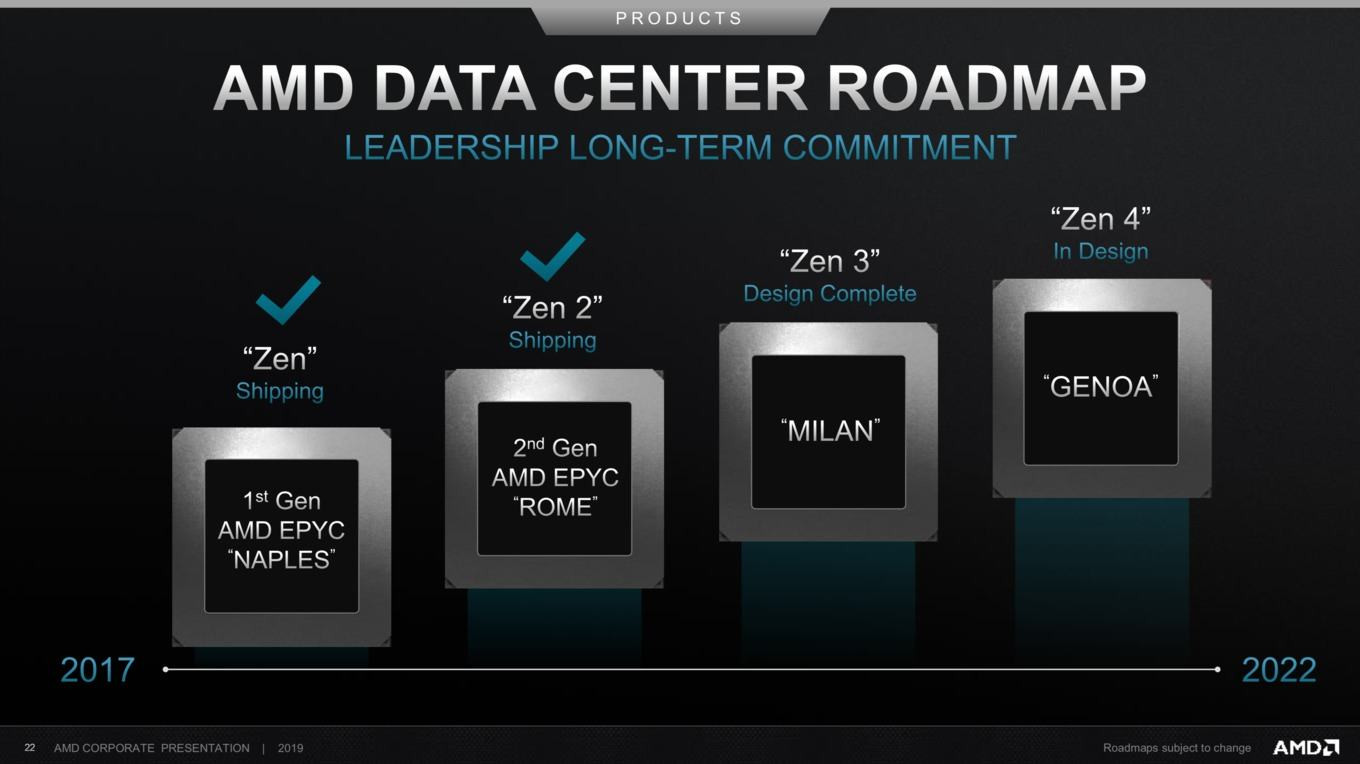
AMD has completed design phase of its "Zen 3" architecture and rumors are already appearing about its details. This time, Hardwareluxx has reported that AMD could bake a four-way simultaneous multithreading technology in its Zen 3 core to enable more performance and boost parallel processing power of its data center CPUs. Expected to arrive sometime in 2020, Zen 3 server CPUs, codenamed "MILAN", are expected to bring many architectural improvements and make use of TSMC's 7nm+ Extreme Ultra Violet lithography that brings as much as 20% increase in transistor density.
Perhaps the biggest change we could see is the addition of four-way SMT that should allow a CPU to have four virtual threads per core that will improve parallel processing power and enable data center users to run more virtual machines than ever before. Four-way SMT will theoretically boost performance by dividing micro-ops into four smaller groups so that each thread could execute part of the operation, thus making the execution time much shorter. This being only one application of four-way SMT, we can expect AMD to leverage this feature in a way that is most practical and brings the best performance possible. AMD isn't the first to implement this kind of solution to its processors. IBM has been making CPUs based on POWER ISA for years now that feature four or even eight-way SMT and they are one of the key reasons why POWER CPUs are so powerful. Nonetheless, we can hope to see more details about Zen 3 core design decisions as we approach 2020 and launch of Milan CPUs.
Source:
Hardwareluxx
Perhaps the biggest change we could see is the addition of four-way SMT that should allow a CPU to have four virtual threads per core that will improve parallel processing power and enable data center users to run more virtual machines than ever before. Four-way SMT will theoretically boost performance by dividing micro-ops into four smaller groups so that each thread could execute part of the operation, thus making the execution time much shorter. This being only one application of four-way SMT, we can expect AMD to leverage this feature in a way that is most practical and brings the best performance possible.
159 Comments on AMD Could Release Next Generation EPYC CPUs with Four-Way SMT
THEY BOTH PROCESSORS!!!
lmao this thread rocks.
Any discussion about Phi being a success or not are pointless. SMT worked very well.
Also, given that Intel built their whole current Xeon lineup out of the Xeon Phi idea, I wouldn't really call it "a failure".Please, don't go down that road.
@theoneandonlymrk can't use proper English and he gets very aroused when asked to work on this.
epyc is not for gaming was my point,and I can't really respond to whatever point he made.
And to not have heard about Xeon Phi is quite an achievement for a "PC enthusiast"
It seems you're really new in this...
I'm not sure who's arguing semantics here, it is a processor as much as any GPU/FPGA/ASIC that can run an OS.Needs citation, unless you're saying the idea was AVX 512 :confused:
The chip that powered Xeon Phi accelerators was a x86 compliant processor. If you put it in a LGA3647 motherboard, it would have worked as a CPU.
I must confess.... I know very little about anyting Intel has produced. I have overclocked a few, but has always been out of my price range. Especially server and workstation processors.
Would love to see 4 way SMT on AMD desktop processors though. At affordable pricing I must add....
And your points wrong, epyc is for the server yes but some of that resource is used to game on and for the next-gen console cloud platform for ps5 and xbox next , as well as their world-beating supercomputer will use an evolved epyc , or perhaps your links have told you different?.
Epyc and the Zen architecture are multi-purpose processors, designed to achieve many goals, not just one, and 2.5D packaging makes epyc or its next hybrid custom weird iteration nothing more than a validation away.
Thats why intel should be scared.
at this moment they would struggle to counter some things that AMD can do but have not yet done, epyc is a wonderful example of something intel cannot do.
Additionally that is advanced with the µOp mechanisms used widely since some years now, excessively since Sandy-Bridge with µOp-Caching.
What 4-way SMT is, is what IBM uses in their Power-Cores since some years now, it is like 1 Core executing 4 Threads, like a doubled Hyperthreading.
I think what IBM does in their ecosystem is not as efficient in the x86-ecosystem, additionally the actual SMT used with Zen2 is very efficient and most of the time better than what Intel offers.
They will advance both intel and AMD with the decoder and OoO-window and µOp-Caching and so on, like Intel recently teasered for IceLake.
What performance level does it operate at that matters to the 99%?
If it's not easy, affordable, and powerful to use for the above average computer user it's not worth anything more than a side note*. Enter Itanium, Phi, and other vaporware.
Epic not for home pc use. No your grandmas dell wont have 256 threads any time soon.... Maybe....