Tuesday, September 24th 2019

AMD Could Release Next Generation EPYC CPUs with Four-Way SMT
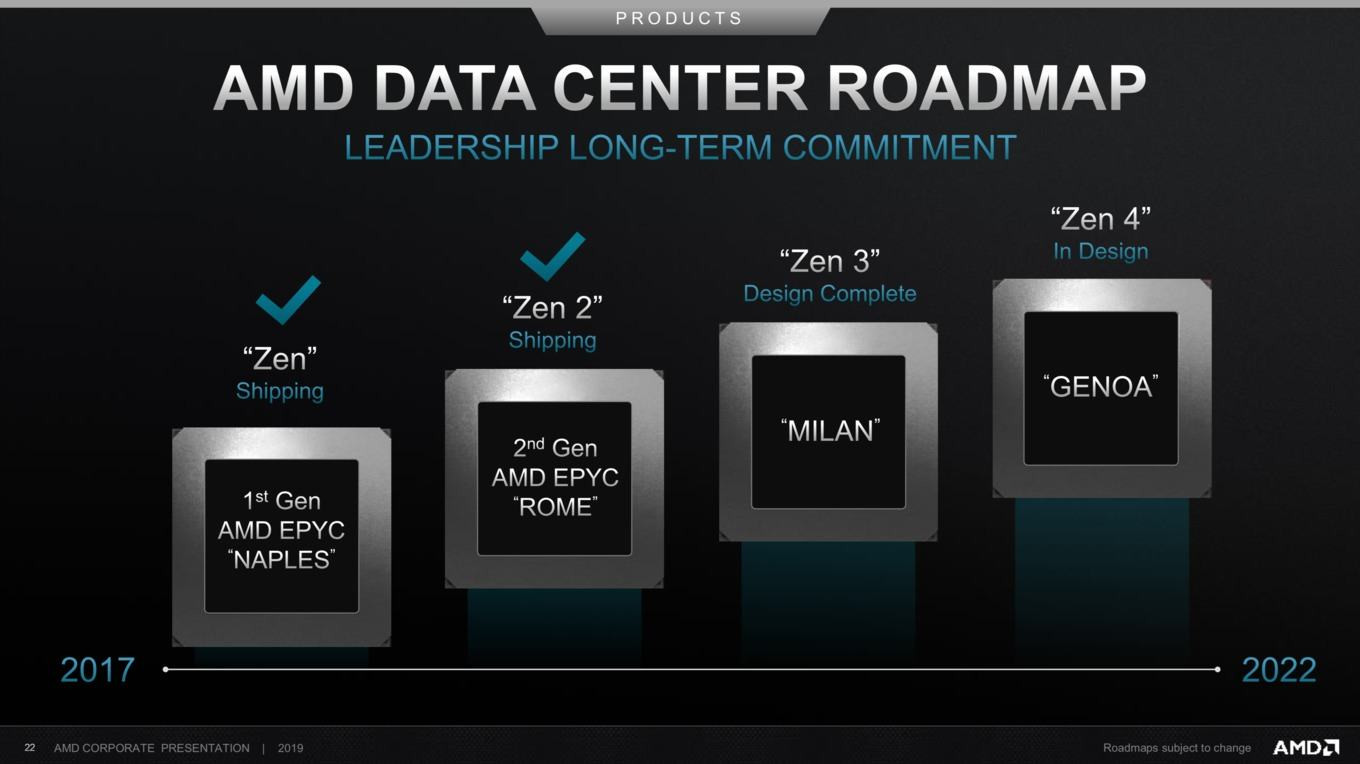
AMD has completed design phase of its "Zen 3" architecture and rumors are already appearing about its details. This time, Hardwareluxx has reported that AMD could bake a four-way simultaneous multithreading technology in its Zen 3 core to enable more performance and boost parallel processing power of its data center CPUs. Expected to arrive sometime in 2020, Zen 3 server CPUs, codenamed "MILAN", are expected to bring many architectural improvements and make use of TSMC's 7nm+ Extreme Ultra Violet lithography that brings as much as 20% increase in transistor density.
Perhaps the biggest change we could see is the addition of four-way SMT that should allow a CPU to have four virtual threads per core that will improve parallel processing power and enable data center users to run more virtual machines than ever before. Four-way SMT will theoretically boost performance by dividing micro-ops into four smaller groups so that each thread could execute part of the operation, thus making the execution time much shorter. This being only one application of four-way SMT, we can expect AMD to leverage this feature in a way that is most practical and brings the best performance possible.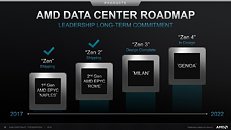 AMD isn't the first to implement this kind of solution to its processors. IBM has been making CPUs based on POWER ISA for years now that feature four or even eight-way SMT and they are one of the key reasons why POWER CPUs are so powerful. Nonetheless, we can hope to see more details about Zen 3 core design decisions as we approach 2020 and launch of Milan CPUs.
Source:
Hardwareluxx
Perhaps the biggest change we could see is the addition of four-way SMT that should allow a CPU to have four virtual threads per core that will improve parallel processing power and enable data center users to run more virtual machines than ever before. Four-way SMT will theoretically boost performance by dividing micro-ops into four smaller groups so that each thread could execute part of the operation, thus making the execution time much shorter. This being only one application of four-way SMT, we can expect AMD to leverage this feature in a way that is most practical and brings the best performance possible.
159 Comments on AMD Could Release Next Generation EPYC CPUs with Four-Way SMT
It's easy to blame the devs when the only thing you do is install a .exe.
Even an UHD620 doesn't get stuck on draw calls, unlike a Navi.
community.amd.com/thread/206176
Check it yourself, even PCSX2 is tired of AMDs bullshit.
AMD has a nice front for Windows Direct3D gamers, the rest of it's software is rotting.
While I can attest to AMD's OpenGL support as being garbage after using it for development for years, their Linux support is actually worse than their Windows support. But this deserves a thread of its own, as I don't see how this relates to Epyc CPUs with 4-way SMT.