Thursday, October 3rd 2019

Intel 10th Gen Core X "Cascade Lake-X" Pricing and Specs Detailed
Ahead of their October 7th product launch and November availability, we have confirmation of the specifications and pricing of Intel's 10th generation Core X "Cascade Lake-X" HEDT processors in the LGA2066 package. These chips feature compatibility with existing socket LGA2066 motherboards with a UEFI BIOS update, although several motherboard manufacturers are launching new products with some of the latest connectivity options, such as 2.5 GbE wired Ethernet, and 802.11ax Wi-Fi 6 WLAN.
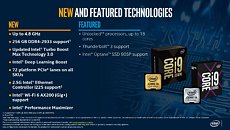
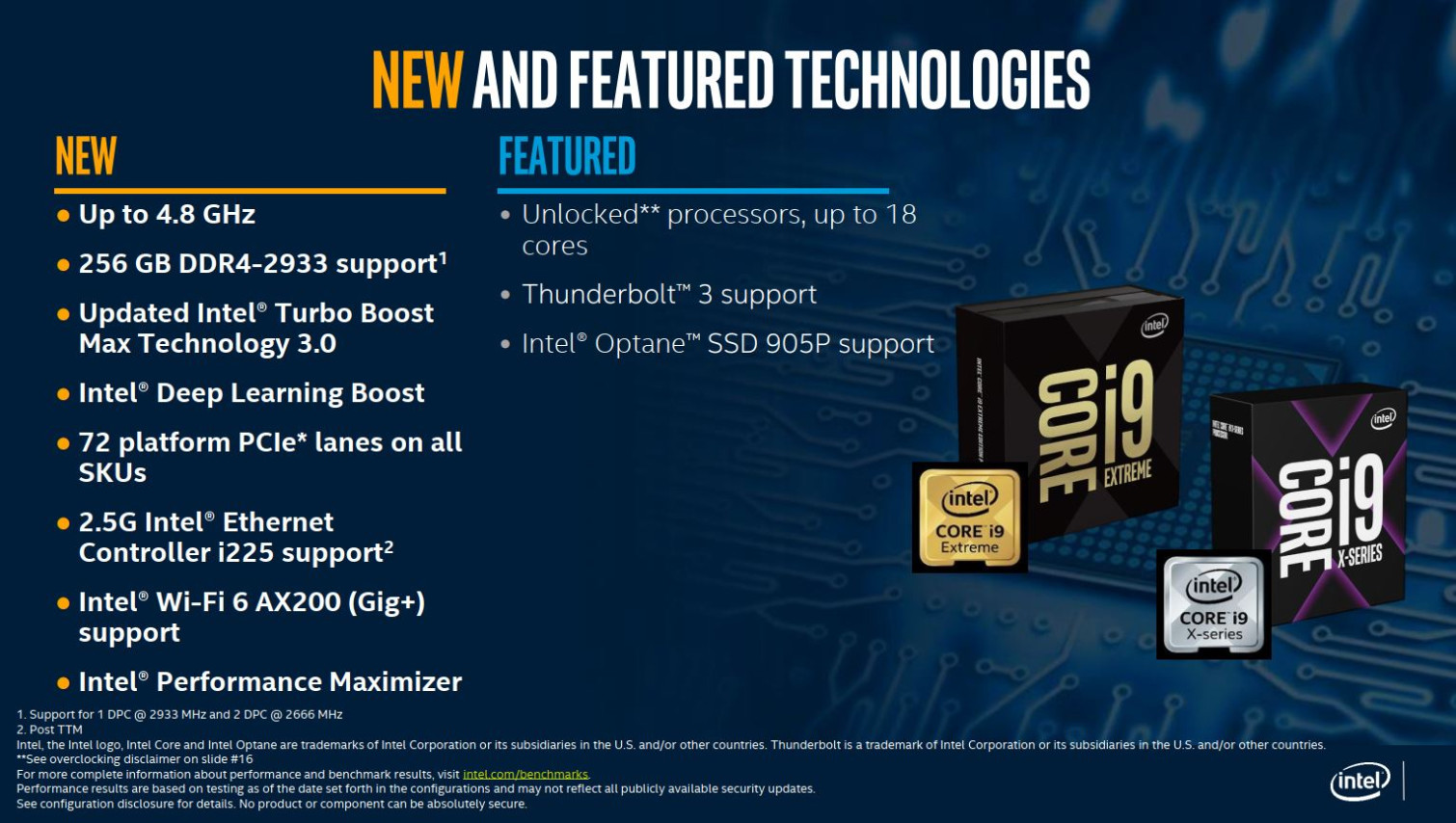
The 10th generation Core X HEDT processor family is based on the new 14 nm++ "Cascade Lake" silicon, which comes with hardware fixes against several classes side-channel vulnerabilities, and introduces an updated instruction-set that includes more AVX-512 instructions, and the new DLBoost instruction. DLBoost leverages new fixed-function hardware on silicon to accelerate AI deep-learning neural-set building and training by up to 5 times. Intel's first wave of 10th gen Core X lineup is rather slim, with just four processor models. The company did away with the Core i7 brand extension, as core-counts in the mainstream desktop segment have already reached 8-core. The lineup now begins at 10-core/20-thread, with the chip's full 48-lane PCI-Express and 4-channel DDR4 interfaces enabled across the board. All models feature the "XE" brand extension, and feature unlocked base-clock multipliers.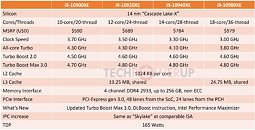
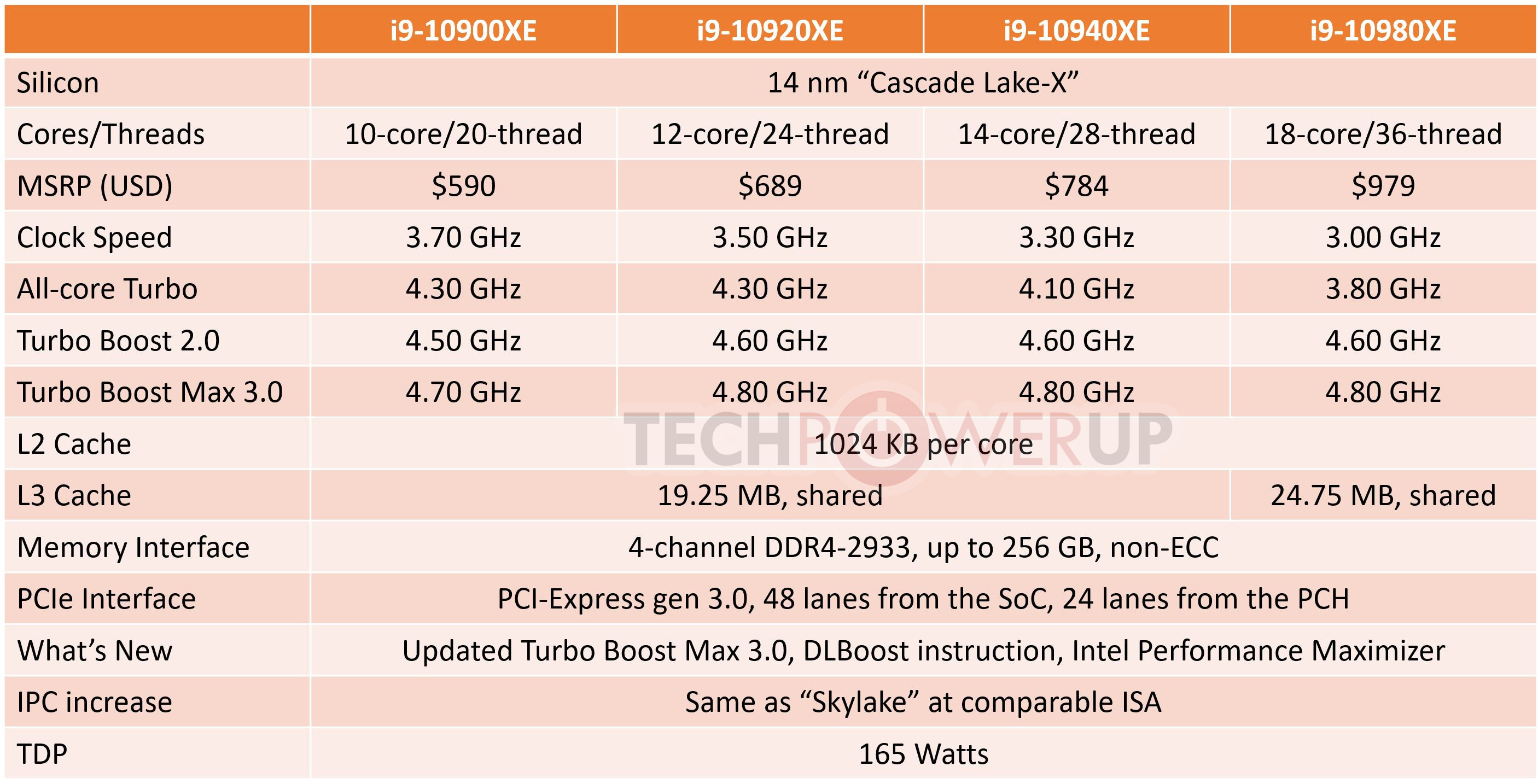
 The Core i9-10900XE is your gateway to the series. This 10-core/20-thread chip comes with a fascinating price-tag of just USD $590, a significant drop from the $999 price for the previous-generation 10-core chip, the i9-9900X. It's clocked higher, with 3.70 GHz nominal, 4.50 GHz Turbo Boost 2.0, 4.70 GHz Turbo Boost Max 3.0 and 4.30 GHz all-core Turbo. The chip is endowed with 1 MB of dedicated L2 cache per core, and 19.25 MB of shared L3 cache.
The Core i9-10920XE is a $689 12-core/24-thread chip priced under AMD's upcoming flagship AM4 model, the Ryzen 9 3950X. It's marginally faster than its predecessor, the i9-9920X, with 3.50 GHz base clocks (same), 4.60 GHz Turbo Boost 2.0, 4.80 GHz Turbo Boost Max 3.0, and 4.30 GHz all-core turbo. Interestingly, the increase in core-count doesn't bring additional L3 cache, you get the same 19.25 MB.
The next step in this series is the $784 Core i9-10940XE, a 14-core/28-thread processor clocked at 3.30 GHz, with 4.60 GHz Turbo Boost 2.0, 4.80 GHz Turbo Boost Max 3.0, and 4.10 GHz all-core turbo. Yet again, you get just 19.25 MB of shared L3 cache. Interestingly, Intel did not plan a 16-core/32-thread model in this series, you jump straight to the flagship.
Leading the pack is the Core i9-10980XE, an 18-core/36-thread processor priced at a mouth-watering $979, which is less than half that of the previous-generation Core i9-9980XE. It ticks at 3.00 GHz, with 4.60 GHz Turbo Boost 2.0, 4.80 GHz Turbo Boost Max 3.0, and 3.80 GHz all-core turbo. You get a larger 24.75 MB of shared L3 cache. All four chips have their TDP rated at 165 W.
The 10th generation Core X HEDT processor family is based on the new 14 nm++ "Cascade Lake" silicon, which comes with hardware fixes against several classes side-channel vulnerabilities, and introduces an updated instruction-set that includes more AVX-512 instructions, and the new DLBoost instruction. DLBoost leverages new fixed-function hardware on silicon to accelerate AI deep-learning neural-set building and training by up to 5 times. Intel's first wave of 10th gen Core X lineup is rather slim, with just four processor models. The company did away with the Core i7 brand extension, as core-counts in the mainstream desktop segment have already reached 8-core. The lineup now begins at 10-core/20-thread, with the chip's full 48-lane PCI-Express and 4-channel DDR4 interfaces enabled across the board. All models feature the "XE" brand extension, and feature unlocked base-clock multipliers.
The Core i9-10920XE is a $689 12-core/24-thread chip priced under AMD's upcoming flagship AM4 model, the Ryzen 9 3950X. It's marginally faster than its predecessor, the i9-9920X, with 3.50 GHz base clocks (same), 4.60 GHz Turbo Boost 2.0, 4.80 GHz Turbo Boost Max 3.0, and 4.30 GHz all-core turbo. Interestingly, the increase in core-count doesn't bring additional L3 cache, you get the same 19.25 MB.
The next step in this series is the $784 Core i9-10940XE, a 14-core/28-thread processor clocked at 3.30 GHz, with 4.60 GHz Turbo Boost 2.0, 4.80 GHz Turbo Boost Max 3.0, and 4.10 GHz all-core turbo. Yet again, you get just 19.25 MB of shared L3 cache. Interestingly, Intel did not plan a 16-core/32-thread model in this series, you jump straight to the flagship.
Leading the pack is the Core i9-10980XE, an 18-core/36-thread processor priced at a mouth-watering $979, which is less than half that of the previous-generation Core i9-9980XE. It ticks at 3.00 GHz, with 4.60 GHz Turbo Boost 2.0, 4.80 GHz Turbo Boost Max 3.0, and 3.80 GHz all-core turbo. You get a larger 24.75 MB of shared L3 cache. All four chips have their TDP rated at 165 W.
124 Comments on Intel 10th Gen Core X "Cascade Lake-X" Pricing and Specs Detailed
Another trick to "increase" their stalemate IPC, is with the help Microsoft for favored cores update , combine these with new algorithm longer boost Turbo Boost Max 3.0 plus higher T Junction, voila, you will have solid 5% increase over previous generation :p
Do you understand that once this 64 core CPU lands in a server (be it on-premise or cloud), it'll be "cut" into pieces - e.g. 8 cores each? :)
You should not underestimate single-core performance in servers (maybe even more so than in PCs).
As for the ability to pack more cores in a socket and dominate scenarios where all of them can be used (e.g. on-premise rendering machines) - AMD's current domination is indisputable. But it's mostly down to node and that's a fragile lead.Intel is enabling ECC in all CPUs that are meant for any kind of servers or production devices - hence it's available in some CPUs in Pentium and Atom families.
Consumers don't care what ECC is, so this functionality is not available in consumer platforms. They don't, really.
AMD fans are stressing this being a huge advantage of Ryzen lineup, but most of them don't know what ECC gives, let alone how it works.
Yes, maybe this move from AMD will force Intel to enable ECC in all CPUs. But that's very unlikely. Intel has separate processors for production systems. They support ECC and other things that are omitted in consumer stuff.But what do you mean by "screwed"? Is it the same "no one will buy Intel anymore" we've heard in 2017?
For HEDT, I really dislike Intel's decision of having three different product lineups. I hope the competition from AMD will encourage Intel to enable ECC on all of their HEDT CPUs, as these are premium workstation hardware anyway.How anyone can believe Intel is screwed is beyond me.
Stop trolling, go play with someone your own age.
While it's just one retailer it paints a grim outlook for Intel's current generation. The problem for Intel is that for the desktop segment they don't have much planned. Only Rocket and Comet Lakes that are still on 14nm and still seem to be Skylake-derived. Ice Lake 10nm desktop parts have been cancelled and that uArch is instead only coming to servers and laptops.
On the other hand AMD is openly talking about Zen 3.
The only part that looks uncertain (or even bad) is the mainstream desktop. Comet Lake-S arriving very late 2019 or early 2020 is only going to be a minor upgrade. There are rumors of a "Rocket Lake-S" later using a Ice Lake chipset, but that remains unconfirmed. But just the fact that Intel is nearly completely silent about this compared to other segments kind of tells us that they are weighing their options.
The things you palm off as positive are actually really bad. All those products, even if they do make 2020 in volume, will have to contend with Zen on 7nm+ which is landing the same time. Unlike Intel's 10nm, which is gonna have major yield issues (still), bugs and flaws as it comes out the gate for the first time in volume, all AMD have to do is iterate and improve upon a proven process and architecture from Zen2.
The rest... irrelevant. Intel is not in a great position right now, and they need something new and it certainly has to go beyond good IGP and further optimization. Realistically, that is what we have. The recent hiring of Jim Keller is no coincidence - it underlines that they're still searching or that they need more input. But there is another problem much bigger than Intel. Physics. The big node shrinks are pretty much over, and it all comes down to architectural changes. Most of those will be tradeoffs - we already saw this with the 3 generations of Zen. Its going to get increasingly difficult to one-up the competition without doing something radical. AMD needed about a decade for that.
Wrt your comments about turbo... you're confusing it with overclocking there. Its not the same thing. Intel's turbo out of the box isn't that fantastic and it certainly is not dynamic the way XFR is today. I'm not talking about how to extract optimal clocks at the expense of power draw, because that's what you're saying here. Those all core turbo Intels you speak of royally exceed the stated TDP. And the kicker is, for the largest markets, consumer and enterprise, overclocking is not an option, but a dynamic boost/turbo certainly is. And about clocks... we've already seen Intel's latest don't quite clock as high on smaller nodes.
Note I'm not a big AMD fan, but as much as I can whine about how their GPU division stacks failure upon failure, its impossible to deny AMD's contribution to CPU design, and its clear they haven't been rewarded fairly for all those efforts. Hopefully they are, now, because its a valuable company for all of us.
Frothing no. These are interesting times :)Screwed is a big word, but losing leadership is definitely one of the possibilities IF they cannot adjust radically, and fast. But still, time is on their side and AMD has to keep pushing competitive stuff to market year after year to make a dent. So far so good, but this is a long term game.Given the rate of progress though, we have to wonder how long Zen can keep giving. The low hanging fruit will soon be gone, that is for sure. This will rapidly look very similar to the progress of Core.Yup, even for just gaming.
Performance-wise i3s are above the Pentium family, so it made sense to give them ECC.
i5 and i7 have Xeon counterparts.
Intel usually makes enterprise CPUs because there is some demand from major partners - not because they *hope* they'll sell. You should not worry about their CPUs making sense or not. The certainly do for Intel's partners. :-)I can 100% agree that Intel platforms are less tweaking-friendly. These CPUs work best for people who know what they want and prefer to use a computer - not play with it.
You have a particular need, you buy an Intel CPU that fits best, you leave it at default and don't care much. That's the idea.
If you like to tweak, OC, tune, test drivers and so on - AMD will give you more pleasure.
I'm not sure if the word "limiting" should be used, though. What is "limiting"?
Lets say I'm running a tiny architectural consultancy firm and I'm not a computer geek, but I need 14-18 cores for my work.
Which platform is more "limiting"? Intel - because I can't OC ("what is OC?"). Or AMD because I'll spend more time solving quirks? ("what is BIOS?")
We could safely say that Apple Mac is the most "limited" platform of them all. And yet, that's what makes it so popular among normal users and so hated on forums like this one. :-)I don't care much about overclocking anymore and can't really give you any sensible answer to this.
I though we're talking about workstations, enterprise clients and ECC. :-)On pure specification? I can't name a single thing. Desktop LGA1151 CPUs are pretty much identical (other than ECC and name).Seriously... Mindfactory again...? :/Well... this is the part that's so difficult to explain on this forum, isn't it? That the segment AMD takes care of the most (high-end DIY desktops) is the least important for Intel.
AMD - thanks to tiny market share - is able to focus on AM4 platform. It gives them great press.
But as their market share grows, they'll have to think about their mobile lineup as well. And enterprise sector in general.
What they're doing today is just totally opposite of what Intel is (and has to be) doing.
"PRO" Ryzen variants come out few months after the consumer models. Mobile architecture is a year behind gaming desktops.
Their chip engineering team is pushing very modern tech, but their planning and strategy looks like its 2005 again.
IMO Intel's actions show they may be thinking about sacrificing this segment for the time being.
It costs them a lot of work and money. The whole idea was to sell expensive 4-core chips and make a decent profit from the small revenue. They can't compete on the margins that AMD is willing to accept.
The already small demand for gaming desktops will soon be hit by cloud gaming and next-gen consoles...
The 18c is still worse than the 16c ryzen unless you need more pcie 3.0 lanes.
Probably better for a DAW workload, eager to see benchmarks.
Still overpriced but a touch closer to reality.
Keep in mind, Intel is holding back announcing the cascade lake Xeon-W's on 3647 socket for Threadripper 3000.
Xeon-w on 3647 should be up to 28c again, with more pcie lanes unlocked due to reallocating omnipath lanes.
Threadripper is supposed to debut at 24cores and will top out potentially all the way at 64 cores and rumored to have 2 variants 4 channel and 8 channel ram.
It's nice to see price cuts vs previous gens, shows you that competition is finally happening, consumers can only win in this.
As for only AMD fans being trolls..... please look at any AMD article to find your Intel shills, lets keep it civil lads, competition is goooooood, don't emotionally attach yourself to a company they don't care about you.
The problem with Intel's mainstream selection is that it's held back by OEM deals. The majority of volume on socket 1151 is low-margin CPUs for OEMs, while the media attention is on the "enthusiast" models of the segment(i7-9700K, i9-9900K), which are comparatively "low volume" but high margin products. Traditionally, Intel have sold these by making them different bins of the same dies, but since the OEM deals require such high volume, it requires them a certain production capacity before they can release a new lineup. As a side-note, this is why Broadwell-S had to be cancelled, because 14nm wasn't ready for that high volume and clock speed. I think Intel's "stupid" policies need to change here; make the chipsets support different microarchitectures if needed (it is possible after all), and release the top two-three SKUs on the latest most fancy production node and microarchitecture.
And for the record, it was known that Intel was working on a mainstream 6-core around the time Skylake launched, still long before the public knew details about Zen, but 14nm was still a challenge then.
As for the HEDT/workstation segment, it has luckily starting to improve, while it took some time, but I'm very happy to see both Intel and AMD focusing on this segment now. Since the Sandy Bridge days, the HEDT selection have gradually improved until Broadwell-E reaching 10 cores at a very steep price. But as evident with the Skylake-X engineering samples from late 2016 featuring up to 18 cores, they had bigger plans. It was after this AMD decided to re-purpose Epyc and make Threadripper to compete, and I'm glad they did, since we are now finally starting to see this competition working.
As we know, HEDT is a fairly low volume segment, but it is still very important;
- Content creators, developers, researchers needs more performance or specific features the mainstream don't offer.
- It serves as a premium platform where expensive features can be showcased and made available to those who want it, before it usually trickles down to the mainstream later on, so it accelerates progress in technology.
- Increased flexibility and upgradability.
- Software. As we all know, hardware is useless without software, and better hardware fuels development of better software, which increases the demand for better hardware, etc. etc. This is something most people forget.
- And for Intel/AMD; HEDT is a very high margin segment, which helps to offset/finance development costs.You should wait for benchmarks of actual workloads, not synthetics like Geekbench etc. which has leaked this far.
The problem for high core count Cascade Lake will be heat. As long as they can stay within similar clocks, they will remain competitive.Nope, they were released several months ago, but those prices, yuck. :(
Mobile!! If you told me 5 years ago that mobile CPU performance and sales would be the main argument for Intel fans defending the company I wouldnt believe you! That's how ridiculous that is. With these HEDT CPUs we're talking about high-end desktop, let's not pretend Intel weren't derided for years trying to improve efficiency and PPW over pure performance and more cores, because they were. Maybe some here only started following CPUs when Ryzen came out and hence weren't around for this.
Now that AMD, not Intel, has brought more cores and wins in pure performance, the people that were lambasting Intel for their mobile focus have changed tact and say it's this mobile performance (and servers!) which show the company is superior or in a great position. You couldn't make it up.
When it comes to Intel's market share and leadership then yes, the money is, was and has been in server and mobile for quite some time now. The desktop PC market is dwindling year after year and this has never been a secret. So in the context of 'Intel is screwed'... this definitely applies and it did apply the last ten years. Those ten years, AMD couldn't make a dent in either of those markets OR the desktop.
Today, AMD makes a comeback on desktop and will make a killing on server sooner rather than later. Mobile however... they still don't have anything ground breaking and Intel is very competitive. But mobile is not the cutting edge. The cutting edge STILL is desktop and HEDT, because that is where the trickle down for mobile begins. For consumer, desktop is the point of reference, free of thermal and power constraints.
Even today Intel still has a separate design for HEDT and for MSDT, and while this makes them less flexible and efficient wrt yields, they do have a much better optimized mobile portfolio. AMD has work to do here (which they are doing).
Bottom line, judging the facts and numbers is not choosing a camp, its just trying to get a good picture of the market. There's nothing to win here by choosing sides, you only lose because you'll be oblivious to what really happens.
Regardless of how nice Zen is, the numbers don't lie and Intel has the market on lockdown, still, in every volume segment there is.