Wednesday, September 2nd 2020

NVIDIA RTX IO Detailed: GPU-assisted Storage Stack Here to Stay Until CPU Core-counts Rise
NVIDIA at its GeForce "Ampere" launch event announced the RTX IO technology. Storage is the weakest link in a modern computer, from a performance standpoint, and SSDs have had a transformational impact. With modern SSDs leveraging PCIe, consumer storage speeds are now bound to grow with each new PCIe generation doubling per-lane IO bandwidth. PCI-Express Gen 4 enables 64 Gbps bandwidth per direction on M.2 NVMe SSDs, AMD has already implemented it across its Ryzen desktop platform, Intel has it on its latest mobile platforms, and is expected to bring it to its desktop platform with "Rocket Lake." While more storage bandwidth is always welcome, the storage processing stack (the task of processing ones and zeroes to the physical layer), is still handled by the CPU. With rise in storage bandwidth, the IO load on the CPU rises proportionally, to a point where it can begin to impact performance. Microsoft sought to address this emerging challenge with the DirectStorage API, but NVIDIA wants to build on this.
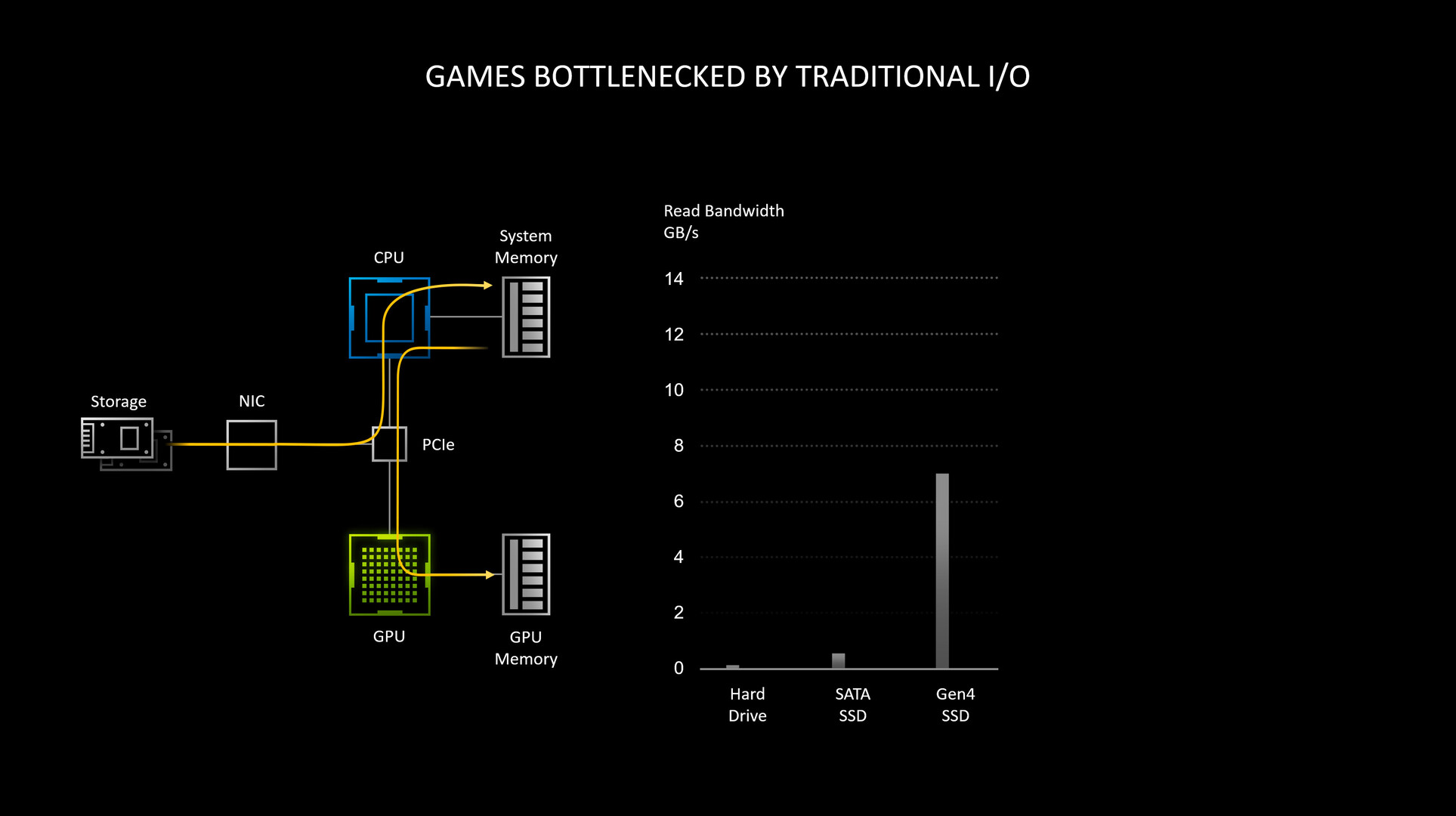
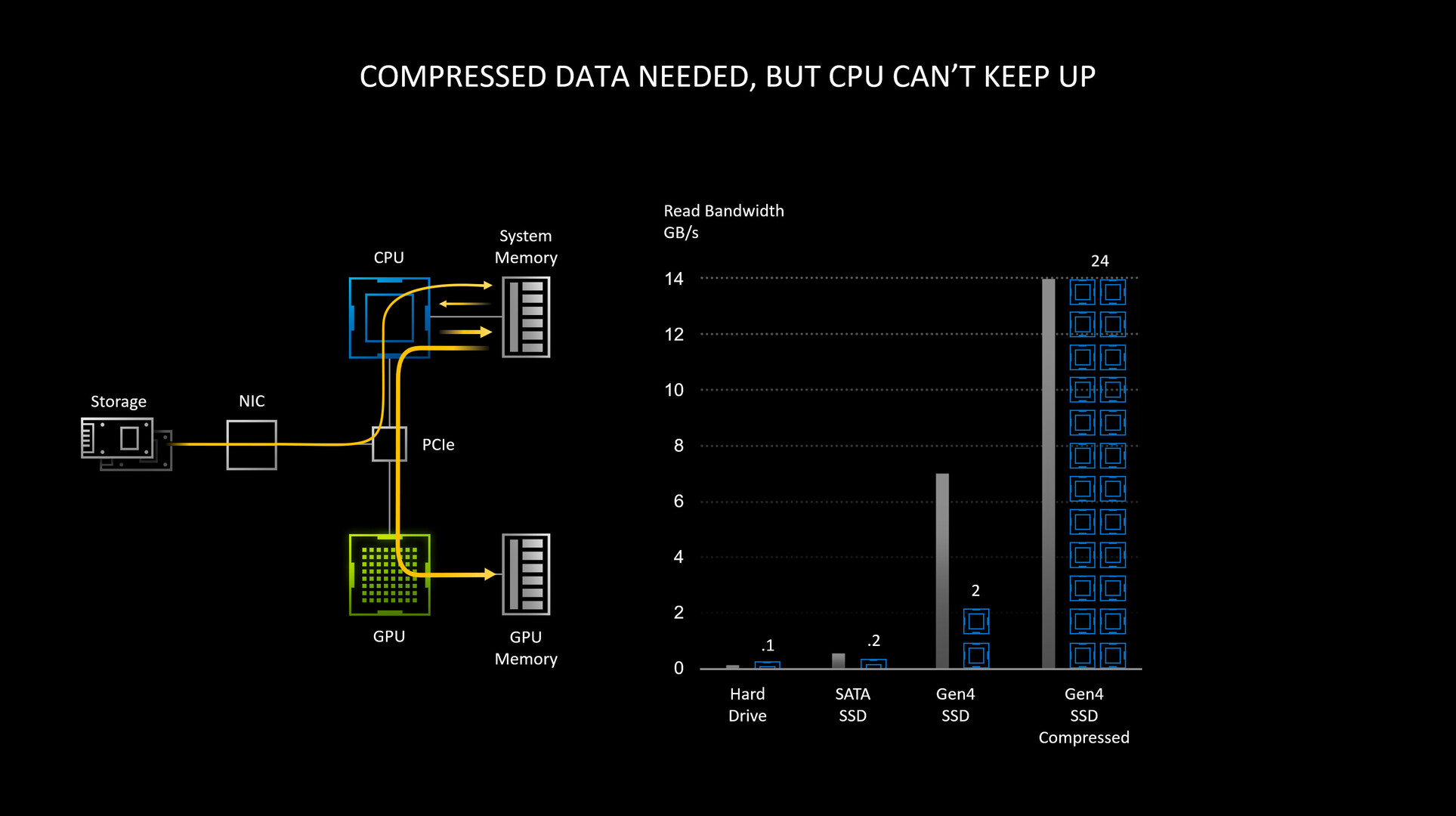
According to tests by NVIDIA, reading uncompressed data from an SSD at 7 GB/s (typical max sequential read speeds of client-segment PCIe Gen 4 M.2 NVMe SSDs), requires the full utilization of two CPU cores. The OS typically spreads this workload across all available CPU cores/threads on a modern multi-core CPU. Things change dramatically when compressed data (such as game resources) are being read, in a gaming scenario, with a high number of IO requests. Modern AAA games have hundreds of thousands of individual resources crammed into compressed resource-pack files.

 Although at a disk IO-level, ones and zeroes are still being moved at up to 7 GB/s, the de-compressed data stream at the CPU-level can be as high as 14 GB/s (best case compression). Add to this, each IO request comes with its own overhead - a set of instructions for the CPU to fetch x piece of resource from y file, and deliver to z buffer, along with instructions to de-compress or decrypt the resource. This could take an enormous amount of CPU muscle at a high IO throughput scale, and NVIDIA pegs the number of CPU cores required as high as 24. As we explained earlier, DirectStorage enables a path for devices to directly process the storage stack to access the resources they need. The API by Microsoft was originally developed for the Xbox Series X, but is making its debut on the PC platform.
NVIDIA RTX IO is a concentric outer layer of DirectStorage, which is optimized further for gaming, and NVIDIA's GPU architecture. RTX IO brings to the table GPU-accelerated lossless data decompression, which means data remains compressed and bunched up with fewer IO headers, as it's being moved from the disk to the GPU, leveraging DirectStorage. NVIDIA claims that this improves IO performance by a factor of 2. NVIDIA further claims that GeForce RTX GPUs, thanks to their high CUDA core counts, are capable of offloading "dozens" of CPU cores, driving decompression performance beyond even what compressed data loads PCIe Gen 4 SSDs can throw at them.
There is, however, a tiny wrinkle. Games need to be optimized for DirectStorage. Since the API has already been deployed on Xbox since the Xbox Series X, most AAA games for Xbox that have PC versions, already have some awareness of the tech, however, the PC versions will need to be patched to use the tech. Games will further need NVIDIA RTX IO awareness, and NVIDIA needs to add support on a per-game basis via GeForce driver updates. NVIDIA didn't detail which GPUs will support the tech, but given its wording, and the use of "RTX" in the branding of the feature, NVIDIA could release the feature to RTX 20-series "Turing" and RTX 30-series "Ampere." The GTX 16-series probably misses out as what NVIDIA hopes to accomplish with RTX IO is probably too heavy on the 16-series, and this may have purely been a performance-impact based decision for NVIDIA.
According to tests by NVIDIA, reading uncompressed data from an SSD at 7 GB/s (typical max sequential read speeds of client-segment PCIe Gen 4 M.2 NVMe SSDs), requires the full utilization of two CPU cores. The OS typically spreads this workload across all available CPU cores/threads on a modern multi-core CPU. Things change dramatically when compressed data (such as game resources) are being read, in a gaming scenario, with a high number of IO requests. Modern AAA games have hundreds of thousands of individual resources crammed into compressed resource-pack files.
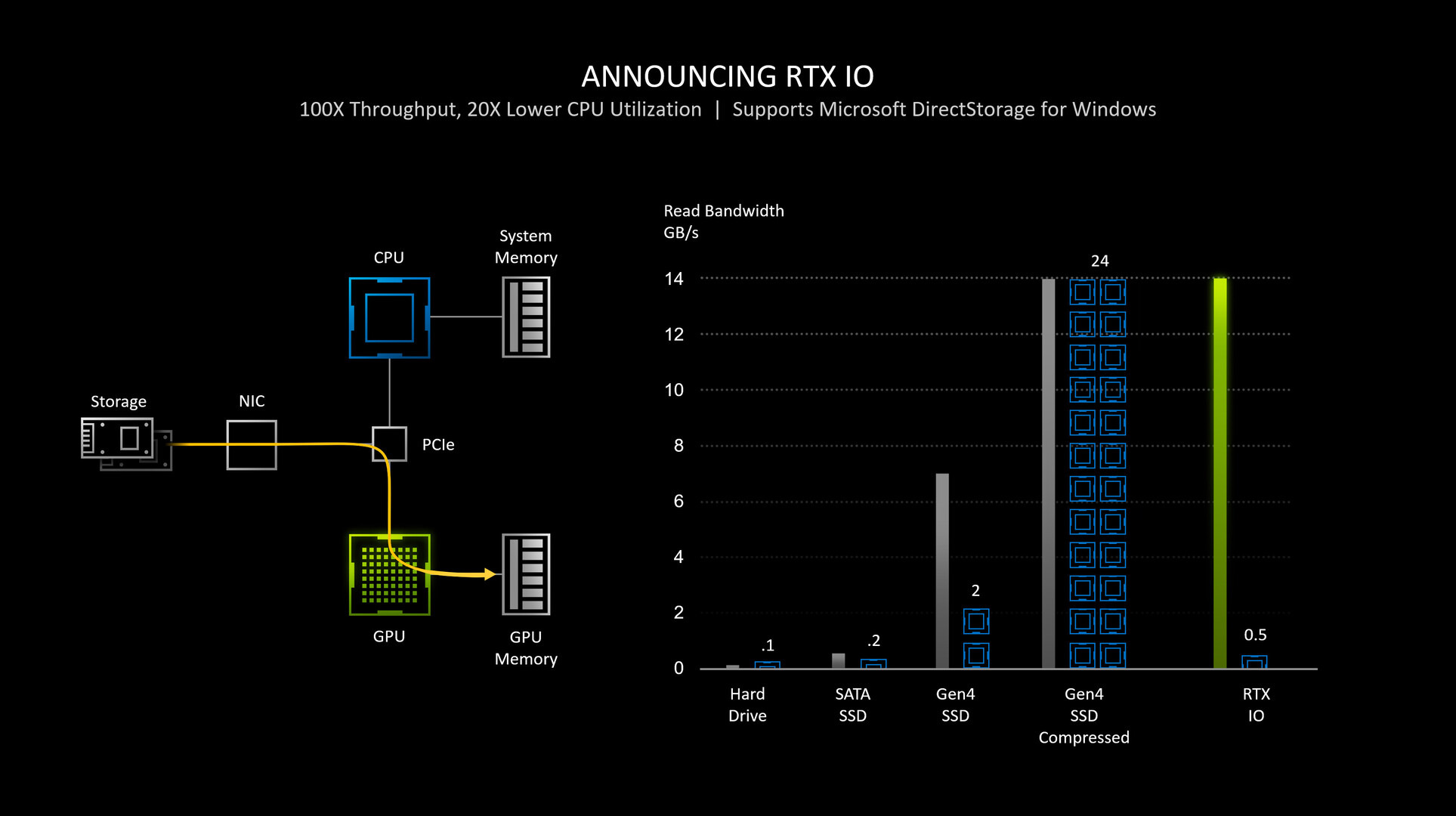
NVIDIA RTX IO is a concentric outer layer of DirectStorage, which is optimized further for gaming, and NVIDIA's GPU architecture. RTX IO brings to the table GPU-accelerated lossless data decompression, which means data remains compressed and bunched up with fewer IO headers, as it's being moved from the disk to the GPU, leveraging DirectStorage. NVIDIA claims that this improves IO performance by a factor of 2. NVIDIA further claims that GeForce RTX GPUs, thanks to their high CUDA core counts, are capable of offloading "dozens" of CPU cores, driving decompression performance beyond even what compressed data loads PCIe Gen 4 SSDs can throw at them.
There is, however, a tiny wrinkle. Games need to be optimized for DirectStorage. Since the API has already been deployed on Xbox since the Xbox Series X, most AAA games for Xbox that have PC versions, already have some awareness of the tech, however, the PC versions will need to be patched to use the tech. Games will further need NVIDIA RTX IO awareness, and NVIDIA needs to add support on a per-game basis via GeForce driver updates. NVIDIA didn't detail which GPUs will support the tech, but given its wording, and the use of "RTX" in the branding of the feature, NVIDIA could release the feature to RTX 20-series "Turing" and RTX 30-series "Ampere." The GTX 16-series probably misses out as what NVIDIA hopes to accomplish with RTX IO is probably too heavy on the 16-series, and this may have purely been a performance-impact based decision for NVIDIA.
52 Comments on NVIDIA RTX IO Detailed: GPU-assisted Storage Stack Here to Stay Until CPU Core-counts Rise
RT is not the topic here, but I'll be brief - no, I don't expect people to believe me blindly. Then again, none of the new products is out and tested yet, so discussing them now is kinda pointless - this is inline my post that I (personally) have low confidence in NVIDIA claims before it (testing) proves them.
What is certain is that they purposely use the terms wrongly, in marketing purposes. From computational point of view, real camera or scene RT is still very far away, also across the whole range of hardware we will have rasterization + RT combination, done by different shaders. All that for, according to Steam, market that currently has significantly less than 5% 'RTX' GPUs. Old games won't be 'upgraded' in 99% cases. Those are the facts.
How game devs will react and what will be adoption rate, also how their interpretations (it's not all about hardware) across a hardware line of different capabilities will look like is questionable. RT is so uneven in computational load that FPS is extreme sawtooth - this applies the most for full scene/camera RT, but also partial interpretations (just lights and reflections, just shadows etc). To compensate this, they will use a lot of approximations - and don't hide it (this may not be necessarily a bad thing, could be an achievement, really - except, well, it's untested too). Those are the questions.
At the end - and this got quite longer than intended - my personal reason to have a low confidence in NVIDIA is that they used terms improperly for marketing, claimed that various partial solutions and approximations are 'the holy grail' of rendering (RT itself, by the way, isn't perfect for that matter), which will provide highly impactful results. Well, I need to see that firstly - and they are obviously in overhype-mode right now, claiming miracles everywhere.