Saturday, March 8th 2025

China Develops Domestic EUV Tool, ASML Monopoly in Trouble
China's domestic extreme ultraviolet (EUV) lithography development is far from a distant dream. The newest system, now undergoing testing at Huawei's Dongguan facility, leverages laser-induced discharge plasma (LDP) technology, representing a potentially disruptive approach to EUV light generation. The system is scheduled for trial production in Q3 2025, with mass manufacturing targeted for 2026, potentially positioning China to break ASML's technical monopoly in advanced lithography. The LDP approach employed in the Chinese system generates 13.5 nm EUV radiation by vaporizing tin between electrodes and converting it to plasma via high-voltage discharge, where electron-ion collisions produce the required wavelength. This methodology offers several technical advantages over ASML's laser-produced plasma (LPP) technique, including simplified architecture, reduced footprint, improved energy efficiency, and potentially lower production costs.
The LPP method relies on high-energy lasers and complex FPGA-based real-time control electronics to achieve the same result. While ASML has refined its LPP-based systems over decades, the inherent efficiency advantages of the LDP approach could accelerate China's catch-up timeline in this critical semiconductor manufacturing technology. When the US imposed sanctions on EUV shipments to Chinese companies, the Chinese semiconductor development was basically limited as standard deep ultraviolet (DUV) wave lithography systems utilize 248 nm (KrF) and 193 nm (ArF) wavelengths for semiconductor patterning, with 193 nm immersion technology representing the most advanced pre-EUV production technique. These longer wavelengths contrast with EUV's 13.5 nm radiation, requiring multiple patterning techniques to achieve advanced nodes.
 However, this Huawei system must still answer questions about resolution capabilities, throughput stability, and integration with existing semiconductor manufacturing flows. However, commercializing an alternative EUV lithography tool will challenge ASML's position. ASML's latest High-NA EUV tool costs around 380 million US Dollars. No matter the cost for Chinese R&D centers, the Huawei EUV machine will deliver the much-needed upgrade path for the older DUV scanners, which previously limited domestic chip production. Despite China's development of solid IP, its manufacturing progress was limited, but it could experience a "DeepSeek" moment very soon. Leading fabs like SMIC are working with Huawei to integrate the EUV scanners into existing workflows. A solid semiconductor manufacturing workflow takes years to build, so we have to see what the final result will be.
Source:
Yin Sun
The LPP method relies on high-energy lasers and complex FPGA-based real-time control electronics to achieve the same result. While ASML has refined its LPP-based systems over decades, the inherent efficiency advantages of the LDP approach could accelerate China's catch-up timeline in this critical semiconductor manufacturing technology. When the US imposed sanctions on EUV shipments to Chinese companies, the Chinese semiconductor development was basically limited as standard deep ultraviolet (DUV) wave lithography systems utilize 248 nm (KrF) and 193 nm (ArF) wavelengths for semiconductor patterning, with 193 nm immersion technology representing the most advanced pre-EUV production technique. These longer wavelengths contrast with EUV's 13.5 nm radiation, requiring multiple patterning techniques to achieve advanced nodes.

92 Comments on China Develops Domestic EUV Tool, ASML Monopoly in Trouble
The hacker news bite deep. :roll:
It makes your previous arguments irrelevent.
Because official CCP sources also receive orders to publish propaganda.
Below is a picture of the CCP official (Vice Minister of Foreign Affairs of China) claiming they did not steal, did not rob, did not lie on their achievements.
So
If 'official sources also receive orders to publish propaganda' is true, then........THEY DID, and your previous arguments are irrelevent.
and,
If 'official sources also receive orders to publish propaganda' isn't true, then you just lied.
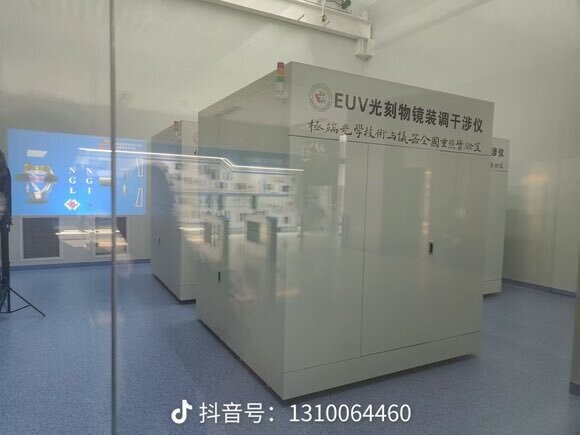
From the picture in the OP, that translates to EUV lithography objective lens mounting interferometer.
It is one part of a machine of an assembly line of manufacturing the lens for EUV lithography.
It is NOT an EUV tool at all.
It is a tool to make one of the tools that goes into the actual EUV tool.
And ASML don't even make interferometer.
Companies like Canon and Ushio made these and supply to various tool manufacturers.
It is like claiming you are able to manufacture a whole car but the only thing you showed us is a machine for making brake handles.
Yes it is an part of the car, but No that's not the whole car and it doesn't make you a car manufacturer.
Moreover, should they ever succeed, no Western country and certainly not TSMC (Taiwan) will install such a machine.
Seems to me just influencing public opinion of "look we can do all that here too".
In comparison, ASML's newest machine is a beast of fourteen meters long.
deingenieur.nl/artikelen/onder-de-motorkap-van-de-nieuwste-asml-machine
I'm sick of that monopoly
I’ve asked myself a question: what is the theoretical smallest size of a transistor on a chip using EUV hardware with 13.5 nm wavelength?
Using the same 19.3-to-1 ratio, could it be approximately 0.7 nm (13.5 / 19.3 = 0.69948... nm)?
I think the ratio in case of EUV should be different.
Consequently, ASML and Huawei might be limited to about 1 nm due to various transistor charge leakage issues, unless an entirely new transistor technology is introduced.
Hegemonies seeing their monopolisation of power being rapidly diminished don't like to talk about that tho
Karma takes a while
Your bad faith is open, so go take a long walk off a short cliff. The discussion was about China "getting stuff done." You've ignored that, and want to claim it's technology. When you engage with bad faith, people will tell you to screw off, because you don't want a discussion. You lie, cheat, steal, and anything else. It's talking to a human rectum, who will spew crap everywhere...and that's why people stop talking to you.The whole east versus west is a stupid dichotomy. It's protected capitalism versus flavored socialism.
Why might I say this? Vietnam. Taiwan. The Chinese are complaining that moving to Vietnam is an issue because workers know they have rights, and their government has been surprisingly stable and good for decades. Taiwan...I don't feel I need to explain.
What's the issue with the CCP? Well, capitalism produces a huge drive to research and investigate. This means you have monopolies like Xerox was at one point, and the second that monopoly disappears the $500 printer is now $200. Xerox though had 20 years to recoup their investment, and after that they have to compete. The CCP pays a few grand to have computers hacked, takes the data, and makes a cheap copy today. In this way, Xerox could never have existed. If the CCP, like Taiwan and Vietnam, played fair in trade it'd be fine. They do not.
One last little bit of fun. The CCP pulls the nine dash line from their butts...now the ten dash line. They use it to claim a monopoly on shipping routes. Countries seek arbitration to say this is unfair, international court rules their claims as bogus, CCP ignores ruling. The tariffs from the west happen. CCP claims it's unfair to the same courts, and the response back is that they are full of crap. China claims it's a western hegemony keeping them down...and the US has to sail warships through the area to keep the CCP from taking over in the area...against their fellow Asian nations. You know, this might just be China finally getting the black eye they deserve for acting like an entitled child to the entire world...
Speaking of which, I hope China gets royalties for the IP theft by Western European and North American polities (hope that's specific enough) regarding ideas for rocketry and gunpowder. And paper. And of course the Arab world should get some for the flagrant use of Arabic numerals and algorithmic mathematics
Those saying that China cannot compete seemingly aren't aware that it is being forced to lock in with those sanctions. They aren't the most effective as blockades (ez H100 smuggling) but still do the job in such a globalized economy... and they certainly are effective as motivation for the CCP. And guess what, they've been gaining substantially in legacy chip market share for the last few years.
There is without any doubt a great chance that they'll tighten the gap in this race with western tech.
FFS *everywhere* is East or West of everywhere else, depending on where you start Are you in Kindergarten? Maybe you think there are no 'blocs' in the world any more...
Though to be fair, now the US is best pals with ex-commie Russia (yet still anti hyper-capitalist China), hates Muslims (but loves Saudia's oil and money), is virulently anti-semitic (but subsidises the Chosen People so that even Intel builds fabs (why?) in the Promised Land)- it does get rather complicated for 'merkins
Gotta love the whining about "unfair competition" though; laughable in its hypocrisy and bitter envy.