Wednesday, October 22nd 2025
NextSilicon Claims Its Maverick-2 Outperforms NVIDIA GPUs, Unveils New RISC-V Chip
NextSilicon, a startup company founded in 2017 has detailed its Maverick-2 Intelligent Compute Accelerator (ICA), claiming it outperforms NVIDIA's HGX B200 GPU and Intel's Sapphire Rapids CPUs in high-performance computing and AI workloads. Built on TSMC's 5 nm node, Maverick-2 is available as a single-die PCIe card with 96 GB of HBM3e (300 W) or a dual-die OAM version with 192 GB of HBM3e (600 W). According to internal benchmarks, Maverick-2 delivers up to 4× higher FP64 performance-per-watt than the HGX B200 and over 20× higher efficiency than Intel's Xeon Sapphire Rapids. In GUPS benchmarks, it reached 32.6 GUPS at 460 W, reportedly 22× faster than CPUs and 6× faster than GPUs. In HPCG workloads it achieved 600 GFLOPS at 750 W, while consuming roughly half the power of competing solutions. The company attributes these gains to a data-flow based architecture that shifts overhead management from hardware to adaptive software, allowing most silicon area to be used for computation rather than control logic.
Alongside Maverick-2, NextSilicon announced Arbel, a RISC-V-based enterprise-grade chip also built on TSMC's 5 nm process. The company claims Arbel already surpasses current RISC-V designs as well as Intel Lion Cove and AMD Zen 5 cores. Arbel features a 10-wide instruction pipeline with a 480-entry reorder buffer for high core utilization, running at 2.5 GHz. The chip can execute up to 16 scalar instructions in parallel and includes four 128-bit vector units for data-parallel workloads. A 64 KB L1 cache and large shared L3 cache ensure high memory throughput and low latency to reduce bottlenecks in compute-intensive applications. No release date or full benchmarks were disclosed, but NextSilicon says Arbel represents a move toward a fully open, software-adaptive silicon platform for future HPC and AI systems.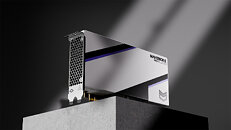


Source:
NextSilicon
Alongside Maverick-2, NextSilicon announced Arbel, a RISC-V-based enterprise-grade chip also built on TSMC's 5 nm process. The company claims Arbel already surpasses current RISC-V designs as well as Intel Lion Cove and AMD Zen 5 cores. Arbel features a 10-wide instruction pipeline with a 480-entry reorder buffer for high core utilization, running at 2.5 GHz. The chip can execute up to 16 scalar instructions in parallel and includes four 128-bit vector units for data-parallel workloads. A 64 KB L1 cache and large shared L3 cache ensure high memory throughput and low latency to reduce bottlenecks in compute-intensive applications. No release date or full benchmarks were disclosed, but NextSilicon says Arbel represents a move toward a fully open, software-adaptive silicon platform for future HPC and AI systems.


7 Comments on NextSilicon Claims Its Maverick-2 Outperforms NVIDIA GPUs, Unveils New RISC-V Chip
Only then, they might be able to break into NVIDIA's billion-dollar software walled garden in the AI market.
Jensen knows GPUs can't hold a candle to ASICs in all metrics, that's why NVIDIA pushed so hard on the software side, to keep their chips in the market.
As a gamer, one can only hope it materializes, basically the only way for GPU architectures to get back to do mainly graphics processing again in the foreseeable future.
As for ASICs in general for AI there have been successful designs like Google's TPU.
As for Google's TPUs, only know smaller iterations go in some edge and smart devices.
However, the big guns (comparable to H100/B100) are google cloud only and not for sale.
If it's anything like the EV trucks being advertised to metropolitan hipsters, it's either never actually going to reach market, will cost WAY more than they initially advertised, and/or will not deliver on its promises anywhere near as well as the fancy renders would suggest. And god help you if you ever need to contact support for your boutique tech brick.