Tuesday, November 11th 2025

AMD Confirms Zen 6 (2 nm) and Zen 7 with Efficiency Upgrades and New AI Features
AMD has updated its CPU core roadmap confirming Zen 6 and Zen 7 architectures as the next steps for its Ryzen and EPYC product families. The new roadmap was shown during the company's Financial Analyst Day 2025. Zen 6 will launch next year and is built using TSMC's 2 nm process node. The lineup will include both Zen 6 and Zen 6C variants, optimized respectively for high performance and power efficiency. According to AMD CTO Mark Papermaster, Zen 6 will bring higher IPC, improved efficiency and expanded AI data type support with additional AI pipelines. We recently detailed here the first Zen 6 ISA changes, which introduce several new instruction sets and expanded compute capabilities. The architecture will appear across multiple platforms, including EPYC "Venice," Ryzen Desktop "Olympic Ridge," and Ryzen Mobile "Medusa Point."
For the first time, AMD has also confirmed Zen 7, listed on the roadmap as a "Future Node" and "Next-Generation" design. Zen 7 will introduce a new matrix engine and broaden AI data format handling, marking a shift toward deeper AI integration within standard CPU cores. AMD has not disclosed the specific process node or launch window, though the architecture is expected to follow Zen 6 around 2027 in next-generation EPYC "Verano" processors. No other details about Zen 7 were shared, so we have to wait for specific things like cache layout, core counts, and power targets.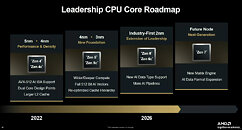

Source:
AMD Investor Relations
For the first time, AMD has also confirmed Zen 7, listed on the roadmap as a "Future Node" and "Next-Generation" design. Zen 7 will introduce a new matrix engine and broaden AI data format handling, marking a shift toward deeper AI integration within standard CPU cores. AMD has not disclosed the specific process node or launch window, though the architecture is expected to follow Zen 6 around 2027 in next-generation EPYC "Verano" processors. No other details about Zen 7 were shared, so we have to wait for specific things like cache layout, core counts, and power targets.


83 Comments on AMD Confirms Zen 6 (2 nm) and Zen 7 with Efficiency Upgrades and New AI Features
Recall how FSR4 runs significantly worse using int8 on older RDNAs (2/3).
Cheers. :)
Someone was asking me for a source, there isn't one. I'm just basing it off of what I think based on a two hour podcast a good while ago between Ian and George (chipsandcheese) where they were discussing Turin. It makes sense for AMD to go the split route and let the c cores use a smaller node coupled with denser libraries. But who knows, I could be wrong and AMD might decide to fab both Zen 6 and Zen 6c using the same node but different variants of it.
I'm also wondering whether rumours of Zen 6 having 12 cores per CCD are true. If so, I might have to break my promise not to upgrade on my current platform, and get one last push out of my AM5 system.
It sounds to me like you'll start seeing just how personal the personal computer can really get
www.techpowerup.com/342753/windows-11-26h1-focuses-on-new-silicon-support-not-new-features
www.windowscentral.com/microsoft/windows-11/windows-president-confirms-os-will-become-ai-agentic-generates-push-back-online
Ezra Klein Interviews Annie Murphy Paul:
www.nytimes.com/2021/07/20/opinion/ezra-klein-podcast-annie-murphy-paul.html
www.vox.com/the-gray-area/2023/9/26/23884046/naomi-klein-doppelganger-the-gray-area
Unless they change that with Zen 6, but i doubt it. Mobile variants may get c cores tho.
It hasn't mattered thats its not really "AI" in any meaningful sense or that the buzzword isn't even associated with a useful product. Maybe that will change though eventually.
Our choices still matter somewhat, because otherwise RDNA wouldn't exist and there'd be just GCN (and as Chester Lam notes, CDNA2's CU design still resembles that of the GCN's). RDNA with its greater emphasis on render frontend is specifically designed to better saturate render pipelines, a non-issue in HPC scenarios.
Yes, I know the merging-into-UDNA thing. I'm just saying that there wouldn't have anything to merge with, had our voice truly doesn't matter.
So no I do not agree
Yes, we should all ask for better optimizations. Maybe halting the advances in GPU processing power would force them to do so.
Why optimize when you can wait for the next gen hardware to deliver double the performance?
Just look at Ubisoft with their outstanding* (relatively speaking**) performance optimizations, and they almost went bust a few months ago***.
*Referencing Massive's Snowdrop and Ubisoft's own AnvilNext engines, but even their retired Dunia 2 (Far Cry 6) has extremely efficient vegatation/shadowing/reflection renderers when placed against e.g., CDPR's 2077.
**id Tech 6 (DOOM'16) demolishes all of the above into ashes and atoms, although it's not designed to render a open world game.
***Speaking of storiy lines and game-designs that taste like something out of the assembly line, I struggle to comprehend how EA is doing the same thing as Ubisoft but still earning (massive amounts of) money with their BF2042 / NBA-2Kth-Ctrl-C-and-V stuff.
AMD arn't the ones building all the infrastructure out of course. They're just bandwagon jumpers.
Some product in the real world has to ultimately pay for the trillions spent on hardware. Not to mention the construction and electricity.
If it all goes pear shaped, likely we stop seeing AMD chucking the word "AI" in to their press releases. They might even focus on features real world users actually want and need.
I don't want a PC with AI at all !!
And depending on how we define ML/AI, machine-learning based solutions can be traced really really far back. iPhone 6s' raise-to-wake utilize ML to some degree, and the branch predictor in your CPU cores have been using neural networks for probably a decade.
*Speaking of units inside CPU cores that does nothing for many users, AVX-512 and AES are probably redundant; and the 40% die area dedicated to Skylake's iGPU for a supposedly performance-tier i7-6700K CPU is probably the least thing a gamer would need.
Neither do I think people would want, or have the time to, integrate anything that resembles ML into the linux kernel.
It's not like linux kernel is actually using AVX512 or something; the hardware logic may be there, but the kernel may be agnostic about its presence (or absence).
And at the end of the day, you can always compile the kernel yourself (and maybe post the de-AIed source code on Github if no one else' doing. I imagine there'd be many stars). Mod-and-break-it-till-you-like-it-ism?
Afterall, aren't many linux distros the product of geeks customizing linux to their own taste? Some (if not most) of those geeks are bound have the same feeling against AI-bloat as you.
Please note how they described Zen 4 and Zen 5.