Tuesday, November 11th 2025

AMD Confirms Zen 6 (2 nm) and Zen 7 with Efficiency Upgrades and New AI Features
AMD has updated its CPU core roadmap confirming Zen 6 and Zen 7 architectures as the next steps for its Ryzen and EPYC product families. The new roadmap was shown during the company's Financial Analyst Day 2025. Zen 6 will launch next year and is built using TSMC's 2 nm process node. The lineup will include both Zen 6 and Zen 6C variants, optimized respectively for high performance and power efficiency. According to AMD CTO Mark Papermaster, Zen 6 will bring higher IPC, improved efficiency and expanded AI data type support with additional AI pipelines. We recently detailed here the first Zen 6 ISA changes, which introduce several new instruction sets and expanded compute capabilities. The architecture will appear across multiple platforms, including EPYC "Venice," Ryzen Desktop "Olympic Ridge," and Ryzen Mobile "Medusa Point."
For the first time, AMD has also confirmed Zen 7, listed on the roadmap as a "Future Node" and "Next-Generation" design. Zen 7 will introduce a new matrix engine and broaden AI data format handling, marking a shift toward deeper AI integration within standard CPU cores. AMD has not disclosed the specific process node or launch window, though the architecture is expected to follow Zen 6 around 2027 in next-generation EPYC "Verano" processors. No other details about Zen 7 were shared, so we have to wait for specific things like cache layout, core counts, and power targets.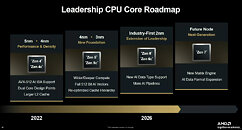
Source:
AMD Investor Relations
For the first time, AMD has also confirmed Zen 7, listed on the roadmap as a "Future Node" and "Next-Generation" design. Zen 7 will introduce a new matrix engine and broaden AI data format handling, marking a shift toward deeper AI integration within standard CPU cores. AMD has not disclosed the specific process node or launch window, though the architecture is expected to follow Zen 6 around 2027 in next-generation EPYC "Verano" processors. No other details about Zen 7 were shared, so we have to wait for specific things like cache layout, core counts, and power targets.


83 Comments on AMD Confirms Zen 6 (2 nm) and Zen 7 with Efficiency Upgrades and New AI Features
Ryzen 5 8500G
www.amd.com/en/products/processors/desktops/ryzen/8000-series/amd-ryzen-5-8500g.html
Little Joey contemplating whether to buy a 5070 Ti or a 9070 XT is just a little extra pocket money.
If that were remotely true, none of the companies offering these products would have survived this long. We have users at work that use Dragon or Fusion without issue, and have done so for over a decade.OK, but tha t10 mil, as you know, doesnt actually represent revenue. Sure it helps valuation, but it isnt gonna help you when the taxman comes around. No matter how many games they play, they still need customers to fund these products.
The AI field is having that issue right now, its why they started the circular investing - it doesnt make any money. Customers are not buying it enough to justify costs, and they have to pay investors back eventually.
No, a company, even a trillion dollar company, cannot just steal investor money and get away with it. Investors can pull their money out, and many ARE, which is leading to a severe capex crunch in the tech sector and is why private equity firms are desperate for 401k investment to shore up their books. And if a company decided to just...not pay? You know how people complain financial crimes are treated harsher than murder? Even IF they did that, and got away with it.....who else would ever invest in them, knowing they would never see that money again? That would destroy all investor confidence in a company.
Also would be time to offer up to date chipset for high end boards:
X870 is barely any different from X670 which wasn't that great when new with use of two separate, but identical daisy chained chips made on some old node wasting power and also naturally devices connected to second chip having extra latency.
But I built 9700x with B650E in January though...
But other than that there's not much. We already have DDR5, USB4, PCIe 5.0, Wi-Fi 7 etc. The new chipset will not bring USB5, PCIe 6.0, Wi-Fi 8 and DDR6.
Aside from increasing the number of Gen5 lanes there's almost no benefit that could not be realized on existing chipsets with new controllers.
I doubt even Zen 7 will necessitate anything newer. Only when AM6 comes with DDR6 near 2030 will we see a significant need for new boards and chipsets.
X670/X870E chipsets (or really just two toward four year old B650 chips) are at 14W.
Also anything connected to second chip will have additional latency:
First chip's internal traffic goes through SerDes into PCIe link to second chip, where it goes through SerDes to other direction before actual silicon of second chip.
Adding latency and power waste in both ends compared to single bigger chip for no good.
It's basically same weaknessses as in current implementation of interconnect between CPU's dies.
(which should be solved by "sea-of-wires" in Zen6 CPUs)
All which makes idle power draw (where most PCs spend majority of their time) of Ryzen PC higher compared to Intel... With single CCD CPU:
www.techpowerup.com/review/amd-ryzen-7-9800x3d/23.html
As another example of ineffciency because of that daisy chaining actually only half of first chip's 16 PCIe lanes give actual connectivity!
And while second chip needs only four lanes for uplink, remaining twelve PCIe lanes are behind that extra latency...
AMD simply doesn't anymore have limited resources excuse for using such bubblegum and duct tape jerry-rig for consumer platform's high end boards.
I doubt the memory requirements for something like this will be affordable though.
Ps. AMD must compete with Intel new Nova Lake. Intel will introduce quite a few interesting features to its motherboard lineup. It won't just be an increase in the number of cores in the CPU.