Friday, November 28th 2025

Valve Steam Machine May Cost Less Than Anticipated
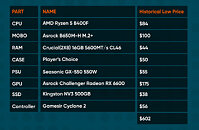
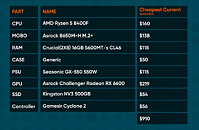
Valve recently sparked concern among gamers when it revealed that the Steam Machine would be priced similarly to a competitive gaming PC, with ensuing speculation resulting in up to $1,000 prices being thrown around. Likely in response to many of these concerns, Linus Tech Tips on YouTube took it upon himself to build a gaming PC with similar specifications and performance to the upcoming Steam Machine in an attempt to estimate the price of the new living room console. The build itself consists of an AMD Ryzen 8400F, an ASRock B650M motherboard, 16 GB of Crucial DDR5-5600 memory, a Kingston 500 GB SSD, a Seasonic 550 W PSU, and an ASRock AMD Radeon RX 6600 GPU. Taking the build's cost at face value, at the time the PC was built, and with the lowest available prices, the Steam Machine will launch at somewhere around $910, with the possibility of bringing the price down by cutting certain features.
However, Valve is not a regular consumer, and economies of scale play a big role in pricing when you start talking about devices that are expected to sell hundreds of thousands or millions of units. Valve also previously said that the pricing for the entry-level Steam Deck was "painful," suggesting that it had employed very aggressive pricing for that device. At Valve's scale, it seems likely that the specific components that the YouTuber used in the build would come to around $700-750, but when accounting for the semi-custom nature of the Steam Machine and adjusting for the potential savings that Valve gets from its direct-to-consumer model, it seems like the Steam Machine cost as little as $600-650 in hardware. Accounting for Valve's assumed profit of around 10% and taking into account Valve's comments to Linus about its hardware business aiming for sustainability, the official pricing guess comes out to $699.99. This price estimate isn't incredibly reliable, since it doesn't account for the current DRAM shortage that has resulted in prices skyrocketing across the board, which will certainly affect Valve when the Steam Machine launches, and it assumes Valve will sell the Steam Machine at a high profit margin.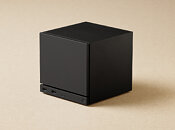
 .
Source:
Linus Tech Tips on YouTube
However, Valve is not a regular consumer, and economies of scale play a big role in pricing when you start talking about devices that are expected to sell hundreds of thousands or millions of units. Valve also previously said that the pricing for the entry-level Steam Deck was "painful," suggesting that it had employed very aggressive pricing for that device. At Valve's scale, it seems likely that the specific components that the YouTuber used in the build would come to around $700-750, but when accounting for the semi-custom nature of the Steam Machine and adjusting for the potential savings that Valve gets from its direct-to-consumer model, it seems like the Steam Machine cost as little as $600-650 in hardware. Accounting for Valve's assumed profit of around 10% and taking into account Valve's comments to Linus about its hardware business aiming for sustainability, the official pricing guess comes out to $699.99. This price estimate isn't incredibly reliable, since it doesn't account for the current DRAM shortage that has resulted in prices skyrocketing across the board, which will certainly affect Valve when the Steam Machine launches, and it assumes Valve will sell the Steam Machine at a high profit margin.


118 Comments on Valve Steam Machine May Cost Less Than Anticipated
For Intel chipsets like the H810 Z890 they cost $28-$57 for nothing, literally offering nothing substantial that I can think of, just SATA ports.
I have no idea how expensive the B650 is, but there's nothing stopping Steam from pocketing that for themselves.
The price of DDR5 skyrocketed overnight, but it will eventually fall.
It's absurd that even potatoes with RX 6600 cost nearly $1,000 when RX 9070 should be the norm.
The sub $300 RTX 5060 in its cheapest lowest bin gets 94 FPS average in TPU test suite at 1080p. The desktop 7600 gets 69. The Steam Machine GPU will be less than that, as you said it's a superclocked RX7400. Of course this is in classic raster, since this isn't an RDNA4 part, any modern game (UE5) that incorporates some level of RT by default will absolutely tank performance to below half of what that sub $300 RTX 5060 can offer.100% it's smarter to buy a 9060 XT/5060 Ti and perhaps a new PSU to upgrade an existing build. Even a 9070/5070 plus PSU could likely be had for less.
Even buying an old office PC (or a brand new one) for $2-400 and slapping a $3-400 RDNA4/Blackwell GPU in will cost the same/less and offer ~50% higher performance, plus upgradability beyond RAM/Storage.
This is a machine for the consumer who is apathetic/lazy, or who desires convenience, or who for some reason must have a speaker sized PC and is willing to pay essentially a 50% premium for it.
I'll remind people that the lower specced Strix Halo Mini-PCs can be had for roughly $1000, and blow this thing out of the water performance wise, plus can have SteamOS.
Regardless I'm tired of companies aiming low. All these RDNA2 APUs and now this crap.
It genuinely holds back PC gaming advancement when the bar is continually set so low, and developers are forced to optimize for the equivalent of last generation low end laptop hardware.
Especially when for the same money Valve could have put a RDNA4 GPU in with twice the performance.
If an end user can DIY it within budget, you can bet the corporation can.
But guess what. People will still cheer for overpriced laptop hardware without the advantages of a laptop.Even without deals, a standard office PC can be had for a lot less than $600. Think $350.
www.hp.com/us-en/shop/vwa/desktops/Price=1-600&segm=Home?jumpid=ma_globalnav_dt_home
There's models with an RTX 5050 for less than that 8400 + 7600 combo.
This is equal to a 3060 desktop in Timespy, and is one of the most common GPUs in the Steam Hardware Survey.
The only people full of themselves are commentators on Techpowerup...
You're trying to tell me Valve, buying tens of thousands of units, getting special custom chips made etc, couldn't do better than this list, with each purchase made separately, with retailer markup?
PCPartPicker Part List: pcpartpicker.com/list/2jDLh7
CPU: AMD Ryzen 5 8400F 4.2 GHz 6-Core Processor ($159.99 @ Amazon)
Motherboard: ASRock A620AM-X WiFi Micro ATX AM5 Motherboard ($89.99 @ Amazon)
Memory: Kingston FURY Beast 8 GB (1 x 8 GB) DDR5-5600 CL40 Memory ($59.99 @ Amazon)
Memory: Kingston FURY Beast 8 GB (1 x 8 GB) DDR5-5600 CL40 Memory ($59.99 @ Amazon)
Storage: Patriot P400 Lite 500 GB M.2-2280 PCIe 4.0 X4 NVME Solid State Drive ($42.99 @ Newegg)
Video Card: Gigabyte GAMING OC Radeon RX 9060 XT 8 GB Video Card ($274.99 @ Amazon)
Case: Rosewill FBM-X3 MicroATX Mid Tower Case w/650 W Power Supply ($69.99 @ Newegg)
Total: $757.93
Prices include shipping, taxes, and discounts when available
Generated by PCPartPicker 2025-11-29 07:25 EST-0500
ca.pcpartpicker.com/product/D9ytt6/asrock-radeon-rx-6600-8-gb-challenger-d-video-card-rx6600-cld-8g
303 CAD is about 215 USD, LTT has shown 220 USD so that's probably it.
I would've preferred they'd had just power limited the 7600 though. 6000 pricing and availability is very unstable.
Edit: The Pro versions have much more capable hardware than the Steam Machine. I would not expect them to be at the same price. But we'll see.
I find it pointless to draw conclusions based on something that we don't know.
Since the actual user's perception of prices for components always lags quite heavily (see second hand market) the question is whether Valve is choosing to immediately choose a starting price that they won't have to raise for a while, or a price based on the current prices they've paid with the potential risk of having to raise prices later (and the backlash that comes with it).
I'm guessing anywhere from 700$ to 800$ depending on what they choose.
Hence:
Edit: Besides, no, you cannot DIY a mini PC. Your choices are a Minisforum box with weak hardware, or Strix Halo for ridiculous money. I'm hoping the Steam Machine will fall in between. I'm not gonna put a full DIY desktop into my living room. Been there, done that, it's bulky and ugly (the missus hated it, and she's right).
Steam Machines are semi-proprietary devices, Steam OS boots by directly accessing the machine's UEFI BIOS without using a boot loader like Grub or LILO and therefore does not allow the easy booting of third-party operating systems.
Another major drawback versus PC, is that during a Steam OS reinstallation, the entire main disk is erased, so the user loses all their data.
Furthermore, it is not even known if it is possible to add internal SSDs to these Steam Machines, nor if it is possible to access a boot menu via the BIOS.
From this point of view, these Steam Machines appear to be semi-proprietary mini PCs, certainly less restricted than a PS5, but less accessible to tinkering than a traditional PC.
Selling these machines at low prices, without making a profit, while limiting sales to a maximum of 2 or 3 units per person, seems to be the only viable option for Valve, unless they want a another failure like 10 years ago.....
For my part, one thing is certain, I would never spend more than 450 € for this game console including one controller. This is already a high price for a non-upgradeable machine almost exclusively dedicated to gaming.
It's also hilarious that you think an off the shelf Mini PC has "weak hardware" when the context is this Steam Machine using a last gen low end laptop CPU/GPU. Those Mini-PCs offer Zen 5/Arrow Lake/RDNA 3.5 options, and some of them even have native PCIe/Oculink/Thunderbolt expansion slots to use normal desktop GPUs with, already making them less locked down than this Steam Machine.
Edit: Also, the Steam Machine is 15 x 15 cm, basically the size of a mini-ITX motherboard. And we're talking about the entire system here.Because a Ryzen Ai something-something with an 890M is not weak? Yeah, right...
Enthusiasts always complain the steam deck is too weak but miss the point of what a handheld system is for or that it's also a full PC not limited to a single game store. The market needs a quiet and compact gaming box at a competitive price without the need to DIY one. And most people won't want to put some cheap HP gaming PC with RGB fans next to their tv.I doubt Valve is paying market prices, or hopefully they have enough units built before ram prices went through the roof.
The PS5 pro isn't really a fair comparison either, with cost subsidized by Sony because users are tied to online subscription costs with a device that isn't a full PC.
Gaming PCs also don't start at $1000, and noone in this thread is claiming that. In fact I specced a significantly better complete AM5 system, with an RDNA 4 9060 XT and much stronger PSU, and otherwise the same RAM, storage as the SM, for $750 a few posts ago. There's also prebuilts going for $500-550 with RTX 5050 GPUs besides otherwise similar specs, also listed in this thread if you want to scroll up.The deck is too weak, it was weak on release and overpriced, and just like this Steam Machine, people will still buy it, so just like all the previous insultingly weak offerings, big corpos will continue to release insultingly weak hardware in future. Because people keep making excuses. Same thing for the Switch 2. I don't want to hear about "development costs/time", when there's zero functional difference having a Ampere or a Blackwell GPU in a computer. They have the same programming language. You can plug and play a 5-10 year newer card from the same vendor in any desktop, without even reinstalling drivers.No excuses for $700+ then. Right?As opposed to the device that runs the literal Steam Store out of the box?
And some random shitty HP desktop with bargain bin parts isn't comparable, like I said most people won't want some gaming PC with RGB fans next to their TV.Depends if Valve wants to take advantage of current prices or not.You can drop out of the steam mode and run it like any other desktop, Valve isn't forcing you to only stay within the Steam store.