Monday, September 7th 2026
DRAM Industry Revenue Rises 59.5% QoQ in 2Q26 as Supply Expansion Continues to Lag Demand Growth
TrendForce's latest findings on the memory industry reveal that sharp rises in traditional DRAM contract prices have led to a 59.5% QoQ increase in total DRAM industry revenue, reaching nearly US$154.73 billion in 2Q26.
Growing demand for AI servers, fueled by expanding LLM training and AI inference, has driven higher shipments of HBM3e, LPDDR5X, and high-capacity RDIMMS. The surge in agentic AI applications is further boosting RDIMM demand across various capacities.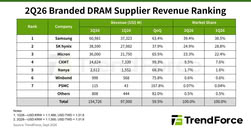 On the supply side, suppliers' inventories remain at historic lows, with additional supply mainly allocated for server use. Consequently, DRAM bit shipments grew only modestly in the second quarter.
Looking ahead, modest growth in bit shipments is expected to be one of the key factors affecting third-quarter revenue. Conventional DRAM contract price growth, however, is projected to moderate to 13-18% QoQ. This reflects a shift in some demand from high-capacity RDIMMs toward lower-capacity products, as well as the limited ability of PC and smartphone customers to absorb further price increases. Consumer DRAM is expected to post the strongest price growth, as suppliers have significantly curtailed supply.
TrendForce notes that Samsung posted the strongest QoQ bit shipment growth among the three major suppliers in 2Q26, supported by its early move into HBM4 mass production and shipments. Combined with a substantial increase in ASP, this lifted Samsung's quarterly revenue to $60.98 billion, up 63.4% QoQ. The company ranked first with a market share of 39.4%.
SK hynix ranked second. Since HBM accounted for the highest proportion of its total bit shipments among the top three suppliers, growth in ASP was relatively limited. Its 2Q26 revenue increased 37.9% QoQ to $38.59 billion, while market share edged down to 24.9%.
Micron continued to prioritize higher-priced server DRAM in its product mix amid capacity constraints. Revenue rose 65.5% QoQ to $36.0 billion in 2Q26, lifting its market share slightly to 23.3%. TrendForce notes that from 2026 to 2027, the three major suppliers will primarily increase bit supply by accelerating migrations to advanced processes.
Meanwhile, wafer starts are expected to see only modest increases through production process optimization, cleanroom acquisitions, and the reallocation of cleanroom space from other product lines.
By comparison, suppliers such as Nanya, Winbond, and PSMC remain focused on mature-process products, with their 2Q26 growth continuing to benefit from demand that the three major suppliers can no longer fully serve as they migrate to more advanced processes. Significant increases in DDR4 and DDR3 contract prices drove Nanya's revenue up 68.3% QoQ to $2.612 billion. Winbond's revenue increased 75.8% QoQ to $998 million.
PSMC's reported DRAM revenue, primarily derived from consumer DRAM products, surged 167.8% QoQ to $115 million in 2Q26. Including foundry revenue, its total revenue increased 54% QoQ. Looking ahead, the company is expected to begin its next phase of supply expansion after obtaining a process technology license from Micron.
Source:
TrendForce
Growing demand for AI servers, fueled by expanding LLM training and AI inference, has driven higher shipments of HBM3e, LPDDR5X, and high-capacity RDIMMS. The surge in agentic AI applications is further boosting RDIMM demand across various capacities.

Looking ahead, modest growth in bit shipments is expected to be one of the key factors affecting third-quarter revenue. Conventional DRAM contract price growth, however, is projected to moderate to 13-18% QoQ. This reflects a shift in some demand from high-capacity RDIMMs toward lower-capacity products, as well as the limited ability of PC and smartphone customers to absorb further price increases. Consumer DRAM is expected to post the strongest price growth, as suppliers have significantly curtailed supply.
TrendForce notes that Samsung posted the strongest QoQ bit shipment growth among the three major suppliers in 2Q26, supported by its early move into HBM4 mass production and shipments. Combined with a substantial increase in ASP, this lifted Samsung's quarterly revenue to $60.98 billion, up 63.4% QoQ. The company ranked first with a market share of 39.4%.
SK hynix ranked second. Since HBM accounted for the highest proportion of its total bit shipments among the top three suppliers, growth in ASP was relatively limited. Its 2Q26 revenue increased 37.9% QoQ to $38.59 billion, while market share edged down to 24.9%.
Micron continued to prioritize higher-priced server DRAM in its product mix amid capacity constraints. Revenue rose 65.5% QoQ to $36.0 billion in 2Q26, lifting its market share slightly to 23.3%. TrendForce notes that from 2026 to 2027, the three major suppliers will primarily increase bit supply by accelerating migrations to advanced processes.
Meanwhile, wafer starts are expected to see only modest increases through production process optimization, cleanroom acquisitions, and the reallocation of cleanroom space from other product lines.
By comparison, suppliers such as Nanya, Winbond, and PSMC remain focused on mature-process products, with their 2Q26 growth continuing to benefit from demand that the three major suppliers can no longer fully serve as they migrate to more advanced processes. Significant increases in DDR4 and DDR3 contract prices drove Nanya's revenue up 68.3% QoQ to $2.612 billion. Winbond's revenue increased 75.8% QoQ to $998 million.
PSMC's reported DRAM revenue, primarily derived from consumer DRAM products, surged 167.8% QoQ to $115 million in 2Q26. Including foundry revenue, its total revenue increased 54% QoQ. Looking ahead, the company is expected to begin its next phase of supply expansion after obtaining a process technology license from Micron.
9 Comments on DRAM Industry Revenue Rises 59.5% QoQ in 2Q26 as Supply Expansion Continues to Lag Demand Growth
To be fair, if anyone is going to be saved by China it will be China itself. Their phone companies will most likely buy LPDDRX at subsidized prices to keep them from collapsing.
Think of it this way. The US practically uses no oil from the middle east, but the conflict over there is still indirectly impacting prices in the US. The market is far more connected than you probably think it is.
The main problem is that this is going to take time and with the way DRAM manufacturers are operating, it could be even longer, but it will eventually cool down and the market will catch up. At least that's my opinion. It's not like this is the first time DRAM prices have gone high. These events are cyclical. I just think that this time it'll be more drawn out. I don't think we're going to a hit a wall and prices will suddenly drop.
Nope.
Fun fact. The 48GB to 128GB of unified memory upgrade for a Macbook Pro with a M5 Max these days is an eyewatering $2,000 USD.
My laptop is old, so you can imagine my dismay at how much more expensive the top tier hardware has become because Intel Macs are about to lose support. The upgrade I want is an easy $8,200 USD. A year ago the same spec was $2,000 USD cheaper. Needless to say, today is a terrible time to need to upgrade. Not because hardware is bad, but because it's become so damn expensive.