Friday, January 2nd 2026

ASUS Intros Pro WS B850M-ACE SE Motherboard with IPMI for Home and SMB Servers
ASUS introduced the Pro WS B850M-ACE SE, an AMD Socket AM5 motherboard in the microATX form-factor that's laid out like a server motherboard, but targets a range of consumers spanning from home and small-business servers, to workstations with storage-heavy loadouts. The board draws power from a combination of 24-pin ATX, and 8+4 pin EPS. It supports the entire range of consumer Ryzen and commercial Ryzen PRO desktop processors from the Ryzen 7000 and Ryzen 9000 series. It also supports EPYC 4005 series server processors in the AM5 package. The board also supports ECC DDR5 unbuffered memory, with support for up to 256 GB of dual-channel (4 sub-channel) DDR5-5600 memory.
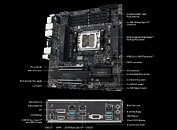
Among its use case-specific features are IPMI, U.2, and PCIe Gen 4 MCIO NVMe interfaces. The IPMI is driven by an ASPEED AST2600 chip that includes ASUS Control Center Express IT management software. Storage options include two M.2-2280 slots each with PCI-Express 5.0 x4 wiring, a PCIe Gen 4 MCIO, a U.2 Gen 3, and four SATA 6 Gbps ports. There's also an internal microSD slot for software key storage. There are three wired LAN interfaces—a 10 GbE driven by a Realtek RTL8127 PHY, a 2.5 GbE driven by Intel i225 series controller, and a third 1 GbE interface for the IPMI controller. USB interfaces include two 10 Gbps USB-C ports on the rear panel, a 20 Gbps USB-C header, three 10 Gbps USB type-A, an internal type-A, and additional 5 Gbps ports via headers. Display outputs include HDMI and DisplayPort from the iGPU, and a D-Sub from the IPMI chip. The board is expected to be priced around the $400 mark.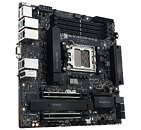
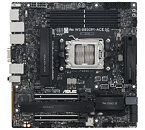
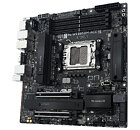
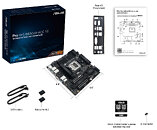
Among its use case-specific features are IPMI, U.2, and PCIe Gen 4 MCIO NVMe interfaces. The IPMI is driven by an ASPEED AST2600 chip that includes ASUS Control Center Express IT management software. Storage options include two M.2-2280 slots each with PCI-Express 5.0 x4 wiring, a PCIe Gen 4 MCIO, a U.2 Gen 3, and four SATA 6 Gbps ports. There's also an internal microSD slot for software key storage. There are three wired LAN interfaces—a 10 GbE driven by a Realtek RTL8127 PHY, a 2.5 GbE driven by Intel i225 series controller, and a third 1 GbE interface for the IPMI controller. USB interfaces include two 10 Gbps USB-C ports on the rear panel, a 20 Gbps USB-C header, three 10 Gbps USB type-A, an internal type-A, and additional 5 Gbps ports via headers. Display outputs include HDMI and DisplayPort from the iGPU, and a D-Sub from the IPMI chip. The board is expected to be priced around the $400 mark.


35 Comments on ASUS Intros Pro WS B850M-ACE SE Motherboard with IPMI for Home and SMB Servers
:banghead:
Usually on mainstream boards the socket is rotated 90 degrees only on boards that are focused on memory OC such as X870 Tachyon.
I assume here it is done due to space issues.
AsrockRack makes a few matx motherboards that have proper lane splitting afaik.
You can, however, transform every M.2-slot and every PCIe x4-slot into U.2 by a simple adapter.Is is possible, but not used on this board. MCIO is provided by lanes shared with one of two M.2 Gen5x4, seperate from the x16-slot, while U.2 is only Gen3x4 and is shared with 4xSATA. You can, however, transform every M.2-slot and every PCIe x4-slot into U.2 by a simple adapter.
A ProArt-like version with IPMI would be nice and fit this role easily.
www.amd.com/en/blogs/2025/amd-introduces-epyc-embedded-4005-processors-for-low.html
the million different way to mount a m2 too small passive cooling header is not to my liking. That usually implies it was not done correctly so far and there is no established way to to for ASUS.
That said, it's about time AMD gave us more lanes. I don't think it'd cut too deeply into Threadripper sales.
Why didn't they just attach 2 PROM21s in parallel to the SoC (for additional PCIeGen4 fanout)? Why not a Gen4 or Gen5 PCIe Switch, instead?
No USB4 means there's a whole block of Gen#x4 lanes that could be used for such.
Looking back, it were these kinds of boards that had PCIe switches and other non-standard expansion fanout.
Kinda surprised to see such a castrated 'Professional/Server board'. Much cost-cut. Very wow.
Would have this new board with
A Ryzen 5 8500GE or Ryzen 3 8300GE and 2×16GB RAM (or 2×8GB with today's prices...)You can split that 16× into 2 connectors of 8× with a PCIe packet switch card or if the BIOS can do it a PCIe splitter card.
I got your point, you wanted it by default, but still you can make this into two 8×