Friday, January 23rd 2026

Intel Core Ultra Series 4 "Nova Lake" Processors Launch in Late-2026
Intel is preparing to launch its Core Ultra Series 4 "Nova Lake" processor generation toward the end of 2026, CEO Lip-Bu Tan confirmed. This processor generation would span various form-factors, including importantly, desktop. Intel is building its next-generation "Nova Lake-S" desktop processor around the new Socket LGA1954 platform that replaces the current LGA1851. The company is planning to release Core Ultra Series 3 "Arrow Lake Refresh" for LGA1851 in the run-up to "Nova Lake-S" by yearend.
With "Nova Lake," Intel is expected to make fundamental changes to its processor design to help the company claw back performance leadership over AMD in the desktop segment. These changes include a doubling in CPU core counts going up to 16P+32E, a new iGPU based on the Xe3 "Celestial" graphics architecture, a new NPU that meets Copilot+ requirements, and the introduction of special SKUs with BLLC (big last-level cache), Intel's answer to AMD's 3D V-Cache. Intel will update the CPU complex with new "Coyote Cove" P-cores, and "Arctic Wolf" E-cores, both of which are expected to improve IPC over the current "Lion Cove" and "Skymont" combo. "Coyote Cove" does not feature HyperThreading, something the Intel CEO wants to see restored on the company's P-cores, but "Nova Lake" will make up for it with a numerical increase in P-core counts.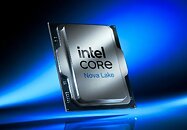
Source:
VideoCardz
With "Nova Lake," Intel is expected to make fundamental changes to its processor design to help the company claw back performance leadership over AMD in the desktop segment. These changes include a doubling in CPU core counts going up to 16P+32E, a new iGPU based on the Xe3 "Celestial" graphics architecture, a new NPU that meets Copilot+ requirements, and the introduction of special SKUs with BLLC (big last-level cache), Intel's answer to AMD's 3D V-Cache. Intel will update the CPU complex with new "Coyote Cove" P-cores, and "Arctic Wolf" E-cores, both of which are expected to improve IPC over the current "Lion Cove" and "Skymont" combo. "Coyote Cove" does not feature HyperThreading, something the Intel CEO wants to see restored on the company's P-cores, but "Nova Lake" will make up for it with a numerical increase in P-core counts.

62 Comments on Intel Core Ultra Series 4 "Nova Lake" Processors Launch in Late-2026
I don't think hyperthreading is coming back to consumer P cores. Intel has always said that the "Rapids" Xeon chips will have P cores with hyperthreading, but hasn't said "Lake" chips will. Why would they? For Meteor Lake, the scheduler:
- Tries the LPE cores
- If big, moves to the P cores
- If backgrounded or P cores are busy, moves to E cores
- If all E cores are busy, moves to virtual P cores (hyperthreading)
In this paradigm, virtual E cores would make more sense to the scheduler than virtual P cores.You took a single comment I made out of context.
Here you go: www.techpowerup.com/forums/threads/intel-core-ultra-series-4-nova-lake-processors-launch-in-late-2026.345539/post-5662396
Before that, it's important to remember that Intel is also contracted by the government, being the only US-based bleeding-edge foundry. Global Foundries also got various federal funds and contracts for the military. The government gives money to companies that can manufacture goods for them locally. AMD got gov funds to build a US-based AI datacenter for the Department of Energy. They don't care much about the contribution those companies make to consumers. They can keep using China, Korea, and Taiwan-based stuff for all they care, but the military? They prefer local stuff.
I'm not debating about whether or not Intel ethically deserved those funds; the US gov do not care, they want power and sovereignty above all.
What I said is that Amd didn't get a bailout from government WHILE it was struggling and OWNED its own fabs. In contrast to what's currently happing to Intel, which not only got the biggest share of the pie from the chips act, for obvious reasons, as much as government trust, in eventually converting these subsidies into 10% equity ownership, while boosting its stock price, and making that very same government Intel's biggest shareholder.
That's why I said Intel is essentially Amd from the past, apart from government help. Intel is struggling now and Amd was back then. It's a point of comparison and a meme, what's so hard to comprehend about that? You're grasping at straws.
Chips are far more ubiquitous, Glo fo bailed on bleeding edge, and the sole US bleeding edge maker was about to go down and leave the US orphan and heavily dependant from Taiwan. That's more dire than circa 2009 when the best US foundry was healthy and running full steam; the overall stakes were lower, and the operating cost less daunting. Sure, there might be a bit of market manipulation, but in the 2020's they also barely had a choice but to save that local manufacturing sinking ship.
Seems though that lga 1700 will keep going alongside lga 1954.
1851 is doomed to oblivion, like some bad windows iteration..
But why would Intel think they need 48 cores to compete with AMD's 24 cores? Especially when they should both be made on TSMC's latest process. AMD did it with Zen 2 because they had a process lead (so they could do it in smaller area) and because they had a ST performance deficit. I worry the latter reasoning may be behind Intel's decision here.
And, like how AMD's best selling parts are the 1 CCD variants, it'll probably be the 8+16 variant that is the most appealing.Not in time for Nova Lake.
I also disagree with the lawsuit being what "saved" AMD. If anything, it's a pittance in the grand scheme of things. It was their reckless, poorly thought out acquisition of ATI. They paid out many times what ATI was worth in 2005, but hindsight is 20/20 - it largely kept AMD afloat thanks to IP deals (console revenue streams were essential at this time) when all of their other businesses, including their core business of designing processors, failed.
www.cbc.ca/news/science/amd-says-it-overpaid-for-ati-1.641782
If Zen hadn't worked out, AMD would have gone bankrupt and completely liquidated a few years ago. By the time they launched the original Ryzen, AMD was running on fumes and on its last stand, without having any major importance to the market at the time and no exceptional quality product to even justify government intervention. They bet the whole farm on it, and pulled it off. Their IP's would probably have ended up with Qualcomm, some maybe even with Intel. The AMD of the mid 2010's was a zombie of a company, nothing like it is today, and Lisa did turn that ship around.
Government interests were different 20 years ago, CEOs were different 20 years ago, the whole industry was different 20 years ago. Such comparisons are emotional, naïve and short-sighted, and of course AMD isn't getting bail money: they're not in need of it, and as a fabless chip design company, their real value and relevance to national security interests lie in their intellectual property and detention of technology.Useless cinebench accelerator Arctic Wolf cores with a full ISA, AVX-512 support that outperform Zen 4, yes. At least on paper.8+16 is going to be Core 3/5 tier, if leaks are to be believed. This may just be the case of another generational leap in core count, like when we went from 4 to 8, and eventually 16 core CPUs being common at the high end. Probably minimal impact at best for current day workloads.
It is bad for the environment.
I would like to see they perform well.
But I wont hold my breath.
PS: I do rendering.
Offer me passive cooled ntb with 4 or 8 Arctic Wolves drawing <15W without Premium Price and I will take one. Or three.
For rendering I would prefer something that can run 24x7x365 without noise of starting Jet.
At this point people still believe current E cores are for background tasks despite Intel saying they have taken over the majority of workloads.
We can only pressure the big reviewers at launch to have some P core vs E core only and vs AMD normal and dense cores to lay the debate about actual performance of E cores to rest
If you read the last paragraph in the Arrow Lake reviews you'll see that we were supposed to get it, but then we didn't.
www.techpowerup.com/review/intel-core-ultra-9-285k/33.html
I proposed this exact thing a while ago, and it did not seem to me that people are interested not even for academic purposes.Public demand is definitely an incentive that can convince a reviewer that his effort will get the necessary views/clicks etc. to justify the effort, but if many consumers have negative sentiments towards Intel that are mainly stemming from the belief that the E-cores are weak (alongside the lackluster gaming performance) then the interest isn't really there, only the informed have that interest but the informed consumers are the minority. It's a vicious cycle, however it can be broken if such a review is made and the wrong beliefs are corrected by facts.
Maybe we'll get it for Nova Lake if Intel at the very least matches AMD. Well actually maybe not because if Nova Lake will have a warm reception then people will simply buy it and not stop to hate on it for being loaded with "weak" E-Cores.
As a replacement for hyperthreading, E cores are great.
Then again, they might have their own scheduling issues. If all four cores in a cluster are given hard work, what's the performance drop? Shared L2 seems like a bottleneck but if the cores execute threads belonging to same process, meaning shared memory, it might not be true.Yes, that's the baddest problem.
There's one thing I still don't understand: can a game direct the scheduler to use certain cores for certain threads or not? Without any additional system utilities, drivers, OS settings?Very few reviewers/analysts do testing just for science, unfortunately, and TPU is not one of them. W1zzard does testing with more practical value, such as memory scaling and PCIe scaling.