Friday, January 23rd 2026

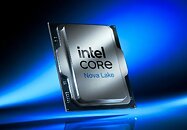
Intel Core Ultra Series 4 "Nova Lake" Processors Launch in Late-2026

Intel is preparing to launch its Core Ultra Series 4 "Nova Lake" processor generation toward the end of 2026, CEO Lip-Bu Tan confirmed. This processor generation would span various form-factors, including importantly, desktop. Intel is building its next-generation "Nova Lake-S" desktop processor around the new Socket LGA1954 platform that replaces the current LGA1851. The company is planning to release Core Ultra Series 3 "Arrow Lake Refresh" for LGA1851 in the run-up to "Nova Lake-S" by yearend.

With "Nova Lake," Intel is expected to make fundamental changes to its processor design to help the company claw back performance leadership over AMD in the desktop segment. These changes include a doubling in CPU core counts going up to 16P+32E, a new iGPU based on the Xe3 "Celestial" graphics architecture, a new NPU that meets Copilot+ requirements, and the introduction of special SKUs with BLLC (big last-level cache), Intel's answer to AMD's 3D V-Cache. Intel will update the CPU complex with new "Coyote Cove" P-cores, and "Arctic Wolf" E-cores, both of which are expected to improve IPC over the current "Lion Cove" and "Skymont" combo. "Coyote Cove" does not feature HyperThreading, something the Intel CEO wants to see restored on the company's P-cores, but "Nova Lake" will make up for it with a numerical increase in P-core counts.
Source: VideoCardz
Add your own comment

62 Comments on Intel Core Ultra Series 4 "Nova Lake" Processors Launch in Late-2026

#51
melkor_unlimited
WirkoShared L2 seems like a bottleneck ....
There are more bottlenecks.
Check the difference between performance of e-cores in Lunar Lake and Arrow Lake.
Cores are the same. But their implementation makes a huge difference.
Posted on Reply
#52
rattlehead99
Prima.VeraThe latest game engines can easily use up to 32 CPU cores with significant performance improvements. We all know how laggy the UE5 engine is. However the more stronger CPU cores, the fastest is runing.
Then if that's the case 16E cores are much faster than 8P cores, so even better.
Posted on Reply
#53
lambda
Waiting for the benchmarks.
Posted on Reply
#54
529th
Highly intrigued with their X3D counter part
Posted on Reply
#55
Dr. Dro
529thHighly intrigued with their X3D counter part
Most likely what I'll be going for unless HEDT returns
Posted on Reply
#56
rattlehead99
WirkoYou have just described HT. Which also means mixing two types of cores: fast ones running one thread and slow ones running two, even if the "type of core" constantly changes.
As a replacement for hyperthreading, E cores are great.
Then again, they might have their own scheduling issues. If all four cores in a cluster are given hard work, what's the performance drop? Shared L2 seems like a bottleneck but if the cores execute threads belonging to same process, meaning shared memory, it might not be true.

Yes, that's the baddest problem.
There's one thing I still don't understand: can a game direct the scheduler to use certain cores for certain threads or not? Without any additional system utilities, drivers, OS settings?


Very few reviewers/analysts do testing just for science, unfortunately, and TPU is not one of them. W1zzard does testing with more practical value, such as memory scaling and PCIe scaling.
Hyper-Threading feeds empty pipeline stages caused by bottleneck in the architecture, the lower than bottleneck, the less performance you gain from hyper-threading. meteor lake's core was so well designed that it only got 7% integer and 13% floating point extra performance from hyper-threading and arrow-lake is even less so.

The better the core is designed, usually means balancing all parts of it so it feed well, along with the branch prediction being on point, the less HT helps, but it always takes the same transistor count, die size and power.
Posted on Reply
#57
MufasaV
MufasaVAre people gonna repeat this a hundred times to those who won't listen?

At this point people still believe current E cores are for background tasks despite Intel saying they have taken over the majority of workloads.

We can only pressure the big reviewers at launch to have some P core vs E core only and vs AMD normal and dense cores to lay the debate about actual performance of E cores to rest
Well, that didn't take long. This review shows SPECINT results where the Pantherlake E core is already competitive vs Zen 5C never mind next Gen Arctic Wolf. Heck the Zen 5C is only 5% ahead per ghz in integer IPC compared to LPE core.

I wonder if old Raichu rumor of double digit IPC gain for Arctic Wolf plus complete feature parity in terms of AVX 512 will pan out well. Doubly so if they get good latency results as I am seeing here. I kind of doubt that though but one can hope.

I hope people will start to realize that P and E core are marketing terms and indicate nothing about capability in any comparison
Posted on Reply
#59
truerock
rattlehead99What benefit do you get from having more than 8P cores that is not a productive/professional workload?
Also their new E-Cores are on par with the last gen P-Cores in terms of IPC, and the clocks seem to be going up as well and now E-Cores will have the same instructions as the P-Cores.
If anything the P-Cores seem to be there just to top benchmark charts.
I'll agree that e-cores are becoming more powerful. But, e-cores are tuned for throughput and parallel processing. P-cores are latency‑optimized, high‑IPC, high‑frequency.
Intel e-cores have smaller IPC as compared to p-cores.

I will say that e-cores - over time - are becoming more like p-cores in functionality.
Posted on Reply
#60
rattlehead99
truerockI'll agree that e-cores are becoming more powerful. But, e-cores are tuned for throughput and parallel processing. P-cores are latency‑optimized, high‑IPC, high‑frequency.
Intel e-cores have smaller IPC as compared to p-cores.

I will say that e-cores - over time - are becoming more like p-cores in functionality.
Skymont(Arrow-Lake E-Cores) were as fast as RaptorLake P-Cores.
There was a benchmark at the same clock speeds, Darkmont(Nova-Lake E-Cores) have slightly higher IPC than Zen5 big cores. In Spec CPU 2017, it's posted here on this thread.
Posted on Reply
#62
Zodwraith
Upgrayedd32 e-cores?? Give me like 8e, delete the iGPU entirely from the design and use the rest of the space for more P-cores or cache. Why are they even playing around with the market segments AMD has taken from them?

Who at Intel is going. "yeah normies need 64 threads and half of them need to be weaker than the other half". Anyone who actually needs that is just going TR or Xeon. I understand this is a cheaper alternative for some people than TR or Xeon, but the mass majority that will get something like this will NEVER need 32e cores.
I use e cores everyday. I find it funny that gamers somehow think the only use for a high end CPU is gaming and say stupid s**t like "e cores are only for cheating on Cinebench." That's exactly the point. Cinebench is a real world test that simulates real world multicore workloads.

Have you seen how stupidly overpriced Threadripper is? If Intel can give me an affordable desktop competitor for mid range Threadripper that doesn't force me to spend a freaking grand on the motherboard alone? Yes, please. Give me all the e cores you can cram in there.
Posted on Reply
Add your own comment
Nov 11th, 2026 18:10 CST change timezone

New Forum Posts

Popular Reviews

TPU on YouTube

Controversial News Posts