Monday, March 2nd 2026

Microsoft Shader Execution Reordering Brings 90% Performance Increase on Intel Arc B-Series, 80% on NVIDIA "Blackwell" GPUs
Microsoft recently updated its Agility SDK to version 1.619, bringing DirectX Shader Model 6.9 alongside some new DirectX 12 improvements. However, Microsoft's latest product demo about Shader Execution Reordering (SER) now confirms a massive performance uplift across several GPUs, with up to a 90% improvement on Intel Arc B-Series and more than 80% from independent sources' benchmarks on NVIDIA "Blackwell." With SER, the API gives applications the ability to dynamically sort rays for highly optimized parallel execution, improving performance by a large margin. In Microsoft's own testing, Intel's Arc B-Series GPUs, which include "Battlemage" discrete GPUs and Xe3-based integrated GPUs in "Panther Lake," managed to achieve a 90% framerate increase in the technology demonstration, suggesting that ray tracing performance still has some tricks up its sleeve for optimization.
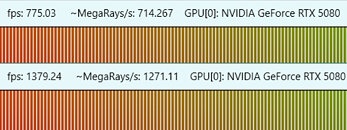
Meanwhile, the company also tested the NVIDIA GeForce RTX 4090 with SER, scoring a 40% improvement over the default ray sorting in the previous execution model. Independent testing from Osvaldo Pinali Doederlein on X showed that the GeForce RTX 5080 "Blackwell" GPU scored about an 80% improvement running this demo, which gives confidence that games implementing this technology will provide gamers with a massive performance boost once implemented. Microsoft has built this D3D12RaytracingHelloShaderExecutionReordering demo with a minimum demonstration of the SER technology, so anyone can test their own hardware and the performance improvement.
 Finally, it is important to note that this is just a technology demonstration, not real-world game testing. In real-world game testing, ray sorting using SER technology will definitely yield an improvement. However, given the nature and complexity of modern game engines and their ray tracing implementations, the improvement could be significantly smaller. This will remain the case until a game has been tested with the new technology update from the Agility SDK v1.619, which will likely require a few months of implementation and testing before being incorporated into an actual game. Only then can we test and see the real-world impact.
Sources:
Osvaldo Pinali Doederlein on X, Microsoft, VideoCardz
Meanwhile, the company also tested the NVIDIA GeForce RTX 4090 with SER, scoring a 40% improvement over the default ray sorting in the previous execution model. Independent testing from Osvaldo Pinali Doederlein on X showed that the GeForce RTX 5080 "Blackwell" GPU scored about an 80% improvement running this demo, which gives confidence that games implementing this technology will provide gamers with a massive performance boost once implemented. Microsoft has built this D3D12RaytracingHelloShaderExecutionReordering demo with a minimum demonstration of the SER technology, so anyone can test their own hardware and the performance improvement.


60 Comments on Microsoft Shader Execution Reordering Brings 90% Performance Increase on Intel Arc B-Series, 80% on NVIDIA "Blackwell" GPUs
It's reddit, so take with a grain of salt, but source is AMD. Apparently hardware units coming in future arch, software implementation (with lower performance) till then on current arch.
Rdna 4 according to microsoft support ser but can't reorder so my guess would be that the benefits will be limited.
chipsandcheese.com/p/rdna-4s-out-of-order-memory-accesses
Hardware support: AMD will be supporting this extension in a future driver release.
www.khronos.org/blog/boosting-ray-tracing-performance-with-shader-execution-reordering-introducing-vk-ext-ray-tracing-invocation-reorder
AMD is late to the party as it seems to always be lately. So RDNA5/UDNA will support SER in hardware. Nvidia on the other hand seems to be implementing all new DXR features ahead of time since SER is there in NvApi since 4xxx series, or simply from their market position they dictate what goes next into DXR Api. Either way for next gen consoles PT is going to be implemented a lot more.
www.windowslatest.com/2026/03/02/microsoft-gets-tired-of-microslop-bans-the-word-on-its-discord-then-locks-the-server-after-backlash/
10fps -> 18fps = 80% performance increase, but still unplayable.
www.tomshardware.com/pc-components/gpus/amd-research-suggests-plans-to-catch-up-to-nvidia-using-neural-supersampling-and-denoising-for-real-time-path-tracing
My current 4k storage benchmarks are certainly lacking...
That's like saying the LOTR trilogy movies are terrible because the elves, orcs and Uruk-hai in the movies are fake.
I'm not sure AMD can do anything in their driver to gain some performance out of SES.
That said, be very cautious about these big numbers in performance gains. These "90%" numbers are often achieved in "lab results", or conditions that are ideal to show off the gains by purposely putting a huge bottleneck in the issue being solved. I wouldn't assume any game is going to get a 28-30% performance boost from Shader Execution Reordering, let alone these 90% on Arc GPUs.
Just look at the performance gains being touted in the days of Xbox's "full RDNA2" marketing campaign. Neither did VRS Tier 2 bring a 20% performance boost in any game, nor did Sampler Feedback Streaming ever "multiply the effective memory and bandwidth by 2.5x". Otherwise we'd all be rocking 8GB GPUs without running out of VRAM at 4K.