Friday, March 6th 2026

PlayStation 6 Leak Tips 4K 120 FPS "In Most Games" With 6-12× RT Performance of PS5
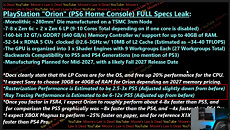
Given the current state of the gaming industry, rumors have started to emerge about the next-gen gaming console launches, with previous rumors claiming that the PlayStation 6 would launch alongside a new standalone PlayStation Portable gaming handheld, and that the PS6 would have less graphical processing power than the upcoming Xbox console. In a new post on YouTube, ubiquitous leaker and industry insider, Moore's Law is Dead, claims that the PS6 Orion—the living room console—will feature 2.5-3× the rasterization performance of the PS5 and 6-12× the ray tracing performance of the PS5, or 3-6× faster ray tracing than the PS5 Pro and roughly twice the raster performance of the PS5 Pro. This is thanks to a significantly faster RDNA 5 GPU with 52-54 CUs running at around 2-3.6 GHz and delivering around 34-40 TFLOPS of theoretical performance.
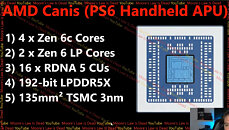
The leaker also shot down rumors that recently surfaced claiming that the PlayStation 6 may be delayed to as late as 2029 due to the ongoing memory crisis, stating that the nature of memory and APU fabrication contracts make it unlikely that the PS6 will be delayed that long. Instead, we may see a brief period of increased pricing or scarcity at launch. Apparently, according to his sources, Sony has a contract with TSMC to start mass-producing the PS6 as early as Q2 2027. MLID also mentions the AMD "Canis" APU slated to arrive in the PS6 handheld console, claiming that it will feature four Zen 6c cores, two Zen 6 LP cores (for running the operating system), and 16 RDNA 5 CUs running at 1.6-2 GHz with a 15 W total board power, all being fed by LPDDR5X memory over a 192-bit bus. All of this will allegedly be targeting 1080p gameplay with a significantly higher power limit when docked. He also speculates that the handheld will feature "vastly better" ray tracing than the PS5.
 See the full leak video below:
Source:
Moore's Law Is Dead on YouTube
The leaker also shot down rumors that recently surfaced claiming that the PlayStation 6 may be delayed to as late as 2029 due to the ongoing memory crisis, stating that the nature of memory and APU fabrication contracts make it unlikely that the PS6 will be delayed that long. Instead, we may see a brief period of increased pricing or scarcity at launch. Apparently, according to his sources, Sony has a contract with TSMC to start mass-producing the PS6 as early as Q2 2027. MLID also mentions the AMD "Canis" APU slated to arrive in the PS6 handheld console, claiming that it will feature four Zen 6c cores, two Zen 6 LP cores (for running the operating system), and 16 RDNA 5 CUs running at 1.6-2 GHz with a 15 W total board power, all being fed by LPDDR5X memory over a 192-bit bus. All of this will allegedly be targeting 1080p gameplay with a significantly higher power limit when docked. He also speculates that the handheld will feature "vastly better" ray tracing than the PS5.


116 Comments on PlayStation 6 Leak Tips 4K 120 FPS "In Most Games" With 6-12× RT Performance of PS5
Rendering at base 4K is a waste IMO.
The PS6 will be a major advancement in new games. Sony is developing custom ML components with AMD, and the new focus is optimizing their architecture to perform better with less cache, allowing more shaders in the same space. The number of shaders per CU will also change.
upscaling from 1080 to whatever is fine and there's plenty of "low end" games that run damn well, 1440p/4K *medium-high w/ some RT* @60FPS isn't a problem, 120FPS is in reach of many
no, my problem lies with the games that run so bad, you have to consider upscaling to even get decent 1080p performance and frame gen for decent 1440p experienceI am guessing they're going with Zen 6 for the alledged updated I/O die to allow for higher mem clocks (and probably some efficiency optimization on the PCIe throughput as well?) I can see Sony go for gen5 to absolutely negate loading times and make everything as seamless as physically possible, something the PS5 does already very, very well despite the now quasi ancient CPU/GPU architectures they've put in it*and* the better ML performance for PSSR 2 (FSR4.1 derivative?) or whatever they call it thenidk about straight up *half* but yeah, I'd imagine that Sony would likely do the same they've done with the PS5 and build their own onboard SSD solution and that RAM/VRAM (assuming they separate the dies and don't get a custom design for an APU) are also some LP-GDDR7 (is that a thing?) getting soldered directly on the motherboard for even increased power efficiencyI honestly doubt that Zen 6 will be such an improvement, Sony's habits to nuke the clocks will still let it be ahead CPU performance wise
that said, there isn't that many games leveragingit's nice and all but the problem lies with devs actually making use of those shaders compressing features and Sony has shown a pattern of killing game studios so we can't expect whatever's left to make a lot of games unfortunately; I can already see Insomniac making yet another Ratchet & Clank tech demo that leverages all the new stuff like Rift Apart did then put the IP back to sleep until the PS7...
PC ports of PS games is dead, we know it, so any actual "major advancement' done there will basically be entirely proprietary and PC gamers will get fuck allreminder that they marketed the PS4 as 4K capable and the PS5 as 8K capable, nobody really expected those to hit that level of performance on any game at all
BUT
those specs are so particularly chunky that it doesn't seem so impossible to achieve that in a lower... 30%? 40%? of the available PS game library? dare I say, 4K@60 w/ PSSR enhanced with headroom to spare for maybe *some* extra frames
Both fake resolution and fake frames are unfortunately redefining the baseline for what's considered a "good" gaming experience.
All of these resources could have been spent making better drivers instead of gimmicks.
PS4 GPU was like the almost top GPU from 2 years prior (GeForce 480) ; while the top GPU then was obviously the GTX 580 (3GB version)
PS5 GPU was like the almost top GPU from 2 years prior (GeForce 2080) ; while the top GPU then was obviously the RTX 2080 Ti / Titan RTX
PS6 GPU is likely going to be like the 5080, because it is also the 2nd from the top gaming GPU from the previous gen (2025->2027 is 2 years)
I don't see anything else happening than this exact pattern once again. I don't understand how anyone could be surprised.
Xbox 360 was surprisingly fast in the GPU department for 2005 and Xbox One was surprisingly slow in the GPU department for 2013
They will perform in the class as a similarly configured PC.Since the RTX 20 series, the performance gap between GPU tiers have increased a lot, while the generational leaps have decreased. Before that, the high-end model used to provide ~40% more than the "60" tier, it's more like ~+100-200%(1080p/4K) up to the "80" tier, and that's not even the top model. I would expect something more in the range of RX 9060 XT - RX 9070 XT.
A PC with the exact same specs (8GB RAM + 8GB VRAM + downclocked and scaled-back Zen 2) would struggle immensely to come close to the PS5. Sony has a low-level API tailored specifically for their console.
Sony's AGC API is functionally no different than other "low-level" APIs like Vulkan and DirectX 12, and it would be ludicrous to claim that Sony somehow crafted a vastly superior API for AMD's hardware. Studios are in fact targeting PS5 using an abstraction layer, so it's actually extra overhead, and most of the development is done on PCs. Such claims demonstrates lack of knowledge of how modern graphics APIs work.
Actual low-level programming in game development is unfortunately rare, if existent at all at this point. And the vast majority of overhead is not in modern APIs, but in the engine itself. Most of these games are even using generic or semi-custom engines, it's not hand-crafted rendering pipelines. The biggest optimization beyond having unique hardware capabilities (which these don't have) lies in efficient batching of data, and then removing any kind of abstraction (incl. OOP), but the current trends in development are going the opposite direction.
Games on PlayStation (and Xbox) will perform just like a similarly configured PC (within margin of error). The only "optimization" you'll get on these consoles is asset optimization; the textures, models and levels are (potentially) calibrated for the specific hardware you'll be running, which is something you don't get on PC even if you tweak your settings.
From RX 580 to Radeon 5600 XT there was 51% improvement in real performance (67.3 vs 101.6)
From 5600 XT to 6600 XT there was about 30% improvement in average real gaming performance (96 vs 74):
7060 XT 16GB typically brought around 26% higher framerate than 6600 XT 8GB:
9060 XT 16GB typically brought ~34% higher framerate than 7060 XT 16GB:
+76% in ray-traced games:
1.3*1.26*1.34 = 2.2x faster RDNA 4 compared to RDNA 1 in many typical rasterized games from the last few years (9060 XT vs 5600 XT), depends largely on a game of course
Here is AMD's own official assessment of their RDNA 2 --> RDNA 4 evolution (per compute unit). They claim 2.4x ray-tracing per compute unit and 4x FP16 ML performance per compute unit. From what I know, it is true. RDNA 4 is clearly a significant improvement over RDNA 2 already.
As for energy efficiency improvements in AMD's lineups:
GCN4 -> RDNA1 : +30%
RDNA1 -> RDNA2 : +50%
RDNA2 -> RDNA3 : +20%
RDNA3 -> RDNA4 : +40%
Between RDNA 1 and RDNA 4, there is +150% improvement in GPU energy efficiency. Between RDNA 2 and RDNA 4, there is ~70%.
RDNA 5 is supposed to be a major architectural leap, bringing +40% to raster, +100% to ray-tracing and +40% to energy efficiency vs RDNA 4.
Additionally, the top RDNA 5 cards will have 32 GB of GDDR7 at ~2 TB/s. But they will be quite expensive to buy (especially at the beginning).
Here is a table featuring mid-range consumer AMD dGPUs of the last few generations (9060 XT will be about 3x to 4x faster than RX 580) + PlayStation:
Yes, that is my prediction regarding PS6 specs. I really think the specs above are exactly what is going to happen. And we will know for sure in 2027. And for memory bandwidth, 32 Gb/s per pin at 192 bit bus seems very likely and totally feasible for around 600 USD launch MSRP. And yes, memory prices will plummet between March 2026 and November 2027. Sony will get hundreds of millions of memory chips for cheap.
For the PS5 handheld, it is likely going to be 3/5 of PS5 standard performance, with RT 2x faster and ML 4x faster. 24 GB of RAM and 1 TB storage.
PS6 2 TB storage, 2x faster SSD than in PS5. Because SSD in PS5 is already so fast, 2x faster SSD will be enough for the next generation. Maybe 2.5x.
As for PS6 RT, 12x is not feasible in 2027. But 6x certainly is. PS5 Pro already has 2.5x faster RT. Going from 2.5x to 8x faster is only 3.2x between PS5 Pro RDNA 3.5 and PS6 RDNA 5. So 8x can happen.
As long as PS handheld features at least RTX 3050 Mobile level of GPU (which has 45W TDP) and PS6 at least RX 9070 XT level of GPU (304 W), I will be satisfied. But they need to lower power draw by a lot. Handheld needs to go from 45 watts to 8 watts GPU and home console from 304 watts for 160 watts. I think it is doable. 3050 is from 2021 and 9070 is from 2025. PS handheld and PS6 will come out in Q4 2027, so there is enough time for that. 3nm process is quite advanced + very new efficient architectures. Zen 6 is allegedly 2x more efficient than Zen 5, which is already 2x more efficient than Zen 3.
PS handheld might be like Nintendo Switch 2, but ~2.5x the performance, 2x the memory and 4x the storage, with a similar MSRP.