Wednesday, April 29th 2026

Blind Test Shows Gamers Prefer NVIDIA DLSS 4.5 Over AMD FSR 4.1
Back in February, ComputerBase conducted a large blind test comparing in-game screenshots generated using the latest upscaling technologies: AMD's FSR 4.0 and NVIDIA's Deep Learning Super Sampling 4.5. The testing has since been updated, and community votes have been processed, revealing that AMD's updated upscaling technology, FSR 4.1, shows significant improvement over FSR 4.0. However, it still trails behind NVIDIA's DLSS 4.5 in visual quality. In the latest ComputerBase testing, the following games were upscaled using FSR 4.0, FSR 4.1, and DLSS 4.5: Year 117 - Pax Romana, ARC Raiders, Assassin's Creed Shadows, Call of Duty: Black Ops 7, Kingdom Come 2: Deliverance, Resident Evil Requiem, and The Last of Us Part I. In all of these games, the ComputerBase review concluded that DLSS 4.5 was the top performer, a view confirmed by the community in a separate blind test vote.
Similar to the previous test, the ComputerBase team conducted the comparison using videos labeled with three options, without revealing which rendering method was used, to ensure a fully blind test. This resulted in a community verdict with two notable outcomes. First, NVIDIA's DLSS 4.5 remains the leader in image quality, with 6 out of 7 games showing the best results using DLSS 4.5. The only game where AMD's FSR upscaling came out on top was Resident Evil Requiem, where DLSS 4.5 placed second behind FSR 4.1. Overall, DLSS 4.5 is seen as providing sharper visual details and more consistent frame generation compared to AMD's FSR upscaling.
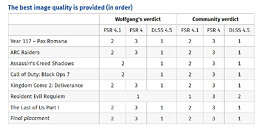 However, it's important to note that AMD has made significant improvements from FSR 4.0 to the latest FSR 4.1 version, nearly matching NVIDIA's technology and even surpassing it in one game. This indicates that AMD is on a promising path of improvement, and future FSR versions might achieve visual parity with NVIDIA's current DLSS 4.5 technology. Gamers are increasingly preferring DLSS 4.5 outputs over native rendering, and future techniques like neural rendering will elevate this further. Revisiting this testing in the future will be intriguing to see how neural rendering is perceived and which platform integrates it best.
Source:
ComputerBase
Similar to the previous test, the ComputerBase team conducted the comparison using videos labeled with three options, without revealing which rendering method was used, to ensure a fully blind test. This resulted in a community verdict with two notable outcomes. First, NVIDIA's DLSS 4.5 remains the leader in image quality, with 6 out of 7 games showing the best results using DLSS 4.5. The only game where AMD's FSR upscaling came out on top was Resident Evil Requiem, where DLSS 4.5 placed second behind FSR 4.1. Overall, DLSS 4.5 is seen as providing sharper visual details and more consistent frame generation compared to AMD's FSR upscaling.


92 Comments on Blind Test Shows Gamers Prefer NVIDIA DLSS 4.5 Over AMD FSR 4.1
Conceptually a broad blind test with the viewerbase is a pretty good test.
Not much news but still good to show most prefer dlss with a wide or narrow gap depending on the game with a rare fsr4.1 win. Pretty good improvement for amd.
If only Windows users would be allowed to use it on rdna3 as it works quite well on my 7900xt
What I mean by that is:
1. Establish baseline performance in native form
2. Pick Upscaling tech 1 -> calculate performance improvement in percentage
3. Pick Upscaling tech 2 -> Normalize to similar performance improvement in percentage
4. Compare image quality
Why this is important, Picking Zero performance uplift "upscaling" vs 30% performance improvement upscaling, results will be skewed.
Did user benchmark see a boost by people pointing out the many flaws in it's testing methodology or it's highly opinionated editorials? No, they fell off a cliff (they are down in search ranking by 1,367) and their reputation is through the floor. Thus my point is proven.
Ultimately the insinuation that a single user viewing content is driving their clickbait farm is ridiculous at best. People can voice discontent with something while not being considered supporting it.
And once again, you yourself are providing nothing of value to this conversation. You aren't commenting on the topic, only attempting (poorly at that) at a gatcha moment.
Also if you're not using FSR at native scale (FSRAA mode which is the equivalent of DLAA mode for nvidia DLSS) it induces a bit of blurriness due to loss of details. It's more noticeable at long ranges.
I used to do long range fights attack heli vs attack heli with the TOW missile and not using DLAA would make the enemy heli harder to see and so harder to hit.
Being Radeon user I default to FSR, sometimes I go with XeSS if it's older game, but all the new ones that run UE5 automatically support FSR 4.x and it's upgraded to latest version via driver so it's always great. If you're on NVIDIA, you'll obviously use DLSS and also upgrade it via driver.
Now I'm not foolish enough to ask a hypothetical question directly to those crapping on the test, as all I'd get is their hypothetical answer which makes them come off looking 'best' and of course disagrees.
But I know what outcome I'd be betting on.
The saddest part is they're closer than ever and AMD won't officially give their working version to their own customers.Nah if you want to read opinion polls just check out TPU polls - especially ones about upscaling or brand choices.
Opinion polls measure what people think or say they prefer based on subjective opinions, while a blind test measures actual preferences or performance by removing that bias and is accepted scientific methodology.
its like asking if a certain app works better on Android or IOS.....I have an Android so even if it works better on IOS...why would I care? its literally not an option for me....
Then when they're told the results from their choices, they can use that information and plug it into the multi-variate assessment we all make when buying hardware.
How is this choice and delivered result a net negative? They might think that the differences are so slight they don't matter, or that they matter so much they'd never choose a certain option.
Either way it serves to inform any participant more than before they engaged with it, for better or uhhhh.. worse.
Despite what some say, nothing actually locks you to one or another as a gamer, you can literally alternate brands every generation and still play the latest games.
Are you guys that “good” to tell them apart in every game? I certainly am not.
…I’ll see myself out.
No, but jokes aside, reality is that, while DLSS is somewhat superior, the actual margins are very thin and, realistically, both would be absolutely fine when implemented well. Both are better than what passes for “native” today, in most cases. The issue with FSR 4 is just straight up availability. Anyone running a vaguely modern and supported NV card can make use of the latest upscaling. But on AMD side, it’s significantly more limited and that by itself seems to hamper developers adopting the latest features.
The number of participants does not seem to be scientifically significant either. It reminds me of those ads for anti aging gloop, that base their claims on fewer than 100 participants.
After all 8 out 10 cats prefer cat food, lol.
DeepL translates this to: "In addition to the editorial team’s assessment, the community once again has the chance to vote on what they consider to be the best technology in the seven games—albeit not in a blind test."
Claudo Opus 4.7 (total overkill for this) translates it to: "the community once again has the chance to vote on the best technology in the seven games – even if not as a blind test."
The title of this TPU article is just factually wrong. Only the prior test was claimed as "blind".
Nevermind the fact that the original test wasn't blind. They didn't have a control group, they didn't have a placebo entry (showing the same image twice or showing native), participants were self-selecting, ect. Realistically the original test was an online poll with images and hidden labels.People have been pointing out the issues with this kind of polling for a long time now. This isn't an AMD vs Nvidia thing, it stems from the fact that none of these polls are conducted via a platform / medium that is designed to eliminate the many issues running a poll on the internet runs into. Not just for the basics like question ordering, selection, wording, and location (which I've yet to see this even get address despite being fundamental to getting accurate numbers) but also internet specific manipulation and bias. The approach we get to polls via YouTube, TPU, and ComputerBase is not one that provides useful data, especially given the times. It made some sense for the early internet, where having a low effort polling system was less likely to be abused and more excusable because it was a side feature intended for fun.
The way it's broadly done now doesn't make sense in the current environment, where the number of bad actors is basically infinite with the advent of AI agents running for a few dollars an hour. A low cost which will only get lower as time passes. There's a reason people are increasingly less interested in what polling shows nowadays, basically no effort is ever made to make the results somewhat reliable. It's treated as a tool to generate clicks with no attention paid to actually improving it.
Opinion polls measure what people think or say they prefer based on subjective opinions, which are formed over much longer periods of time and accumulated personal experience, against a known set of answers. A blind test offers its participants the exact same quantity and quality of experience and asks them to select their preference, they are not the same.
Because this study did not follow vigorous scientific methodolgy, I don't see its value IMHO which was why I used 'Opinion polling' as a pejorative in the first place, it has about as much value as the average opinion poll one might read in a UK tabloid newspaper.
In the end, I use both DLSS and FSR 4 and I dont really care what other people think about which is 'better' when playing games.
If people are going to take the time to test the hypothesis that one is 'better" that than the other they might as well do it with proper scientific rigour.
End of line
Christ what a boring generation we are living through