Wednesday, April 29th 2026

Blind Test Shows Gamers Prefer NVIDIA DLSS 4.5 Over AMD FSR 4.1

Back in February, ComputerBase conducted a large blind test comparing in-game screenshots generated using the latest upscaling technologies: AMD's FSR 4.0 and NVIDIA's Deep Learning Super Sampling 4.5. The testing has since been updated, and community votes have been processed, revealing that AMD's updated upscaling technology, FSR 4.1, shows significant improvement over FSR 4.0. However, it still trails behind NVIDIA's DLSS 4.5 in visual quality. In the latest ComputerBase testing, the following games were upscaled using FSR 4.0, FSR 4.1, and DLSS 4.5: Year 117 - Pax Romana, ARC Raiders, Assassin's Creed Shadows, Call of Duty: Black Ops 7, Kingdom Come 2: Deliverance, Resident Evil Requiem, and The Last of Us Part I. In all of these games, the ComputerBase review concluded that DLSS 4.5 was the top performer, a view confirmed by the community in a separate blind test vote.

Similar to the previous test, the ComputerBase team conducted the comparison using videos labeled with three options, without revealing which rendering method was used, to ensure a fully blind test. This resulted in a community verdict with two notable outcomes. First, NVIDIA's DLSS 4.5 remains the leader in image quality, with 6 out of 7 games showing the best results using DLSS 4.5. The only game where AMD's FSR upscaling came out on top was Resident Evil Requiem, where DLSS 4.5 placed second behind FSR 4.1. Overall, DLSS 4.5 is seen as providing sharper visual details and more consistent frame generation compared to AMD's FSR upscaling.

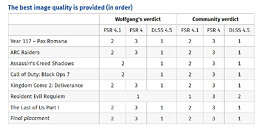
However, it's important to note that AMD has made significant improvements from FSR 4.0 to the latest FSR 4.1 version, nearly matching NVIDIA's technology and even surpassing it in one game. This indicates that AMD is on a promising path of improvement, and future FSR versions might achieve visual parity with NVIDIA's current DLSS 4.5 technology. Gamers are increasingly preferring DLSS 4.5 outputs over native rendering, and future techniques like neural rendering will elevate this further. Revisiting this testing in the future will be intriguing to see how neural rendering is perceived and which platform integrates it best.
Source: ComputerBase
Add your own comment

92 Comments on Blind Test Shows Gamers Prefer NVIDIA DLSS 4.5 Over AMD FSR 4.1

#51
Visible Noise
ZoneDymoYikez, you actually believe people would buy one brand over the other because of the quality of an upscaler?
Christ what a boring generation we are living through
I would.

I did.
Posted on Reply
#52
wolf
Better Than Native
obsidian24776Because this study did not follow vigorous scientific methodolgy, I don't see its value IMHO which was why I used 'Opinion polling' as a pejorative in the first place, it has about as much value as the average opinion poll one might read in a UK tabloid newspaper.
I can't say I agree with this false equivalence because it hasn't met your thresholds, but hey, I'll agree to disagree here, because I can't see them as having similar value.
ZoneDymoYikez, you actually believe people would buy one brand over the other because of the quality of an upscaler?
Christ what a boring generation we are living through
That's fairly twisting my words, come on.

"they can use that information and plug it into the multi-variate assessment we all make when buying hardware."
Posted on Reply
#53
JustBenching
ZoneDymoYikez, you actually believe people would buy one brand over the other because of the quality of an upscaler?
Yeah? Of course.
Posted on Reply
#54
john_
ZoneDymoYikez, you actually believe people would buy one brand over the other because of the quality of an upscaler?
Christ what a boring generation we are living through
15-20 years ago, such features were considered nothing more than 'cheating'.

Since its debut, even in the version 1.0, with all it's disadvantages, DLSS has been promoted as the most essential feature of a modern graphics card. Its marketing has been far more intense and aggressive than that of other features, including Frame Generation and even Raytracing.

So, when the average gamer reads everywhere that DLSS alone justifies paying a significant premium for an Nvidia card, that FSR is 'trash', regardless of the version - these 'blind tests', and even more so the commentary chosen by Computerbase's ....author(?), aim to undermine even version 4.x of FSR - and that XeSS lacks wide support, gamers are heavily influenced. And they aren't just being driven to choose a card based on its upscaler; they are being conditioned to think that the very first thing they must do upon starting a game is enable upscaling. They're led to believe that if the upscaler isn't the absolute best and the latest version, they won't be able to enjoy the game at all. For the average gamer, especially younger ones who have grown up seeing upscaling as a standard performance-boosting option, buying based on upscaling has become the norm.
Posted on Reply
#55
JustBenching
john_So, when the average gamer reads everywhere that DLSS alone justifies paying a significant premium for an Nvidia card, that FSR is 'trash', regardless of the version - these 'blind tests', and even more so the commentary chosen by
This battle happens all in your head though. FSR 4 has been received insanely positive by everyone. You are shadowboxing an invisible enemy trying to convince us he is real.
Posted on Reply
#56
lexluthermiester
JustBenchingFSR 4 has been received insanely positive by everyone.
Don't exaggerate. Well received does not equate to "insanely positive".
Posted on Reply
#57
john_
JustBenchingThis battle happens all in your head though. FSR 4 has been received insanely positive by everyone. You are shadowboxing an invisible enemy trying to convince us he is real.
It might come as a shock, but it is possible to reply using actual arguments instead of resorting to personal comments with the only goal to discredit someone with a different view. Believe it or not—check with others if you don't believe me—there are ways to focus on the heart of the matter rather than trying to diminish the person you're talking to.
Posted on Reply
#58
JustBenching
W1zzard gave it 5 out of 5. So who called it trash?


Posted on Reply
#59
lexluthermiester
JustBenchingW1zzard gave it 5 out of 5. So who called it trash?


There's a long list, however most of those peoples are sellouts or are beyond stupid..
Posted on Reply
#60
JustBenching
lexluthermiesterThere's a long list, however most of those peoples are sellouts or are beyond stupid..
W1zzard has received numerous similar comments (that he is basically shilling for dlss) in every review and comparison he has done between the two. So seeing how he gave it a 5 out of 5...well, shows that he isn't doing that.
Posted on Reply
#61
lexluthermiester
JustBenchingW1zzard has received numerous similar comments (that he is basically shilling for dlss)
And we know that is total nonsense.
JustBenchingSo seeing how he gave it a 5 out of 5...well, shows that he isn't doing that.
Exactly.
Posted on Reply
#62
john_
JustBenchingW1zzard gave it 5 out of 5. So who called it trash?
TPU characterized FSR 3.x and its previous versions as more or less useless in almost every single review. Some people disagreed, arguing that while playing, they didn't care about having a 100% perfect image as much as having smooth motion, which was the result of a higher framerate. Regarding version 4.0, it received positive reviews, mainly because many considered it superior to DLSS 3 and thus sufficient for Radeon owners to finally have high-quality upscaling. However, over time, 'blind tests' and comments have started popping up on various websites and YouTube channels attempting to present FSR 4.x as 'too little' compared to DLSS 4.5. In a previous 'blind test' by ComputerBase, FSR 4.0 was presented as inferior to native resolution, which in turn is considered inferior to DLSS 3. This was a clear contradiction to what was initially said about FSR 4.0 being superior to DLSS 3. In ComputerBase's latest 'blind test', the author mentions in his commentary that AMD has not only failed to close the gap with Nvidia's DLSS, but is actually starting to fall behind again. We are seeing, therefore, an attempt by certain media outlets to once again cultivate a climate of depreciation toward FSR, even in its latest version.
Posted on Reply
#63
JustBenching
john_TPU characterized FSR 3.x and its previous versions as more or less useless in almost every single review.
Which is true. Now regardless of whether you agree or not - FSR 4 was a big improvement and VOILA, nobody called it crap again.

I don't see what you are seeing. In my community on X almost everyone considers FSR4 superior to DLSS 4.5. Not necessarily for image quality but for the performance.
Posted on Reply
#64
john_
JustBenchingWhich is true. Now regardless of whether you agree or not - FSR 4 was a big improvement and VOILA, nobody called it crap again.
So, you agree that the versions before 4.0 were 'trash'. You agree that even TPU more or less used that characterization. And that's your opinion and in a market where Nvidia controls 90%, probably most people have that opinion. But definitely not what everyone would consider as 'truth'. Just an opinion. So, was I wrong there when I said that many associated the characterization 'trash' with FSR? Personally, I found that characterization to be an exaggeration, to say the least. I played Tomb Raider—which didn't even support FSR—using AFMF 2.1 on an RX 6600, and I thoroughly enjoyed it. And keep in mind, AFMF is considered inferior to FSR 2.x because it’s a driver-level feature, not integrated into the game itself. When you’re playing a game, you know you’re looking at computer graphics. You don't expect perfection, nor do you care about it. In fact, if you happen to be of a certain age, you grew up with much more simplistic graphics. But more importantly, you grew up with a mindset that makes gameplay the priority and graphics secondary.
I don't see what you are seeing. In my community on X almost everyone considers FSR4 superior to DLSS 4.5. Not necessarily for image quality but for the performance.
Does your community on X consist of people who expect to receive graphics cards and drivers early so they can have their reviews ready by launch day? If they come out and say what you’re saying—if they claim that FSR 4.x is better than DLSS 4.5—do they risk seeing the number of review units they receive decrease? If not, then we are talking about two completely different categories of people. There is a huge difference between someone who voices their opinion fearlessly and someone who has to be careful about what they say and how they say it.
And by the way, if everyone in your community on X says that FSR is superior to DLSS 4.5, does it make it truth, or is it just an opinion?
Posted on Reply
#65
JustBenching
john_So, you agree that the versions before 4.0 were 'trash'. You agree that even TPU more or less used that characterization.
I don't remember TPU saying it's trash. And no I don't think it was trash but let's just say it wasn't good. Unlike DLSS back then it was more like last resort - "oh crap I can't play this game without it, I might as well enable it".

The problem with FSR (before 4) was that - if you see it, you couldn't unsee it. I had people posting me videos of how great FSR looked, and when I pointed out some stuff to them (the whole background basically being jelly and bouncing around) they were like "oh, now I can see it". And then you can't unsee it.
john_Does your community on X consist of people who expect to receive graphics cards and drivers early so they can have their reviews ready by launch day? If they come out and say what you’re saying—if they claim that FSR 4.x is better than DLSS 4.5—do they risk seeing the number of review units they receive decrease? If not, then we are talking about two completely different categories of people. There is a huge difference between someone who voices their opinion fearlessly and someone who has to be careful about what they say and how they say it.
This is the shadowboxing we were talking about. I'll make the same argument - if reviewers don't find the x3d the best CPU fro gaming they risk not receiving launch days reviews....Can we stop making things up my man?
john_And by the way, if everyone in your community on X says that FSR is superior to DLSS 4.5, does it make it truth, or is it just an opinion?
Since it's based on the performance, it's a fact. Performance is measurable, FSR4 tends to run higher framerates than DLSS 4.5. It's for the same reason I prefer DLSS 4 over 4.5.
Posted on Reply
#66
john_
JustBenchingI don't remember TPU saying it's trash. And no I don't think it was trash but let's just say it wasn't good. Unlike DLSS back then it was more like last resort - "oh crap I can't play this game without it, I might as well enable it".
Again, it depends on the player. Ultimately, if FSR was poorly implemented in a game, one could simply lower the resolution instead of enabling upscaling. That’s what we all used to do before upscaling was introduced as a better solution.
JustBenchingThe problem with FSR (before 4) was that - if you see it, you couldn't unsee it. I had people posting me videos of how great FSR looked, and when I pointed out some stuff to them (the whole background basically being jelly and bouncing around) they were like "oh, now I can see it". And then you can't unsee it.
The moment you resort to upscaling, image quality will inevitably take a hit. This applies not only to FSR but also to DLSS; with every new version, reviewers suddenly discover flaws in the previous one that they couldn't find before. That is why many people choose not to enable upscaling at all.
JustBenchingThis is the shadowboxing we were talking about. I'll make the same argument - if reviewers don't find the x3d the best CPU fro gaming they risk not receiving launch days reviews....Can we stop making things up my man?
These are completely different cases. As you mention further down in your post, performance is something measurable.
JustBenchingSince it's based on the performance, it's a fact. Performance is measurable, FSR4 tends to run higher framerates than DLSS 4.5. It's for the same reason I prefer DLSS 4 over 4.5.
You cannot treat a subjective opinion on upscaler quality as an objective truth only when it suits you, and then immediately pivot your argument by talking about measurable performance. Furthermore, DLSS 4.5 is considered superior to DLSS 4.0. In fact, the ComputerBase author relies on this approach to downplay FSR 4.1, claiming that Nvidia has achieved significant quality improvements with DLSS 4.5 compared to 4.0. Therefore, the ComputerBase author could point out differences between DLSS 4.0 and 4.5 that you won't be able to 'unsee' afterwards.
Posted on Reply
#67
JustBenching
john_Again, it depends on the player. Ultimately, if FSR was poorly implemented in a game, one could simply lower the resolution instead of enabling upscaling. That’s what we all used to do before upscaling was introduced as a better solution.

The moment you resort to upscaling, image quality will inevitably take a hit. This applies not only to FSR but also to DLSS; with every new version, reviewers suddenly discover flaws in the previous one that they couldn't find before. That is why many people choose not to enable upscaling at all.

These are completely different cases. As you mention further down in your post, performance is something measurable.

You cannot treat a subjective opinion on upscaler quality as an objective truth only when it suits you, and then immediately pivot your argument by talking about measurable performance. Furthermore, DLSS 4.5 is considered superior to DLSS 4.0. In fact, the ComputerBase author relies on this approach to downplay FSR 4.1, claiming that Nvidia has achieved significant quality improvements with DLSS 4.5 compared to 4.0. Therefore, the ComputerBase author could point out differences between DLSS 4.0 and 4.5 that you won't be able to 'unsee' afterwards.
Computerbases approach is wrong cause as I've said in the previous page, if you don't performance normalize any image quality comparisons are pointless. 4.5 might look better than 4 but it's also a lot heavier. To the point where im getting the fps in DLSS 4 Quality as I do with 4.5 in performance mode.

So yes - 4.5 is superior in image quality, but unless you take FPS into account it's completely pointless. You might as well argue that DLDSR at 4x is better. Well yeah it is, but you are dropping to 20 fps. The point of upscalers isn't to get you more FPS - at least not in my opinion. The point of upscalers is to give you better image quality at the same FPS. Say your goal is to hit 90 frames per second, what method gives you the best image quality? And I think FSR 4 and DLSS 4 are better than 4.5 in that regard. Previous iterations of FSR aren't even in the ballpark, and neither is native.
Posted on Reply
#68
john_
JustBenchingComputerbases approach is wrong cause as I've said in the previous page, if you don't performance normalize any image quality comparisons are pointless. 4.5 might look better than 4 but it's also a lot heavier. To the point where im getting the fps in DLSS 4 Quality as I do with 4.5 in performance mode.

So yes - 4.5 is superior in image quality, but unless you take FPS into account it's completely pointless. You might as well argue that DLDSR at 4x is better. Well yeah it is, but you are dropping to 20 fps. The point of upscalers isn't to get you more FPS - at least not in my opinion. The point of upscalers is to give you better image quality at the same FPS. Say your goal is to hit 90 frames per second, what method gives you the best image quality? And I think FSR 4 and DLSS 4 are better than 4.5 in that regard. Previous iterations of FSR aren't even in the ballpark, and neither is native.
Then, someone else will come along and tell you that DLSS 4.5 in 'Performance' mode is better than DLSS 4.0 in 'Quality' mode, so you're making the wrong choice. They might be right, or they might be wrong. You aren't obligated to follow their opinion; everyone makes their own choices. The same applies to FSR, even when talking about older versions.
Some claim that FSR 4.0 is useless on RDNA 2/3 cards due to low performance.
Others will disagree with you, arguing that the whole point of upscalers is to achieve a higher framerate.

Everyone is entitled to their opinion. The problem arises when someone cannot tolerate others having a different view. In fact, some are so absolute in their belief that the other person is wrong, that they start drawing conclusions not about the opinion itself, but about the person expressing it.
Posted on Reply
#69
JustBenching
john_Then, someone else will come along and tell you that DLSS 4.5 in 'Performance' mode is better than DLSS 4.0 in 'Quality' mode, so you're making the wrong choice. They might be right, or they might be wrong. You aren't obligated to follow their opinion; everyone makes their own choices. The same applies to FSR, even when talking about older versions.
Some claim that FSR 4.0 is useless on RDNA 2/3 cards due to low performance.
Others will disagree with you, arguing that the whole point of upscalers is to achieve a higher framerate.

Everyone is entitled to their opinion. The problem arises when someone cannot tolerate others having a different view. In fact, some are so absolute in their belief that the other person is wrong, that they start drawing conclusions not about the opinion itself, but about the person expressing it.
Well when they all hit the "good enough" point (and FSR certainly did that with version 4) it doesn't matter to me anymore. They are all great. Comparing them at this point is epeen measuring. The fatal flaw with FSR4 is the company behind it, not supporting it in cards that could really really use it
Posted on Reply
#70
john_
JustBenchingWell when they all hit the "good enough" point (and FSR certainly did that with version 4) it doesn't matter to me anymore. They are all great. Comparing them at this point is epeen measuring. The fatal flaw with FSR4 is the company behind it, not supporting it in cards that could really really use it
Then again, you are expressing an opinion that others will disagree with. But it doesn't matter. Everyone chooses what they want.

Intel is the only company making an effort to keep users satisfied in the GPU market—out of necessity. They offer both good upscaling and multi-frame generation to everyone, even for iGPUs. From what I can understand, AMD has let many people from the Radeon Group leave for Intel and Nvidia. They have focused on EPYC and Instinct. Their problem seems to be a lack of will to support new features on older cards, likely because it would require dedicated staff or even hiring and training new personnel. I assume that’s the reason. However, they have the money now and those older cards still sell. Furthermore, as I’ve mentioned in the past and other posts, they could offer it as a beta without official support. Nvidia, however, pulls similar stunts. They could have easily offered Frame Generation to the 3000 series; they could provide Multi-Frame Generation for every RTX card. I'm not sure if they could even offer Frame Generation or upscaling to the 16-series, as it is based on the Turing architecture. But Nvidia controls the market; they can get away with it. It’s not the same. AMD made the wrong call regarding FSR 4.0 on RDNA 2/3.
Posted on Reply
#71
lexluthermiester
Guys, this back & forth seems to be going in circles, don't you think?
Posted on Reply
#72
john_
lexluthermiesterGuys, this back & forth seems to be going in circles, don't you think?
Many times in forums this happens, not just here and now. Many discussions end up in circles and now that we are talking about it, it's like that scene in Top Gun Maverick where both are pushing beyond the limit until someone bails out.
Posted on Reply
#73
lexluthermiester
john_Many times in forums this happens, not just here and now. Many discussions end up in circles and now that we are talking about it, it's like that scene in Top Gun Maverick where both are pushing beyond the limit until someone bails out.
I love that movie. Keeps the spirit of the first going and improves on it. Very rare thing for Hollywood. Good example too!

I'm going to offer my two cents from experience.
Whether or not FSR, XeSS or DLSS is better or worse is HIGHLY dependent on the factors of use. The game engine, the settings used, the GPU used and, of course, the users personal preference.
In blind tests like the one subject of this article, overall preference can be relieved but it's VERY important to note that stated preference is a reflection of the test parameters and settings and as such the lead might be by the slimmest of margins.

The Key take away here? Test for yourself, with each game you enjoy and find out what settings meet with your personal liking.

For me personally? I don't use any of them. It's the raw native performance or nothing. I don't use AA of any kind and all other settings are adjusted to my personal liking.
So for me, all of this is academic..
Posted on Reply
#74
wolf
Better Than Native
john_15-20 years ago, such features were considered nothing more than 'cheating'.
Citation needed.
Posted on Reply
#75
lexluthermiester
wolfCitation needed.
User verified. That's how we looked at such things back in the day.
Posted on Reply
Add your own comment
Nov 25th, 2026 09:22 CST change timezone

New Forum Posts

Popular Reviews

TPU on YouTube

Controversial News Posts