Wednesday, April 29th 2026

Blind Test Shows Gamers Prefer NVIDIA DLSS 4.5 Over AMD FSR 4.1

Back in February, ComputerBase conducted a large blind test comparing in-game screenshots generated using the latest upscaling technologies: AMD's FSR 4.0 and NVIDIA's Deep Learning Super Sampling 4.5. The testing has since been updated, and community votes have been processed, revealing that AMD's updated upscaling technology, FSR 4.1, shows significant improvement over FSR 4.0. However, it still trails behind NVIDIA's DLSS 4.5 in visual quality. In the latest ComputerBase testing, the following games were upscaled using FSR 4.0, FSR 4.1, and DLSS 4.5: Year 117 - Pax Romana, ARC Raiders, Assassin's Creed Shadows, Call of Duty: Black Ops 7, Kingdom Come 2: Deliverance, Resident Evil Requiem, and The Last of Us Part I. In all of these games, the ComputerBase review concluded that DLSS 4.5 was the top performer, a view confirmed by the community in a separate blind test vote.

Similar to the previous test, the ComputerBase team conducted the comparison using videos labeled with three options, without revealing which rendering method was used, to ensure a fully blind test. This resulted in a community verdict with two notable outcomes. First, NVIDIA's DLSS 4.5 remains the leader in image quality, with 6 out of 7 games showing the best results using DLSS 4.5. The only game where AMD's FSR upscaling came out on top was Resident Evil Requiem, where DLSS 4.5 placed second behind FSR 4.1. Overall, DLSS 4.5 is seen as providing sharper visual details and more consistent frame generation compared to AMD's FSR upscaling.

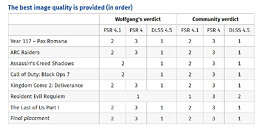
However, it's important to note that AMD has made significant improvements from FSR 4.0 to the latest FSR 4.1 version, nearly matching NVIDIA's technology and even surpassing it in one game. This indicates that AMD is on a promising path of improvement, and future FSR versions might achieve visual parity with NVIDIA's current DLSS 4.5 technology. Gamers are increasingly preferring DLSS 4.5 outputs over native rendering, and future techniques like neural rendering will elevate this further. Revisiting this testing in the future will be intriguing to see how neural rendering is perceived and which platform integrates it best.
Source: ComputerBase
Add your own comment

92 Comments on Blind Test Shows Gamers Prefer NVIDIA DLSS 4.5 Over AMD FSR 4.1

#76
wolf
Better Than Native
lexluthermiesterUser verified. That's how we look at such things back in the day.
Like, one person says something and one other agrees, and now that's a factual retelling of history? Can I try too?
Posted on Reply
#77
lexluthermiester
wolfLike, one person says something and one other agrees, and now that's a factual retelling of history? Can I try too?
Sure. Are you going to offer an opposing position?
Posted on Reply
#78
zenlessyank
"My fake girlfriend is prettier than your fake girlfriend."

A blind test without using the original unfaked frames in the mix. Need I go on? This as about as useful as dehydrated water. It is almost as if the bickering fodder is intentional.
Posted on Reply
#79
wolf
Better Than Native
lexluthermiesterSure. Are you going to offer an opposing position?
15-20 years ago, such features didn't exist, not even remotely close to what we currently have. What was there to reduce render resolution and aide performance was rarely if ever controversial, if present.

Since its debut, even in the version 1.0, with all it's disadvantages, DLSS had been promoted by its maker as a feature to offset the performance cost of raytracing. Its marketing has gradually increased over the years as it has overtaken raytracing in desirability by customers, as a generally performance enhancing feature irrespective of raytracing, with very little in the way of downsides.

When the average gamer reads from tech press who test DLSS features and game/product support vs competing solutions, they see that DLSS can potentially justify paying a premium for an Nvidia card, and that FSR has historically had significant issues from v1-3.1, and that fsr 4+ has all but caught up and even has performance wins, and despite the lacklustre product and long term support, gamers are more informed than ever.

They aren't just being driven to choose a card based on raster performance and VRAM, they're being given more information about the strengths and weaknesses of each products feature set, and how widely supported they are in games, as well as the products themselves and their short and long term support.

I an a hardware and gaming landscape where high resolutions, high framerates and next generation visual features are desirable to a large proportion of pc gamers, those buyers are placing increasing value on a hardware purchase that has the features and long term product and feature support to enable the experience they desire.
Posted on Reply
#80
lexluthermiester
wolf15-20 years ago, such features didn't exist, not even remotely close to what we currently have.
No, but things similar to this did and were not well received. Not going down that list either, it's too long to attempt.
wolfWhat was there to reduce render resolution and aide performance was rarely if ever controversial, if present.
No, but there were many attempts to come up with schemes to improve the gaming experience that were little more than was to "cheat" the system and gamers.
Posted on Reply
#81
wolf
Better Than Native
lexluthermiesterNo, but things similar to this did and were not well received.
lexluthermiesterNo, but there were many attempts to come up with schemes to improve the gaming experience that were little more than was to "cheat" the system and gamers
Care to elaborate? This is all very vague.

I recall render resolution sliders/settings in games, not forced and not really problematic or called "cheating". Reducing the quality of effects generally decreases their resolution and wasn't considered cheating either.

Or is this a reference back to the geforce fx period with cheating at the driver level in that instance? I don't follow what "such features" are claimed to be happening 15-20 years ago that was cheating the system and gamers.
Posted on Reply
#82
lexluthermiester
wolfI don't follow what "such features" are claimed to be happening 15-20 years ago that was cheating the system and gamers.
That was a fair example, there were many others. IF you're not following why that's considered cheating then there is no reason for further debate on the subject.
Posted on Reply
#83
john_
From Copilot (sorry, for choosing Copilot, I thought I give a chance to Microslop)

Before 2015, both Nvidia and AMD/ATI used techniques that resemble today’s upscaling in the sense that they produced artificially improved performance or image quality that didn’t reflect true rendering workload. These methods weren’t AI‑based like modern DLSS/FSR, but the underlying idea was similar: increasing apparent performance by altering how frames were generated or displayed.

Key historical examples include:

Driver “optimizations” that reduced image quality (e.g., Nvidia GeForce FX in 2003), boosting FPS by rendering less detail than advertised.

Benchmark‑specific tricks, where drivers detected executables like 3DMark03 and applied special settings not used in real games, inflating scores for both Nvidia and ATI.

Adaptive or “fake” trilinear filtering, used by both companies in the 2000s, which mimicked higher‑quality filtering while actually cutting corners.

Application‑specific performance boosts in games like Quake III, where ATI enabled special paths only for certain titles or benchmarks.

How this resembles modern upscaling:
In all these cases, the displayed image wasn’t a fully accurate representation of native rendering. Just as upscaling reconstructs detail from a lower‑resolution base, these older techniques produced performance or visuals that were not the result of full, native computation. The difference is that today’s methods are openly documented, technically advanced, and widely accepted, whereas earlier ones were often considered misleading or deceptive.
Posted on Reply
#84
wolf
Better Than Native
lexluthermiesterThat was a fair example, there were many others. IF you're not following why that's considered cheating then there is no reason for further debate on the subject.
All I asked for was being specific, without examples what am I supposed to agree with? I was the first to offer a real example because I genuinely did not know what you were both talking about.

So john_ I see your copilot assessment and it seems I was pretty close with my GeForce FX guess, so in relation to;
john_15-20 years ago, such features were considered nothing more than 'cheating'.
They weren't actually features back then at all... they were a select few isolated cases of doing something dishonest behind the scenes, and trying to hide that from the user. To me these situations aren't really comparable at all, when those tricks were used the user had no awareness and no way to disable it if so (until it was surfaced and they could change drivers), as oppose to optional settings added to current era games where the users is in completely control of how they are deployed, or not. To me, likening the two as 'such features' is false equivalence.

here is a copilot answer on how they differ.

Prompt: please succinctly articulate the differences between the situation in the early 2000's where Nvidia and ATI cheated image quality and the current landscape of upscaling

Early‑2000s Image‑Quality “Cheating” (NVIDIA / ATI)

  • Undisclosed driver behavior altered rendering when benchmarks were detected.
  • Image quality was silently reduced (shader replacement, lower precision, broken filtering).
  • Results claimed full fidelity but delivered less.
  • Often benchmark‑specific and misleading.
  • Goal: inflate performance numbers.

Modern Upscaling (DLSS, FSR, XeSS)

  • Explicit, user‑enabled techniques that trade resolution for performance.
  • Lower internal resolution is disclosed, with clearly labeled modes.
  • Image reconstruction is the point, not a hidden side effect.
  • Applies uniformly across gameplay, not selectively.
  • Goal: make modern rendering feasible.

Core Difference

Early cheating was hidden and deceptive.
Modern upscaling is transparent, intentional, and opt‑in.
-----------------------------------------
May I ask what prompt you used?
Posted on Reply
#85
JustBenching
Even for the native enjoyers out there, you can't possibly mean that DLSS / FSR is cheating. Even if we agree for the sake of argument that 4k DLSS / FSR quality isn't as good as 4k native - it still is better than 1440p native while providing the same performance. Getting better image quality without sacrificing performance isn't cheating. So instead of getting a 1440p monitor cause you have a midrange card, grab a 4k one and enable upscaling, congrats you upgraded your image quality.
Posted on Reply
#86
wolf
Better Than Native
JustBenchingEven for the native enjoyers out there, you can't possibly mean that DLSS / FSR is cheating
Optional features and settings choices by definition aren't "cheating" anyway. Unless cheating to get better performance also involves a user's choice in low, medium, high, ultra, optimised, any combination of their choosing settings, as well as using a subnative resolution or resolution scaling etc. Of course, a reviewer misrepresenting fps with a game set to medium as if it was set to high would still be wrong, or using DLSS quality and saying it's native resolution results and so on.
Posted on Reply
#87
lexluthermiester
wolfI was the first to offer a real example because I genuinely did not know what you were both talking about.
Perhaps because you weren't alive to be there, or maybe just not old enough to have had such thing be relevant enough to you for it to have stuck in your memory. We don't know enough about you to know that. It's certainly not the kind of lengthy debate I want to engage in. We were there, we remember. You can either take our word for it, look it up yourself if you really want to know, or not.

But make no mistake, it happened and THAT time, it was consider sneaky underhanded nonsense and cheating. ATI started it, and NVidia followed suit. 3DFX was on it's way out at the time and never got a chance to engage in that kind of sneaky crap.
Posted on Reply
#88
wolf
Better Than Native
lexluthermiesterPerhaps because you weren't alive to be there, or maybe just not old enough to have had such thing be relevant enough to you for it to have stuck in your memory. We don't know enough about you to know that. It's certainly not the kind of lengthy debate I want to engage in. We were there, we remember. You can either take our word for it, look it up yourself if you really want to know, or not.
I'm trying to be as respectful as I can here because I value your input across this sites, but this is getting frustrating.

I was there, I do remember, cast your mind back some 36hrs and re read the replies to see that I was the first person to actually be specific as to the vague notion John put forward. He mentioned 'such features', you seemed to agree, I said "citation needed", and "Care to elaborate? This is all very vague." and questioned what "features" and named multiple possibilities because neither of you were actually specific whatsoever about what on earth he was talking about because nothing seemed to actually fit the bill based on "such features".

I'm not a mind reader, once either of you actually agreed with my example or said what you actually meant instead of vaguely implying "such features", we could actually discuss the difference between those and modern upscaling. I had to first understand what was meant by "such features", because the statement used a vague and ill fitting term to describe the cheating. I can't take someone's word for something when I don't even know what on earth they're talking about.
lexluthermiesterBut make no mistake, it happened and THAT time, it was consider sneaky underhanded nonsense and cheating. ATI started it, and NVidia followed suit. 3DFX was on it's way out at the time and never got a chance to engage in that kind of sneaky crap.
I don't doubt it for a millisecond, that was absolutely, conclusively and user verified cheating, but I had no idea that's what was being referenced, because it was referred to as a feature, which they weren't, which caused the entire confusion.

I am in complete agreement that those examples all were and are cheating and terrible and should called out every time. DLSS, FSR, XeSS are not that. It's that simple.

About the only thing they even slightly have in common is reducing visual quality to improve performance. None of the rest of it is at all, and I've already gone into why at length.
Posted on Reply
#89
JustBenching
wolfI'm trying to be as respectful as I can here because I value your input across this sites, but this is getting frustrating.

I was there, I do remember, cast your mind back some 36hrs and re read the replies to see that I was the first person to actually be specific as to the vague notion John put forward. He mentioned 'such features', you seemed to agree, I said "citation needed", and "Care to elaborate? This is all very vague." and questioned what "features" and named multiple possibilities because neither of you were actually specific whatsoever about what on earth he was talking about because nothing seemed to actually fit the bill based on "such features".

I'm not a mind reader, once either of you actually agreed with my example or said what you actually meant instead of vaguely implying "such features", we could actually discuss the difference between those and modern upscaling. I had to first understand what was meant by "such features", because the statement used a vague and ill fitting term to describe the cheating. I can't take someone's word for something when I don't even know what on earth they're talking about.

I don't doubt it for a millisecond, that was absolutely, conclusively and user verified cheating, but I had no idea that's what was being referenced, because it was referred to as a feature, which they weren't, which caused the entire confusion.

I am in complete agreement that those examples all were and are cheating and terrible and should called out every time. DLSS, FSR, XeSS are not that. It's that simple.

About the only thing they even slightly have in common is reducing visual quality to improve performance. None of the rest of it is at all, and I've already gone into why at length.
Occlusion culling is the only thing I can think off. I wouldn't call it cheating though, I would call it working smarter. Nothing else comes to my mind either, and I've been gaming since 93.
Posted on Reply
#90
john_
wolf"features"
You are playing with words here. I used the word "features" because that's how we see them today. 20 years ago the word would be "cheating" and I never thought someone would need an explanation on this. Except if the goal here is to forget what we are talking about and focus on the word used.

We are not a court, we are a forum.
Posted on Reply
#91
wolf
Better Than Native
john_You are playing with words here. I used the word "features" because that's how we see them today. 20 years ago the word would be "cheating" and I never thought someone would need an explanation on this. Except if the goal here is to forget what we are talking about and focus on the word used.

We are not a court, we are a forum.
I'm not playing with words, I was trying to understand what was being implied. It was vague, and I didn't know what you meant by it because it just didn't add up to me, and we eventually got there after I asked and did some guesswork. Actually being precise with the wording and description of what you meant made all the difference. I'm not a mind reader and choice of words does matter. I never implied this was a court.

I still stand by saying that what we agree was cheating then, and modern upscaling today, being extremely different and almost entirely incomparable technologically, in operation and socially, as I outlined in this comment.
Posted on Reply
#92
lexluthermiester
wolfI'm trying to be as respectful as I can here because I value your input across this sites, but this is getting frustrating.

I was there, I do remember, cast your mind back some 36hrs and re read the replies to see that I was the first person to actually be specific as to the vague notion John put forward. He mentioned 'such features', you seemed to agree, I said "citation needed", and "Care to elaborate? This is all very vague." and questioned what "features" and named multiple possibilities because neither of you were actually specific whatsoever about what on earth he was talking about because nothing seemed to actually fit the bill based on "such features".

I'm not a mind reader, once either of you actually agreed with my example or said what you actually meant instead of vaguely implying "such features", we could actually discuss the difference between those and modern upscaling. I had to first understand what was meant by "such features", because the statement used a vague and ill fitting term to describe the cheating. I can't take someone's word for something when I don't even know what on earth they're talking about.
Then perhaps we just have a difference of opinion and perspective. It is also entirely possible that we passed through the same point in time and never crossed paths with some of the same issues. I too value you and the input you offer. This is one of those things we experienced differently and thus just have to let it go and chock it up to life being life. It happens.
wolfI don't doubt it for a millisecond, that was absolutely, conclusively and user verified cheating, but I had no idea that's what was being referenced, because it was referred to as a feature, which they weren't, which caused the entire confusion.

I am in complete agreement that those examples all were and are cheating and terrible and should called out every time. DLSS, FSR, XeSS are not that. It's that simple.

About the only thing they even slightly have in common is reducing visual quality to improve performance. None of the rest of it is at all, and I've already gone into why at length.
Agreed. DLSS, FSR and XeSS are not exactly the same kinda of thing. These are technological attempts to improve performance without degrading overall visual experiences, and each is up front about what they are doing, how and why. So today's efforts, while similar in technological goals, are not attempts to deceive or "cheat" the end user.
Posted on Reply
Add your own comment
Nov 25th, 2026 09:22 CST change timezone

New Forum Posts

Popular Reviews

TPU on YouTube

Controversial News Posts