Monday, May 4th 2026
DDR6 Development Aims for Commercial Shipments in 2028
It seems we are not too far from the next-generation Double Data Rate 6 (DDR6) memory for desktops and servers, as memory manufacturers are working with JEDEC to establish a new standard. According to South Korean media outlet The Elec, major memory makers such as SK hynix, Samsung, and Micron have reportedly begun designing DDR6 in their labs and are gradually coordinating module development with substrate manufacturers. This collaborative effort is taking place under the supervision of JEDEC, the industry authority that oversees standard development and ensures a common foundation for design. Manufacturers could have accessed JEDEC's first DDR6 draft since 2024, but the draft still lacks concrete specifications such as finalized voltage ranges, signal usage, power envelopes, and pinout design. However, this is expected to change as manufacturers are now accelerating standard development.
Last year, we reported that the major players mentioned above had already moved past the prototype stages and embarked on rigorous validation cycles. Perhaps the most interesting aspect is the designated throughput of 8,800 MT/s, with plans to scale up to a staggering 17,600 MT/s, nearly doubling the ceiling of today's DDR5. This increase is driven by DDR6's 4×24-bit sub-channel architecture, which requires entirely new approaches to signal integrity. It also differs from DDR5's current 2x32-bit sub-channel structure. To overcome the physical limits faced by DIMM form factors at higher speeds, the industry is betting on CAMM2 technology. Early indications suggest that server platforms will lead the change, with high-end notebooks following once manufacturing ramps up.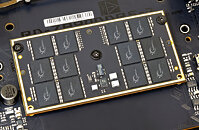 Last year's developments pointed to a 2027 launch. However, this may only apply to customer validation, as commercialization is now expected in 2028. With new server shipments and overall DDR5 usage around 80% last year, and expected to reach about 90% this year, the older DDR4 memory is now being considered for discontinuation. This would make room for newer standards and free up major fab capacity to manufacture these new DDR6 modules.
Source:
The Elec
Last year, we reported that the major players mentioned above had already moved past the prototype stages and embarked on rigorous validation cycles. Perhaps the most interesting aspect is the designated throughput of 8,800 MT/s, with plans to scale up to a staggering 17,600 MT/s, nearly doubling the ceiling of today's DDR5. This increase is driven by DDR6's 4×24-bit sub-channel architecture, which requires entirely new approaches to signal integrity. It also differs from DDR5's current 2x32-bit sub-channel structure. To overcome the physical limits faced by DIMM form factors at higher speeds, the industry is betting on CAMM2 technology. Early indications suggest that server platforms will lead the change, with high-end notebooks following once manufacturing ramps up.

29 Comments on DDR6 Development Aims for Commercial Shipments in 2028
And all of this still depends on market conditions which are terrible right now.
Zen 6 will should be fine on DDR5 i'm would be more concerned about Nova lake's top entries 48-52 Cores on Dual channel DDR5
Zen 7 and whatever intel has next will for sure need DDR6 bandwidth.
just put in all the screws lol
LPCAMM is what is used in laptops, and it has actually shipped. However, it struggles to hit higher speeds then SODIMMs already manage, and for the same reasons. LPCAMM2 supposedly fixed the signal integrity problems but we haven't seen it yet.
People will want to see these techs reliably back up their claims of greater bandwidth and less power without a million asterisks before they are willing to walk away from the standard they have used for 30+ years. As it is now, we have yet to see those claims come to life. And neither SOCAMM or LPCAMM allow for you to upgrade later without throwing out the existing module, unlike DIMMs where you can add more DIMMs at a later date.
SOCAMM is also more expensive due to its compact nature, and the last thing we need now is even more expensive designs
it took NvidAI 500W+ of power through a badly designed connector to *rarely* start a fire after it melted for quite a while
if a pinned design was all it took to start a fire, we'd be getting reports of that happening from CPU sockets that push from 65 to 400W
that implies amd am5 should last at least till 2029.
i translate am5 = 5 = ddr5 // am4 = 4 = ddr4.
the AI monster must be fed, speed is everything, and $ talks, so, realistically, 2030 consumers might catch a break, or maybe there will be some hybrid thing coming out for consumers
Zen 6 wont even double core counts. Nova Lake will more than double, but even this will be fine.
I doubt we will see any core count increases right after with Zen 7 and NVL successor anyway.I already need and fully utilize 32GB. By 2030 i imagine on enthusiast builds 64GB will be the standard. Also because each new DDR generation ups the per stick capacity and the most common stick capacity. With DDR4 it was 8GB so most kits were 16GB. With DDR5 it's 16GB so most kits are 32GB. DDR6 will likely up this to 32GB so most kits will be 64GB.
Im not saying lower or higher capacity kits wont exist. They will, but at reduced availability and higher prices. Thus not being a good deal unless you're building a true budget machine or a workstation monster.Why would it be worse as a late adopter?
I would argue that this is actually the best time to jump on a memory purchase for the following reasons:
1. Speed. Since it's the end of the generation the manufacturers have exacted most they can out of them and this often means that these are actually faster than the brand new standard with it's higher initial latency that largely nullifies it's advantages.
2. Price. Assuming the memory cartel has not upped the prices and the old standard production has not yet ceased, there are very good deals on the older stuff.
3. Compatibility. Since it's been on the market for 5+ years compatibility is excellent.
4. Availability. Same as point 3.
I went from DDR1 to DDR3 at the end of the generation. DDR3 was fast, cheap and available. I had 4x4GB 1866 speeds at CL9 if i remember correctly.
Conversely DDR4 was not that much faster (2100-2400 at CL20+), expensive and had poor availability.
I did the same with DDR4 albeit a bit earlier, but still got very good speeds at a good price. 4x8GB 3733 CL14 (sticks are actually 4400 CL19 rated).That will happen regardless. By the time DDR6 comes we will have DDR5-10000+ below CL46.
Now whether anyone can afford them is another matter entirely...
Probably not that exciting, though, with both AMD and Intel focusing on having massive L3 caches.
Yes, your math is spot on. DDR6 changes the architecture to increase total bandwidth: Single Module: 4 sub-channels × 24-bit = 96-bit total/Dual Channel: 2 modules × 96-bit = 192-bit total.
Narrower 24-bit paths are easier to keep stable at around 17600MHz.
Is 20000 MT/s memory, a performance improvement or not?First word is not the only metric that matters....
Explain "meaningless" more eloquently. You do realize that's double data rate.
Anyways,
20,000 MT/s at CL110 = 11.0 ns, within margin of error behind 6000CL30.