Monday, May 18th 2026

Laptops Powered by Intel "Wildcat Lake" Arrive in China, Starting at $449
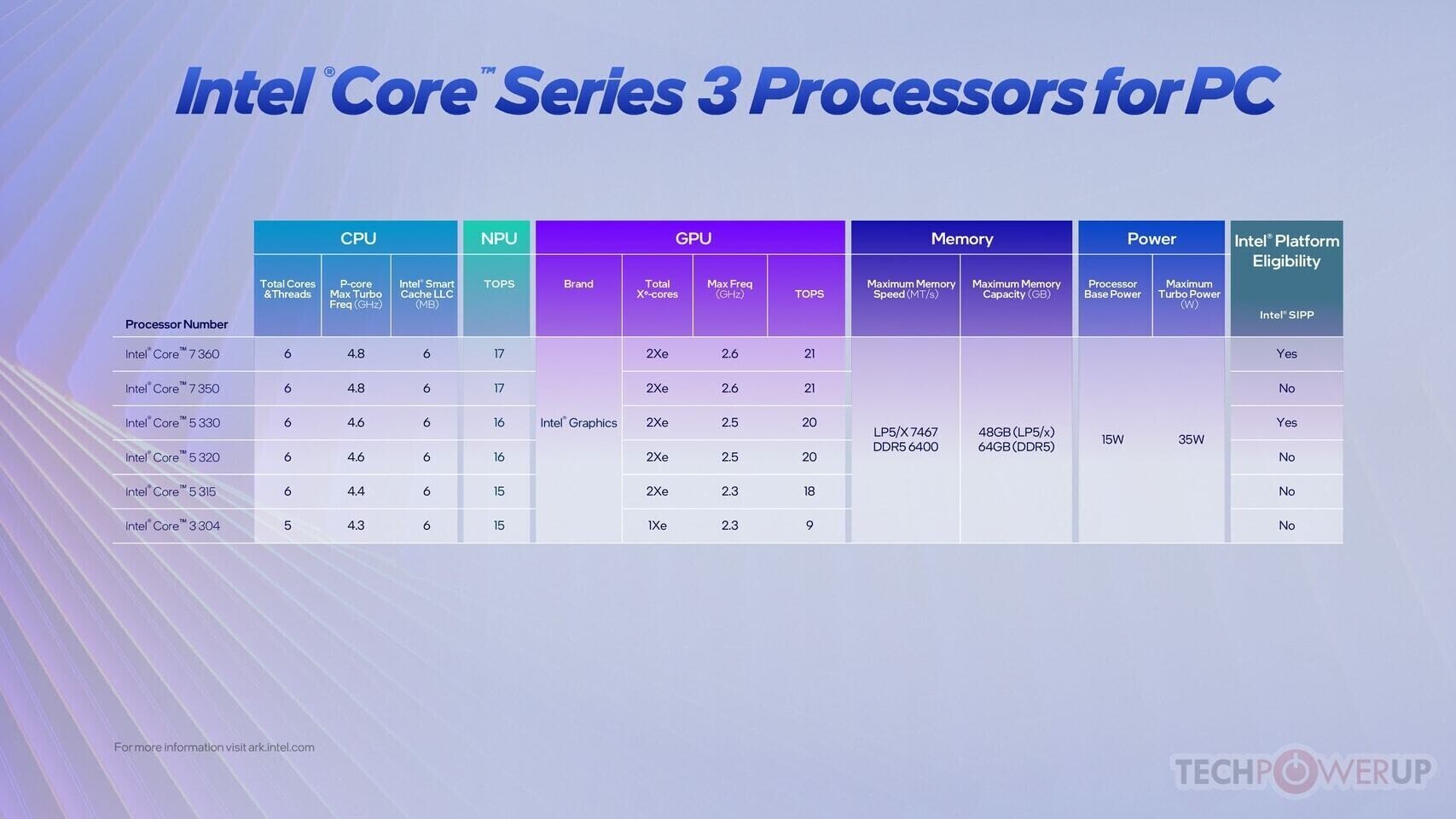
China appears to be the first in line to receive laptops powered by Intel's "Wildcat Lake" Core 300 series processors, and the initial models have already arrived. The most affordable option is the CHUWI UniBook, which features a five-core Intel Core 3 304 processor. This is the lowest in the series and the only five-core "Wildcat Lake" processor available. The laptop comes with 8 GB of LPDDR5X memory running at up to 7,467 MT/s and 256 GB of SSD storage. All of this is housed in a 14-inch body with a 1920x1200 IPS display. Interestingly, this model poses a direct challenge to Apple's MacBook Neo, operating on Windows 11 Pro and a different x86 platform.
Additionally, other laptop manufacturers have started listing their "Wildcat Lake" models on the Chinese retailer JD, including ASUS, HP, and Honor. These offerings include the ASUS Fearless 14SE 2026, HP OmniBook 3, and Honor Notebook X14 2026 Combat Edition. All three models are powered by the Intel Core 5 320 processor, which features a six-core design. They also come with 16 GB of LPDDR5X memory and 512 GB of SSD storage. The prices for these models are $597 for the ASUS, $571 for the Honor, and $662 for the HP OmniBook 3. These laptops offer twice the storage and memory compared to the popular Apple MacBook Neo, aiming to surpass Apple in the entry-level PC market. Interestingly, sales tax is not included in these prices.
 Intel is collaborating with OEMs to ship SoCs featuring the 18A internal Intel node, which includes a 6-core CPU configuration, NPU 5 with 40 TOPS of INT8 data, an Xe display and media engine, and a GPU with up to two Xe3 cores. This die also contains the memory controller and cache pool, supporting LPDDR5X memory running at 7,467 MT/s or up to 6,400 MT/s for DDR5. The memory-side cache includes 4 MB to help buffer tasks before and after accessing memory. Intel dedicates the second die to I/O handling, as the platform supports 6 PCIe Gen 4 lanes, two Thunderbolt 4 connections, two USB 3.2 connectors, and up to eight USB 2.0 connectors. For wireless connectivity, there is the Wi-Fi 7 standard, and Intel also includes Bluetooth 6.0.
Sources:
VideoCardz #1, VideoCardz #2
Additionally, other laptop manufacturers have started listing their "Wildcat Lake" models on the Chinese retailer JD, including ASUS, HP, and Honor. These offerings include the ASUS Fearless 14SE 2026, HP OmniBook 3, and Honor Notebook X14 2026 Combat Edition. All three models are powered by the Intel Core 5 320 processor, which features a six-core design. They also come with 16 GB of LPDDR5X memory and 512 GB of SSD storage. The prices for these models are $597 for the ASUS, $571 for the Honor, and $662 for the HP OmniBook 3. These laptops offer twice the storage and memory compared to the popular Apple MacBook Neo, aiming to surpass Apple in the entry-level PC market. Interestingly, sales tax is not included in these prices.

20 Comments on Laptops Powered by Intel "Wildcat Lake" Arrive in China, Starting at $449
:p
is this a joke?
Because I'm on W10 and 8GB was fine until I needed to run a game. But maybe W10 is better. I'm avoiding W11 for obvious reasons, but people here can get things like W11 debloaters.
Theresa’s no,trim and you had to turn of disk defragmenter or it would ruin the drive.
Whats the point of an npu, when it seems a notebook gpu can generate more "tops"? Are those different tops? is the npu just weak silicion?
But at 17tops it’s aneamic and the limited shared memory bandwidth won’t help either
Apple can sell a machine with 8GB of RAM because macOS is much better with memory. Two years ago, I would have been skeptical about that, but I've been daily driving a base model Mac mini for over a year now. The only time I feel limited by the 16GB of RAM is when I run an LLM on it. I've yet to have the machine feel slow. Then again, no gaming, just daily desktop stuff. Web, email, office apps, streaming, etc.—lots of multitasking on two screens simultaneously. I think that would be a different story for me with only 8GB on macOS, but for most people, I'm sure it is fine.
Before I upgraded to 16GB, my main desktop was 8GB Windows 10. My laptop is 8GB for both 4th Gen U and 7th Gen Y, neither of which has a dGPU. The Y is slower, but it is barely 7W, and runs 5W most of the time. Plus if I enable all C-state power savings on my desktop, it gets noticeably sluggish too. Only time I saw my system dangerously close to pagefile was when I got Expedition 33, and running on a 4GB VRAM card. That's when I quickly swapped out to 8GB VRAM card and got additional 8GB system memory. It was an RX 470 too so there's that as well.
60Hz was shown as fine for many many years.
Windows 11 doesn't exist to me.