Monday, June 22nd 2026
AMD FSR Upscaling 4.1 Officially Released for Radeon RX 7000 GPUs
AMD has officially released the RDNA 3-focused FSR Upscaling 4.1 model for the Radeon RX 7000 series of graphics cards. This marks the first step towards deploying the FSR 4 technology across all RDNA gaming GPUs. According to a post on X by AMD's Jack Huynh, Senior Vice President and General Manager of the Computing and Graphics Group, FSR Upscaling 4.1 is now available for RDNA 3 GPUs. With the latest AMD Software: Adrenalin Edition 26.6.2 graphics driver download, Radeon RX 7000 series gamers can enjoy more than 300 games running FSR 4.1, providing a significant performance boost and finally offering features that RDNA 4 gamers have been enjoying for a while. You can find some AMD-provided performance comparisons in the slides below.
We have confirmed that AMD's FSR Upscaling 4.1 model for RDNA 3 GPUs is fundamentally different from the RDNA 4 version. RDNA 4 has native processing for 8-bit floating point data, allowing FSR 4.1 on RDNA 4 to run on FP8 data types. To get the FSR 4.1 Upscaling model to run on RDNA 3, AMD must convert this to 8-bit integer data, as RDNA 3 hardware uses INT8 data types without FP8 support. Generally, integer math is sufficient to optimize these models, but the conversion work is necessary, which explains the delay between RDNA 4 and RDNA 3 support. This difference required AMD to completely modify the FSR 4.1 model for the new data type and ensure there is no quality loss in the final visual output. AMD officially states that the visual fidelity is on par with the FSR 4.1 model that runs on RDNA 4.
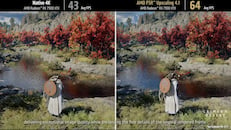

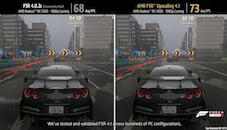 Finally, AMD is also addressing RDNA 3-based APUs. Since integrated graphics are inherently weaker than discrete GPU solutions, some additional performance optimizations are needed. AMD claims that they are working on this with fine-tuned "lightweight machine learning models" to support FSR 4.1. Whether this includes RDNA 3.5 remains to be seen, but Valve's recent leak of the INT8-based FSR 4.1 model shows that the technology runs on RDNA 3.5 without issues, so future updates from AMD are expected.

Source:
Jack Huynh on X
We have confirmed that AMD's FSR Upscaling 4.1 model for RDNA 3 GPUs is fundamentally different from the RDNA 4 version. RDNA 4 has native processing for 8-bit floating point data, allowing FSR 4.1 on RDNA 4 to run on FP8 data types. To get the FSR 4.1 Upscaling model to run on RDNA 3, AMD must convert this to 8-bit integer data, as RDNA 3 hardware uses INT8 data types without FP8 support. Generally, integer math is sufficient to optimize these models, but the conversion work is necessary, which explains the delay between RDNA 4 and RDNA 3 support. This difference required AMD to completely modify the FSR 4.1 model for the new data type and ensure there is no quality loss in the final visual output. AMD officially states that the visual fidelity is on par with the FSR 4.1 model that runs on RDNA 4.


106 Comments on AMD FSR Upscaling 4.1 Officially Released for Radeon RX 7000 GPUs
Overall, it is the difference between people cheering after a hard fought battle, and people getting total victory in achieving a fundamental and lasting change, where instead of a short cheer, the vibes become more like this :):
For the greed aspect, it seems that the part that was quoted may have been the only part that was actually read which lead to that response. It is like someone opening an article about new fluid bearing designs for large ships, and quoting just the word "and" then write a response assuming they were talking about the game Jack and Daxter, and then arguing that they are wrong in the article and that the game really didn't make Daxter cute enough and that needs to be fixed in a remake of the game. While a valid and correct take on the game, in the context of such an article, it would seem like a strange or nonsensical response. :)
Beyond that, I understand that many will not want to read a long post, but it also makes no sense to read one or 2 sentences and then use your imagination for the rest in order to attack an imaginary straw man rather than engaging with the substance of the post.
Anyway, simply put, AMD needs to be proactive in supporting older hardware, at least to the extent that the competition is in they want to better compete. From a short term greed and profit standpoint, they may not feel happy about dedicating time and resources to an older product they they have replaced with a new generation, but in a market where companies rely on people purchasing new iterations while the old model is still functional, then each generation is a long extended advertisement for the next generation as well as the brand as a whole. People will base their next upgrade decision based on their experience of the previous generation that they purchased. If the user feels well taken care of for how long they used their existing older card then they would feel confident in buying the latest gen card. If the user feels that they were treated poorly, then their next upgrade will be with a competing brand.