Monday, June 22nd 2026
AMD FSR Upscaling 4.1 Officially Released for Radeon RX 7000 GPUs
AMD has officially released the RDNA 3-focused FSR Upscaling 4.1 model for the Radeon RX 7000 series of graphics cards. This marks the first step towards deploying the FSR 4 technology across all RDNA gaming GPUs. According to a post on X by AMD's Jack Huynh, Senior Vice President and General Manager of the Computing and Graphics Group, FSR Upscaling 4.1 is now available for RDNA 3 GPUs. With the latest AMD Software: Adrenalin Edition 26.6.2 graphics driver download, Radeon RX 7000 series gamers can enjoy more than 300 games running FSR 4.1, providing a significant performance boost and finally offering features that RDNA 4 gamers have been enjoying for a while. You can find some AMD-provided performance comparisons in the slides below.
We have confirmed that AMD's FSR Upscaling 4.1 model for RDNA 3 GPUs is fundamentally different from the RDNA 4 version. RDNA 4 has native processing for 8-bit floating point data, allowing FSR 4.1 on RDNA 4 to run on FP8 data types. To get the FSR 4.1 Upscaling model to run on RDNA 3, AMD must convert this to 8-bit integer data, as RDNA 3 hardware uses INT8 data types without FP8 support. Generally, integer math is sufficient to optimize these models, but the conversion work is necessary, which explains the delay between RDNA 4 and RDNA 3 support. This difference required AMD to completely modify the FSR 4.1 model for the new data type and ensure there is no quality loss in the final visual output. AMD officially states that the visual fidelity is on par with the FSR 4.1 model that runs on RDNA 4.
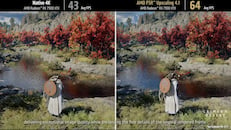

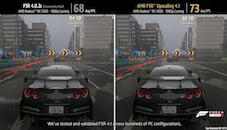 Finally, AMD is also addressing RDNA 3-based APUs. Since integrated graphics are inherently weaker than discrete GPU solutions, some additional performance optimizations are needed. AMD claims that they are working on this with fine-tuned "lightweight machine learning models" to support FSR 4.1. Whether this includes RDNA 3.5 remains to be seen, but Valve's recent leak of the INT8-based FSR 4.1 model shows that the technology runs on RDNA 3.5 without issues, so future updates from AMD are expected.

Source:
Jack Huynh on X
We have confirmed that AMD's FSR Upscaling 4.1 model for RDNA 3 GPUs is fundamentally different from the RDNA 4 version. RDNA 4 has native processing for 8-bit floating point data, allowing FSR 4.1 on RDNA 4 to run on FP8 data types. To get the FSR 4.1 Upscaling model to run on RDNA 3, AMD must convert this to 8-bit integer data, as RDNA 3 hardware uses INT8 data types without FP8 support. Generally, integer math is sufficient to optimize these models, but the conversion work is necessary, which explains the delay between RDNA 4 and RDNA 3 support. This difference required AMD to completely modify the FSR 4.1 model for the new data type and ensure there is no quality loss in the final visual output. AMD officially states that the visual fidelity is on par with the FSR 4.1 model that runs on RDNA 4.


106 Comments on AMD FSR Upscaling 4.1 Officially Released for Radeon RX 7000 GPUs
Yes I'm a RDNA3 user, I should be happy now, but I was not happy for a few months because of how the situation is poorly managed. And I probably have wasted too much time typing unhappy comments on the situation.
A few years from now i'll have a decision to make, do i go with the product that appears to be better value, or do i go with the one that pushes latest gen features to it's older cards in a timely manner...
This was long overdue, but its truly a unique selling point AMD now has regained again over Nvidia, let's keep that straight.Yep and they should really have communicated on this clearly from the get go if they were intending to push it forward no matter what on RDNA3. That would have helped. Now, its very likely that for many 7000 series buyers the damage is done AND they've had to invest after all to get it fixed.
This is AMD setting itself up for failure in a nutshell.Now that's some good parenting skills right here
It's AMD's endlessly bad timing that constantly makes things look worse than they are or should be.
Frank Azure said a few weeks ago that no decision has been made on RDNA 3.5 support, and they were still listening to feedback. That's the company itself, indicating how us raising hell influences their decisions. You can argue they are referring to the engineers and other technical folks. But there is precedent for community back lash making things happen. Regardless of how the corpos spin it later.
So, let's add incredibly bad communication skills to the list of reasons why the Radeon division is the embodiment of Hanlon's Razor.
I mean, yes, AMD's communication is terrible as always. But shouldn't we be happy for the support regardless? Don't we buy graphics cards, and not AMD's PR department with every purchase after all? Aren't we supposed to play games instead of cry for some bad PR, which every company is guilty of at one point or another?
And part of that "playing games", is giving me the tools to do it better. FSR4 is one of those tools. If I have to hold their feet to the fire to get them to give it to me, well...I'm their Huckleberry.
Two of my mates from our battle hardened and tight knit EFT and B6 squad jumped on Sapphire Pulse 7900 XT cards. Ones driving 1440p and the other 4K. I was eyeing the same card myself back then but coming from a 3080 the uplift wasn't enough to go dirty on the wallet. The 4K lad (especially) will be happy with this 4.1 blessing.
I get the RDNA 2 throughput is weaker and perhaps not worthy of the same blessing but unofficial tools already show its technically doable. 6000-series deserves a taste too, don't leave them lads out in the cold.
But it's apparently both user error and Microsoft's fault, go figure :)
The error is on AMD for not testing it, if they had done it right they would of noticed.
Nope all AMD, seems like it was not even tested.
Drivers don't work in a EOL version of Windows? AMD's fault for not telling Microsoft to support Windows 10 longer.
We get FSR and people still find a reason to complain? Must be AMD's fault people are still mad instead of being happy the feature made it to the 7000 series.
Edit- whatever the reason is for the w10 driver bug is, not surprising if no one tested for w10 compatibility, Microslop is forcing w11 on everyone and you'll have to switch at some point if you want to stay on Windows.
support.microsoft.com/en-us/topic/june-9-2026-kb5094127-os-builds-19045-7417-and-19044-7417-bf1073f3-e317-40ac-94c7-4c23c080c7cf
Vulgarity...
Overall, the leak of the int8 model and the in the context of those early days, strongly hints at development work taking place, and then someone higher up decided to make it exclusive to RX 9000 cards, thinking it would encourage users to upgrade, then the strong community backlash came, along with pushing many AMD users to Nvidia, and eventually that backlash applied enough pressure for them to reverse course.
In my opinion, this is a more likely chain of events, considering that AMD has a history of short support cycles. By the time the RX 6000 cards came out, it was looking like AMD was really turning things around and improving driver support, and really giving those fine wine vibes. The past 2 generations are what lead me to get the RX 7800XT, as it started to look like AMD was becoming serious about supporting their older hardware to better match Nvidia. That all changed with RX 9000 cards, and how AMD seemed to looking for every way possible to abandon their older cards, and essentially falling back into old habits that caused them to lose most of their market share in the past.
While I am glad that RX 7000 cards are getting FSR 4.1 (though no word on the rest of redstone). AMD did a lot of damage in how they initially behaved and it doesn't feel like they are turning over a new leaf, instead, it feels like the community won a concession this time around, but the status quo has not changes, and the intent is still for older cards to quickly drop to a maintenance branch and not receive feature support unless backlash gets big enough.
Because of all of this, I still strongly feel that my next GPU upgrade, will have me going back to Nvidia. PS, before the 7800XT, I was on a GTX970 (the mining craze and price gouging kept me from upgrading longer than I would have liked, but I am glad Nvidia kept good driver support for so long, i also did a vbios mod to increase the power limit to 250 watts, along with a small voltage increase and GPU and VRAM overclocking).
FSR4 was originally released on March 2025 and during that entire time, they maintained bad PR in regards to older cards.
With that in mind, Unless AMD really puts a lot of work into proving that they are truly changing, my next upgrade will likely be the mid cycle refresh for something like an Nvidia RTX 6070 Ti Super.
But, bruh, on the internet the majority says!11
You remember when Zen 3 came out?