Monday, June 22nd 2026
AMD FSR Upscaling 4.1 Officially Released for Radeon RX 7000 GPUs
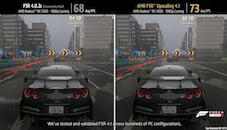
AMD has officially released the RDNA 3-focused FSR Upscaling 4.1 model for the Radeon RX 7000 series of graphics cards. This marks the first step towards deploying the FSR 4 technology across all RDNA gaming GPUs. According to a post on X by AMD's Jack Huynh, Senior Vice President and General Manager of the Computing and Graphics Group, FSR Upscaling 4.1 is now available for RDNA 3 GPUs. With the latest AMD Software: Adrenalin Edition 26.6.2 graphics driver download, Radeon RX 7000 series gamers can enjoy more than 300 games running FSR 4.1, providing a significant performance boost and finally offering features that RDNA 4 gamers have been enjoying for a while. You can find some AMD-provided performance comparisons in the slides below.
We have confirmed that AMD's FSR Upscaling 4.1 model for RDNA 3 GPUs is fundamentally different from the RDNA 4 version. RDNA 4 has native processing for 8-bit floating point data, allowing FSR 4.1 on RDNA 4 to run on FP8 data types. To get the FSR 4.1 Upscaling model to run on RDNA 3, AMD must convert this to 8-bit integer data, as RDNA 3 hardware uses INT8 data types without FP8 support. Generally, integer math is sufficient to optimize these models, but the conversion work is necessary, which explains the delay between RDNA 4 and RDNA 3 support. This difference required AMD to completely modify the FSR 4.1 model for the new data type and ensure there is no quality loss in the final visual output. AMD officially states that the visual fidelity is on par with the FSR 4.1 model that runs on RDNA 4.


 Finally, AMD is also addressing RDNA 3-based APUs. Since integrated graphics are inherently weaker than discrete GPU solutions, some additional performance optimizations are needed. AMD claims that they are working on this with fine-tuned "lightweight machine learning models" to support FSR 4.1. Whether this includes RDNA 3.5 remains to be seen, but Valve's recent leak of the INT8-based FSR 4.1 model shows that the technology runs on RDNA 3.5 without issues, so future updates from AMD are expected.

Source:
Jack Huynh on X
We have confirmed that AMD's FSR Upscaling 4.1 model for RDNA 3 GPUs is fundamentally different from the RDNA 4 version. RDNA 4 has native processing for 8-bit floating point data, allowing FSR 4.1 on RDNA 4 to run on FP8 data types. To get the FSR 4.1 Upscaling model to run on RDNA 3, AMD must convert this to 8-bit integer data, as RDNA 3 hardware uses INT8 data types without FP8 support. Generally, integer math is sufficient to optimize these models, but the conversion work is necessary, which explains the delay between RDNA 4 and RDNA 3 support. This difference required AMD to completely modify the FSR 4.1 model for the new data type and ensure there is no quality loss in the final visual output. AMD officially states that the visual fidelity is on par with the FSR 4.1 model that runs on RDNA 4.


106 Comments on AMD FSR Upscaling 4.1 Officially Released for Radeon RX 7000 GPUs
After being pressured, the justification used was that they would need to remove support for Bristol Ridge to make it work, as if anyone looking to buy Zen 3 wanted Excavator out of anything.www.tomshardware.com/news/ryzen-5000-comes-to-x370-via-leaked-asrock-taichi-alpha-bios
TPU covered this, still in 2020, "allegedly work":
www.techpowerup.com/274400/amd-ryzen-5000-processors-allegedly-work-with-300-series-motherboards
AsRock introduced Zen 3 support on the X370 Taichi against their wishes with the P6.61 BIOS release, and this BIOS leaked through a German shop called JZ Electronics, once AMD caught wind of it they were sent a cease and desist and were forced to stop distributing it. You should be able to find it if you dig on old articles from late 2020. It was the first, and only motherboard to get some sort of unofficial Zen 3 support at the very start.
After that, for quite some time, motherboard vendors were not allowed to implement newer versions of AGESA (V2) on any 300-series motherboards. It seemed like a perfect storm at the time, tech media was largely disinterested because of the introduction of the X570, and just glossed it over as a minor inconvenience.
People like me, who owned ROG Crosshair VI series motherboards, were forced to purchase a 500-series motherboard, and I did end up buying one so my 5950X would work. Do note the GPU installed here... and on the next one.
Then, out of nowhere, Intel drops Alder Lake and a processor called "i5-12400F", which put the 5600X in the ground at $140 less MSRP... it didn't take long, somehow all those nasty BIOS size limits disappeared like magic, and just about every 300-series motherboard under the sun, including those with a 16 MB BIOS got happily updated to run these CPUs.Selective memory is one hell of a thing. I just literally had enough with people telling me I'm a hater with no substance, y'know. I forgive but I don't forget, I've been slighted at so many turns. If I don't trust AMD anymore this isn't senseless hate, it's years of everything that could go wrong - going wrong.
And this thread has derailed to AMD AM4 now. You guys enjoy bashing AMD, isn't it?
But it should work on Windows 10, what doesn't work is the driver that enables it. But don't let me be the one to say that AMD drivers are problematic, that's just me hating.
It's not red vs green vs blue, It's all of us vs the billion dollar corpos, and the reason we greif them is so that they do better by us, because we buy their products and don't want to get screwed.
I genuinely like AMD and want them to succeed, I own many products both past and present from them, and I vocalise my displeasure with certain moves because I want them to do better by everyone that isn't their shareholder.
Between the 3 graphics giants, who can we really support now? nvidia focused more on AI and datacenters, their higher end card now uses 12VPWR connector which I avoid like a plague, not to mention the price of their GPU. AMD meanwhile having delusions they still 'in the game' with pricing similar to nvidia offering but support like this FSR 4 is lackluster, only coming to RX 7k series and they have a bad track record of supporting older architecture. Intel, while they are starting to get a little bit of spotlight, now decided didn't want to do discrete GPU with the new Xe3 Celestial architecture, and the big Battlemage GPU is rumored to come out but that was 6 months ago.
From what I've seen over the last day-or-so, and for all the hullabaloo, FSR 4.1 on RDNA3, at least the higher end offerings seems legitimately excellent and I'm very happy for all those users, some of which are close friends of mine, whom I will no doubt accumulate their cards to collect as years pass by. I'm even tempted now by one just to mess around with, but the 7900 series is worth a good bit used still, more than I'm willing to pay to play around a bit.
(edit: It's a joke obviously and difficult to do anyway. Vega's int8 has some limitations and the gpu family has no real driver support)
If they had not come through on this, I was definitely taking my biz elsewhere next time I shop. It is just that simple. My relationship with these companies is purely transactional. Tribalism and brand loyalty are non sequiturs.Fixed it. And that's exactly my stance. Anti-consumer behavior should be called out and fought against. No exceptions, no excuses, no loyalties.Red herring fallacy.
AMD did do the right thing in the end, and all indications are they intend to follow through on the rest of it. Mission accomplished.
Polaris andVega GCN systems in Linux. The one that gets completely behind and left out in any way is RDNA 1 as AMD removed INT8 support from most RDNA 1 GPUs.Edit: Looking well at the specifications, it seems INT8 specifically was added in GCN 5 with some of that Vegas, however the point is that with the later GCN architectures that support INT8, it is possible to run the leaked FSR4 in Linux.
AMD is better for consumers than Ngreedia, maybe—well, not much if they are... I guess, go Intel? Wait, they've acted like criminals in the past too. Damn, we are out of options...
(Also resizable bar on Turing, that never came as well)
Otherwise all of the DLSS model improvements work across the board.
ReBAR/"SAM" is the one thing I don't understand why so many people make such a huge deal of, even HAGS is something that has more impact. Drivers actually selectively disable it for certain games and applications, because just as having a large aperture can help, it can also hinder performance. In the cases that it helps, it's a 0-5% improvement. In the cases that it doesn't, it's a similar figure in the negative. This has been extensively benchmarked and tested.
Frame Generation... I mean, you can use Lossless Scaling or FSR Frame Gen universally, and I'm guessing you already know why you don't. Even with access to dynamic and 6x. FG is quackery anyway.Flip Metering engine is the one thing that Ada is lacking and what enables the higher frame generation rates. Lossless Scaling supports 20x MFG, even if you run it on a RX 480 or something. The problem with frame synchronization at high rates becomes quite apparent, it's bad enough I don't wanna use it (DLSS's above 2x, I mean) even on the 5090 anyway.
Even after the Int8 model leaked they continued refusing to commit to an official release, and instead kept pushing the exclusivity of the features for RX 9000 cards. It took a critical mass of backlash from the community for them to release it. The evidence of this is that they made no effort to quell the outrage, their messaging was either dismissive of the concerns or they would deflect, which means that the only messaging that stood firm was from 2025 where they spoke more clearly in their messaging that it would be exclusive to RX 9000.
Nvidia is an extremely greedy company, but they have the business sense to think about long term success, especially when it comes to their exclusive features. I am sure that Nvidia would have preferred to never offer any feature updates to older cards, but they know that it is bad for business. For example look at their major features and how they started.
CUDA spent nearly a year not getting much traction until it became clear that it was a feature that was sticking around and growing, as they did not gatekeep between GPU generations, thus they could market it as a feature with a rapidly growing community as new and old gen cards would work, thus with each new generation, the userbase is only expanding, it eventually reach a point where you have college courses designed around CUDA.
DLSS started off widely hated as its results were truly horrible, and people were able to make due with basic spatial upscaling.
Nvidia could have pulled a future AMD and left the RTX 2000 cards with only DLSS 1.0 but that would have ruined adoption and success of their brand exclusive upscaler because it would artifically shrink the potential userbase, and game studios would not devote resources to a feature that probably 1-2% of users could use. So with each new iteration of the tech, Nvidia released the model for all RTX cards so that the userbase would naturally grow without needing gamers to upgrade each generation. This eventually allowed Nvidia to command considerable game studio attention for their eclusive features, as the userbase was not dependant on any single GPU generation. Nvidia could release a new DLSS model alongside a new video card release, and be able to tell game studios, that 250-300 million people can use this feature right now.
On the other hand, with FSR4, upon release, it didn't get much traction early on, and heavily relied on eventual driver level overrides which gave suboptimal results since replacing the upscaler model, does not change any game level parameters and optimizaitons, thus if a game had perameters and optimizaitons for an older model, then an override could lead to artifacts such as oversharp if the new model is sharper, or other visual issues.
SImply put, game studios prioritized DLSS over FSR and put more resources into ensuring a more optimized DLSS implementation rather than AMD, and that is because a game studio can release a game, and be confident that 90% of the users could use those features.
This also ensures that studios rapidly switch to optimizing for new models without needing to wait for users to buy the latest cards, thus games that are still being actively supported, have been quicker to get DLSS 4.5 patches as compared to AMD FSR 4+.
Furthermore, if you look at features that are being locked behind a new generation wall (the rest of redstone), it is getting virtually no traction at all, because it is being seen as a feature that less than 1% of users can use.
For DLSS, since the inputs for the upscaler are also used for frame gen, this is an arera whre Nvidia has a lot more flexibility with their greed, and they immediately indulge in that greed. For example, the newer models of frame gen no longer need the optical flow accelerator ASIC, thus Nvidia could technically bring it to older cards, but they won't because they don't need to. A game optimizing for the latest upscaler models will natrally result in an optimized frame gen implementation as well.
Then for RTX 4000 cards, Nvidia could easily bring multi-frame gen to those cards, but they artifically restrict it with even driver level workaround detections which add a black overlay if you try to bypass the restriction. You can read up on it here: hardforum.com/threads/dlss-4-multi-frame-generation-3x-4x-on-rtx-4000-software-lock-not-hardware.2047083/
github.com/FirstEverTech/RTX4000-MFG-Unlock
Frame pacing was stable as well.
Nvidia blocks it because they can without impacting the implementations of multi-frame generation, because Nvidia only needs to maintain wide adoption and optimization for the upscaler to ensure that frame gen has everything it needs to function well. This is also why all of the RTX cards get ray reconstruction as well.
Nvidia is greedy, but they know when to hold back some of that greed to ensure that new features are successful in terms of adoption by major game studios.
Odds are if the RTX 6000 cards introduce some new feature that no current RTX card has, Nvidia will ensure that there is some enhancement to existing features that can make use of the inputs needed for whatever new exclusive feature they want for RTX 6000, as that will ensure that game studios instantly begin working on implementing those aspects and optimizing for them even if only 1% of gamers end up with an RTX 6000 card, and that is because whatever the new exclusive feature needs to function well, they will have an existing use that will work on 250-300 million existing user's systems.
This is likely also why Nvidia allows RTX 2000 cards to run the DLSS 4.5 model, even though anything above balanced leads to a performance regression in the super majority of cases. The fact that it can run means that they get added to the list of potential users, and the existing users are free to choose which model they want to use and can experiment with settings and models, and still get some use, e.g., if you have a game that is averaging 55FPS and you just need to get it to 60, an RTX 2000 user will be able to get away with DLSS 4.5 and depending on the combination of settings, hit a smaller performance uplift target while maintaining higher visuals than they otherwise would be able to hit.
PS, when Nvidia released their first gen RT cores, there was a small amount of unrest from the community at RTX cards not getting it, and some of the unrest remained even after Nvidia stated that it needs dedicated RT cores, because RT calculations were well within the capabilities of CUDA. Rather than trying to gaslight the community or ignore them and hope they go away. Nvidia did the smartest PR move at the time. They released a driver update that allowed RT to be pushed to CUDA cores if no RT cores were present, and made it so that game devs could whitelist GTX cards for RT if they wanted.
AMD's folly was trying to introduce brand exclusive features and then gatekeeping them between GPU generations, thus ensuring that those features would never achieve a large userbase because they would always be reliant on how well the latest generation of card sells. Furthermore, any performance excuse doesn't matter as it didn't matter for the competition. Gamers are largely fine with a feature working rather than not, as that quickly quells any outrage, and leaves the door open for perfomance optimization in the future.
Edit: fixed a few typos.
HAGS is also not supported on vega. If that offer a 2,5% as well the total, along with resizable bar, would be 1,05x1,025=1,07625=7,625% for free. This is a generational leap nowadays :roll:
Now add fsr4.1 on all those new games which already use forced TAA and you can see how much difference it makes in both performance and image quality.
Do you think my 9070 XT will get FSR 5 (if it's even a thing)? Maybe AMD will come up with something fundamentally different for RDNA 5 that my card won't run. Maybe they won't come up with anything. There's no way of knowing.It doesn't get MFG. Only Blackwell gets that, even though the hardware to run it is there since Turing.
For most other areas in the computer industry, as well as competitors in the GPU space, it is more common than not to see a product be released, and further into its life cycle, it gets new feature updates.
The RTX cards only really got DLSS 1.0 advertised and DLSS 2, 3, 3.5, 4, and 4.5 were nowhere to be seen, but it still got those features. Ray reconstruction was also not advertised, but they got that feature as well.
Features like RTX voice were not advertised but it got that as well.
Even outside of the PC space, many older ILC cameras from Sony and Fujifilm gained features such as expanded low light focusing, animal eye auto focus, better speed and azimuth calculation, as well as various video features that were never originally advertised.
Lens makers like Tamron during the DSLR days, ended up releasing firmware updates for some of their large aperture prime lenses which quietly implemented tripod detection as part of their OIS, even though they did not advertise it, thus saving users from having to manually flick the OIS switch on the side of the lens.
Supporting older products with feature updates helps bring good will to the brand, as well as helps to retain customers. If a user has a camera that has works well, and has a good enough sensor, but a competitor releases a new camera with animal eye AF, then a good way to retain the current customers is to simply release a firmware update that adds it to an existing model. The current customer becomes amazed that their product just got better, and when that customer is ready to upgrade, they will stick with the brand that took care of them, and went above and beyond.
To tie it all back to the 6800 XT and 7800 XT, it exists in a market where the competition from a relative standpoint, is going above and beyond by consistently providing feature updates long after the card was released. AMD can either compete in that reality, or take a stance of "well we never advertised FSR4 on these cards", and enjoy having less than 10% market share.
This is especially the case since AMD no longer significantly undercut Nvidia, instead it is common to see each generation have a pricing structure of Nvidia minus ~$50. And for the super majority of users, they can rationalize an extra $50 to buy into a longer driver support cycle, feature updates without needing to fight and shame the company, and other random features that don't get used but the user will think it is better to have it and not need it than to need it and not have it.
At the end of the day, AMD needs to change and be proactive in their support for their products. Repairing that reputation damage will take time, but unless they take steps to commit to it, it will be hard to restore confidence in their video cards, especially in a marketplace where the competition has a more consistent track record.
There was also no RT or DLSS when the GTX 10 series was released, but we still call it Nvidia's best up to this day. Why is that? Should we be angry that Nvidia introduced a whole bunch of stuff that didn't run on it with the 20 series (even though it technically does at low speed thanks to a later driver update)? Should 40 series owners be angry for not getting MFG even though there's no technical reason for it?That is a plus, not the norm. Were you around in the '90s when you had to buy a new graphics card every 6-12 months just to be able to run the newest games because there was a new DirectX version that the old one wouldn't run?
Also, are you avoiding the topic of frame generation and MFG on purpose?Empty words.
Rapid obsolete events were more sporadic and typically followed major breakthroughs in GPU and game design, where major developers were quicker to adopt those features,, e.g., programmable shaders, then independently programmable pixel and vertex shaders, etc. In such cases, users would have been forced to upgrade if they wanted to play certain games, though even then, when such features came out, mass adoption would usually lag behind around 2 years. Outside of that, since the PC gaming market was extremely small back then, game studios liked to cast a wide net in terms of support, and gamers were willing to drop down to 1024x768 or even 800x600 if needed and many settings could scale down to some absurd levels, thus people were able to go many years without upgrading outside of major breakthroughs.
Beyond that, while GPU makers iterated on cards rapidly, it is because the market was far more competitive, and they were quick to make new cards the moment they had even a minor new feature ready. Especially when we had Nvidia, ATI, 3DFX, and Matrox all rapidly pumping out products. Once it shrunk to just ATI and Nvidia, then things slowed quite a bit.
Also, it is not empty words to point out that AMD needs to be proactive in supporting older products. this has been the source of nearly all of the outrage remaining after they were finally able to improve their drivers. From a standpoint of today, looking back, getting support and improvements for older AMD video cards has required persistent public shaming, and an overall contentious process to get older products supported, while with Nvidia, users largely got feature updates without even needing to ask. Over time that gets tiring, and makes the competition look better from a fundamental business model standpoint, as customers purchasing an AMD video card will see ongoing feature support as a series of skirmishes that they have no guarante of winning.
For example, the cusomers won the first round of the FSR skirmish, but theye will likely be a skirmish for other redstone features such as Ray Regenration.
On the other hand, from the competition, a new upscaler and Ray Reconstruction was released proactively without users even needing to ask or shame the company for a year before they decide to release it.
Beyond that, while it is all a plus that goes above and beyond what was intially advertised on release day of the older product, for the past 20 or so years, such things became fairly common across a wide range of things.
Compare windows 10 on launch day, to how it is now and how many features were added (also aware of the features that people wish ddn't get added such at the copilot junkware).
As for frame gen, I addressed it in my previous post www.techpowerup.com/forums/threads/amd-fsr-upscaling-4-1-officially-released-for-radeon-rx-7000-gpus.350185/post-5743809