Monday, July 13th 2026

Chinese CXMT to Match Micron's DRAM Manufacturing Capacity This Year
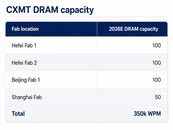
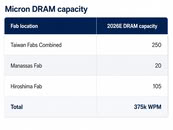
Chinese memory giant CXMT has been expanding its capacity so rapidly that the company is now able to compete with one of the largest memory manufacturers in the world—Micron. According to analysis from Citrini Research and their proprietary data, CXMT is projected to produce about 350,000 DRAM wafers per month by the end of 2026, assuming all current projects are completed on schedule. This is an impressive figure, especially considering that Micron, one of the "big three" DRAM manufacturers, is currently estimated to produce about 375,000 DRAM wafers per month by the end of 2026, assuming their capacity expansions are fulfilled. Micron has been a memory supplier for decades, while CXMT is a relatively new player that emerged to meet China's domestic needs.
A particularly surprising discovery is that CXMT is constructing its cleanrooms—where the actual silicon is produced—in just around 12 months, whereas the rest of the DRAM manufacturing industry typically takes 21-24 months, nearly a full year longer. The biggest challenge for Chinese memory makers like CXMT is acquiring advanced lithography solutions from around the world, as the United States government has imposed sanctions on the company and placed it on a blacklist, preventing access to modern EUV scanners. Instead, CXMT relies on older DUV lithography tools and uses multi-patterning techniques to work around the lack of EUV technology. Despite this, CXMT is matching Micron's output this year with nearly the same number of DRAM wafers, which is impressive for such a new market entrant.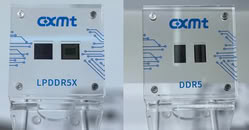
 Earlier this year, it was confirmed that CXMT began shipping 16 Gb DDR5 chips running at 8,000 MT/s, which measure 67 mm² and have a density of 0.239 Gb per square millimeter. The G4 DRAM cells are 20% smaller than CXMT's previous G3 generation. This development follows the company's progression from 23 nm (G1) and 18 nm (G2) nodes. However, it appears that 24 Gb modules are now in mass production, albeit at slightly lower speeds of around 6,000 MT/s. The company is also producing LPDDR5X-10667 DRAM modules, which are in mass production and available in 12 Gb and 16 Gb capacities. Much of this production is driven by the demand from the AI sector.
Finally, the report notes that the Chinese government is encouraging CXMT to transfer its DRAM technology IP to other Chinese DRAM manufacturers such as JHICC, Swaysure, and YTMC's subsidiary XMC. This initiative aims to alleviate memory shortages domestically before CAMT-designed DRAM enters other markets, such as the EU and possibly even the U.S.
Source:
Zephyr on X
A particularly surprising discovery is that CXMT is constructing its cleanrooms—where the actual silicon is produced—in just around 12 months, whereas the rest of the DRAM manufacturing industry typically takes 21-24 months, nearly a full year longer. The biggest challenge for Chinese memory makers like CXMT is acquiring advanced lithography solutions from around the world, as the United States government has imposed sanctions on the company and placed it on a blacklist, preventing access to modern EUV scanners. Instead, CXMT relies on older DUV lithography tools and uses multi-patterning techniques to work around the lack of EUV technology. Despite this, CXMT is matching Micron's output this year with nearly the same number of DRAM wafers, which is impressive for such a new market entrant.


Finally, the report notes that the Chinese government is encouraging CXMT to transfer its DRAM technology IP to other Chinese DRAM manufacturers such as JHICC, Swaysure, and YTMC's subsidiary XMC. This initiative aims to alleviate memory shortages domestically before CAMT-designed DRAM enters other markets, such as the EU and possibly even the U.S.
28 Comments on Chinese CXMT to Match Micron's DRAM Manufacturing Capacity This Year
China has flooded the market before, causing foreign rivals to go out of business or cease expansion (or enter protected status via government intervention), then reduce supply to comfortable margins for them but uncomfortable margins for any remaining rivals. Then if rivals try and ramp up, they simply increase output again. If they repeat that with memory chips, it would crater the memory market for Samsung, SK Hynix, Micron, and other big-name memory makers, forcing them to either lower their prices, or also speed up expansion efforts to try and remain competitive in output while they still have the cash flow to do so to.
China would eventually join them in manipulating the costs, but only after they set the terms via market manipulation. Even the article mentions that they're hoping CXMT shares their IP with other Chinese memory makers, in an effort to further accelerate mass-production.
EDIT: If the mods feel this is too political, feel free to delete my post.