Tuesday, July 21st 2026
Report: NAND Flash Shortages to Finally End in 2027
In the sea of negative news surrounding the entire semiconductor industry, NAND Flash might be one of the few major components that will become abundant again. According to the latest report by TrendForce, the storage supply chain is expected to achieve balance by 2027, making it the only area of computing projected to stabilize. Although the demand for NAND Flash and all SSD storage solutions that rely on it is expected to remain in short supply for the rest of 2026, TrendForce forecasts that supply and demand will return to normal in 2027. This year, there will be about a 4-6% supply deficit compared to demand for the remainder of the year. However, the second half of 2027 is anticipated to finally bring balance to the supply chain, with no deficit in NAND Flash supply a year from now.
This supply balance is driven by several factors. First, increased production capacity from NAND Flash suppliers like SK hynix, Micron, Samsung, YMTC, and others is crucial. The increase in the number of wafers produced each month, along with process node upgrades, will significantly boost supply, bringing this commodity to balance after a long period of uncertainty. The second factor is the persistently weak demand from consumers, as consumer electronics prices have risen so much due to DRAM and NAND Flash shortages that many consumers are opting not to purchase new hardware, avoiding the high premiums compared to a year ago. On the enterprise side, server demand will continue to rise, consuming most of the NAND Flash supply. Server demand accounts for about 40% of output consumption, while smartphones and notebooks together account for more than 40%.
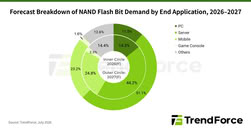 However, storage makers in the United States, Japan, and South Korea are upgrading their fabs at a moderate pace, avoiding rapid expansion. A significant portion of global NAND Flash bit production will be driven by China and its YMTC, as China is expected to increase its global share of NAND Flash output to nearly 19% this year. Although this seems significant on a global scale, most China-made chips will satisfy only internal mainland demand, with only a smaller portion of production going to external suppliers, such as Lenovo laptops shipping to Germany.
Source:
TrendForce
This supply balance is driven by several factors. First, increased production capacity from NAND Flash suppliers like SK hynix, Micron, Samsung, YMTC, and others is crucial. The increase in the number of wafers produced each month, along with process node upgrades, will significantly boost supply, bringing this commodity to balance after a long period of uncertainty. The second factor is the persistently weak demand from consumers, as consumer electronics prices have risen so much due to DRAM and NAND Flash shortages that many consumers are opting not to purchase new hardware, avoiding the high premiums compared to a year ago. On the enterprise side, server demand will continue to rise, consuming most of the NAND Flash supply. Server demand accounts for about 40% of output consumption, while smartphones and notebooks together account for more than 40%.


21 Comments on Report: NAND Flash Shortages to Finally End in 2027
I have no doubt the big 3 would find something to blame to keep the artificial shortage going.
Free cooling! Never mind the rockets we need, nor the risk, or the issues around servicing all of that, no.... its nice and cold up there, lets go.Head injuries guaranteed. (Sorry I had a picture of it raining HDDs in my mind)
I don't know why some people here are so allergic to good news.
it never did.
This crisis was caused by market manipulation and memory makers were all too happy to go along with it as they needed a serious boom after years of bust.
There will be a correction, prices will crash, retailers won't be willing to let go of their stock for normal prices.
Holy shit lol, no offense intended... but see why we all go collectively stupid now? Watch a video to get it explained... are you for real? Where did general education & common sense go?Forget about allergies, we are just not naive fools like the perceived majority on the internet. See above. Maybe watch a video... :twitch: