Monday, July 27th 2026
China Begins Limited Production of Domestic Immersion DUV Machines
According to sources close to The Information, a Chinese company Shanghai Yuliangsheng Technology has reportedly begun limited production of immersion DUV lithography machines. This Shanghai-based company aims to produce five systems for delivery this year, with an estimated production of about 20 immersion DUV machines by 2027. While this may not seem like a large number, it represents a significant effort in developing homegrown DUV machine production, reducing reliance on third-party suppliers like ASML. The Shanghai company plans initial deliveries to SMIC, CXMT, and Hua Hong, which will integrate these machines into their production processes.
For those unfamiliar, immersion deep ultraviolet (DUV) machines use an argon-fluoride (ArF) excimer laser to produce DUV light at a 193 nm wavelength. This light travels through a layer of ultra-purified water placed above the final lens, which imprints circuit designs onto a wafer. Although this may sound straightforward, immersion DUV lithography tools are highly complex machines that ASML has been mass-producing for years. By comparison, ASML shipped 131 immersion DUV machines last year, showing the smaller scale of the Chinese production. Additionally, Chinese immersion DUV also imports some key components from Japan, while most are being sourced from China.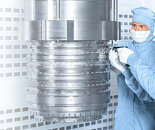 However, many questions remain about this advancement. For instance, how many wafers per hour can this new immersion DUV system handle, and what level of lithography can it achieve? ASML's flagship DUV scanner, the TWINSCAN NXT:2150i, can process over 310 wafers per hour and achieve 7 nm and even 5 nm at SMIC with multi-patterning. For a company like CXMT, the most advanced node isn't necessary, as DRAM is typically manufactured using mature nodes like 10 nm. However, for Chinese SMIC, the challenge might be adapting this tool to produce its N+3 5 nm-class node, which may require self-aligned quadruple patterning (SAQP) or a similar technique to achieve the desired density.
Source:
The Information
For those unfamiliar, immersion deep ultraviolet (DUV) machines use an argon-fluoride (ArF) excimer laser to produce DUV light at a 193 nm wavelength. This light travels through a layer of ultra-purified water placed above the final lens, which imprints circuit designs onto a wafer. Although this may sound straightforward, immersion DUV lithography tools are highly complex machines that ASML has been mass-producing for years. By comparison, ASML shipped 131 immersion DUV machines last year, showing the smaller scale of the Chinese production. Additionally, Chinese immersion DUV also imports some key components from Japan, while most are being sourced from China.

9 Comments on China Begins Limited Production of Domestic Immersion DUV Machines
That monopoly of the ASML on market is far away by meaning to call it free worlds free market!!!
As for CXMT I am guessing that the reason it sells it's chips at higher prices that Samsung is that CXMT is a new player and companies are making deals with CXMT at a much latter time than the deals they made with Samsung meaning it's to be expected the prices to be higher.
Which is to say that most private, or public, companies will overtime use their dominant position for abuse eventually, especially if they can get away with it.
You also have to keep in mind that CXMT is in a buildup phase and they are building FAST .... so it won't take long for them to flood the market with affordable ram !
Sure this might not happen next year but you can bet your top dollar sooner or later China will disrupt the market !