Thursday, July 30th 2026

Seagate Roadmap Targets 50 TB HAMR Hard Drives in 2027

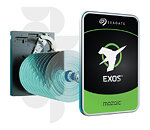
This Tuesday, Seagate presented its Q4 fiscal 2026 earnings report and during the presentation it offered some updated storage roadmap details. The company says that new 50 TB HAMR hard drives are planned for customer validation in 2027. The current Mozaic 4+ platform supports drives up to 44 TB and is built around Seagate's Heat-Assisted Magnetic Recording Technology (HAMR). By the end of 2026, the company expects that Mozaic 4+ models will account for 50% of its HAMR exabytes shipped to customers. "We expect to achieve our next ramp milestone by exiting calendar 2026 with 50% of our HAMR exabytes on our Mozaic 4 platform," CEO, Dave Mosley said. CFO Gianluca Romano confirmed the company is on track to exceed 5 TB per platter and since Seagate flagship-tier HDDs use ten platters, we will have 50 TB per drive. The next step is Mozaic 5+, the third generation of the platform, which will enable that +5 TB per platter density. As mentioned, first Mozaic 5+ drives are expected to ship to customers for qualification later in 2027, after which they go through OEM and data center validation before any broader availability.

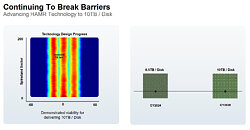
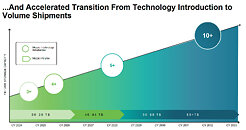
Seagate also has a lab demonstration target of 10 TB per platter around 2028, which would eventually bring drives close to the 100 TB range. Last year, Seagate disclosed that it successfully produced a prototype platter capable of storing roughly 6.9 TB of data and is trying to reach 8 TB per platter. The broader capacity roadmap runs from 40-44 TB in the 2027/2028 window, scaling to 50-60 TB around 2030, and pushing past 80 TB in the 2031/2032 timeframe. Worth keeping in mind what "customers" means in this context, these drives first go to Big Tech, enterprises and AI companies, not retail. Consumer availability typically follows years later, if at all.
Source: TechSpot
Add your own comment

17 Comments on Seagate Roadmap Targets 50 TB HAMR Hard Drives in 2027

#1
mrnagant
Why not introduce a new form factor? Every other bit of PC technology has a slew of form factors. But hard drives whether consumer or in a server use the same exact form factor. If you increase the physical size of the drives, less space in a given space will be taken up by the body of the storage drive, which will increase the overall platter density in that given space.

Thinking like a Backblaze 60 HDD storage pod. If your HDD takes up two slots but you can say fit 4 additional platters in that same space. That POD would have 120 additional platters. Would be like adding 10 standard hard drives.
Posted on Reply
#2
Athena
mrnagantWhy not introduce a new form factor? Every other bit of PC technology has a slew of form factors. But hard drives whether consumer or in a server use the same exact form factor. If you increase the physical size of the drives, less space in a given space will be taken up by the body of the storage drive, which will increase the overall platter density in that given space.

Thinking like a Backblaze 60 HDD storage pod. If your HDD takes up two slots but you can say fit 4 additional platters in that same space. That POD would have 120 additional platters. Would be like adding 10 standard hard drives.
I would say that making a new form factor would be way too expensive, there are a ton of racks out there that would need to be changed, then they would need to recalculate the airflow and lots of other variables like vibration that it would take a very long time to certify everything

they could bring back 5 1/4" HDs, but, most cases only expect 3.5"/2.5", so you would have the same problem

it's pretty crazy how much they are cramming into the platters, I wonder how often they need to mark bad sectors on these things?
Posted on Reply
#3
qlum
mrnagantWhy not introduce a new form factor? Every other bit of PC technology has a slew of form factors. But hard drives whether consumer or in a server use the same exact form factor. If you increase the physical size of the drives, less space in a given space will be taken up by the body of the storage drive, which will increase the overall platter density in that given space.

Thinking like a Backblaze 60 HDD storage pod. If your HDD takes up two slots but you can say fit 4 additional platters in that same space. That POD would have 120 additional platters. Would be like adding 10 standard hard drives.
It's not that simple more platters means stronger motors more heat, sure you could probably optimize the form-factor a bit but just won't be worth it. there is a reason we stick to 3.5 not 5.25 nor 2.5 hdd's in servers. wider disks hold more data but need to spin slower smaller disks contain a lot less data.

Another problem is cost, you would only use these in very large data-centers as redundancy is going to suck.
Posted on Reply
#4
Zareek
Athenathey could bring back 5 1/4" HDs, but, most cases only expect 3.5"/2.5", so you would have the same problem
That was my thought: bring back the old 5.25-inch double-height drives they used back in the IBM XT days. I think that the physical space is too much of an issue for doing that. There is only so much space even in a massive data center. Not to mention the seek times increase as the platters get wider.

A massive 10 megabytes using a 5.25-inch wide by 3.25-inch tall by 8-inch deep form factor!!! Then again, your OS and a good amount of software would fit comfortably in those 10 megabytes, and it was way faster than booting from a floppy.
Posted on Reply
#5
ymdhis
mrnagantWhy not introduce a new form factor?
Because it would be incompatible with 100% of existing server racks.
Posted on Reply
#6
ISSEnterprise
These hard drives have to compete with the evolving QLC SSDs. I think biggest issue for the HDDs is the speed limited by its mechanical parts. If competed with cold data storage, nothing better than magnetic tapes.
Posted on Reply
#7
Kaleid
Now if we only could get rid of the HDD cartels
Posted on Reply
#8
dinmaster
looking at the picture, it shows 10 disks so 10tb per disk as it mentions. 100tb in 2028? why not roll what you have now out if you can do it, that's right gouge us through the years and hold the tech back.
Posted on Reply
#9
IMABEARLOL
We are going to need a drastic read/write speed improvement too.

How long is it going to take to scrub one of these or resilver even a small array?
Posted on Reply
#10
TumbleGeorge
dinmasterlooking at the picture, it shows 10 disks so 10tb per disk as it mentions. 100tb in 2028? why not roll what you have now out if you can do it, that's right gouge us through the years and hold the tech back.
This is more than actual today.
10 years later just will touch a half of 100TB HDDs.
Posted on Reply
#11
CornyOC
Look at all that SSD gold, you know what, let's do the same with HDD!

— HDD Cartel —
Posted on Reply
#12
soder
The industry scared about inventing a new HDD form factor. On the other hand, NGFF was delivered without much trouble, and conquered the SSD use-case very well & quickly. I dont see the reason to fear about a bigger HDD form factor.
Yes, it will be incompatible with all the existing 3,5" HDD racks. So what? Only datacenters and big ass companies will buy those in the 1st couple of years, because of course it will be hell expensive. By the time price reduced, the new form factor racks, and chassis will be widespread even in the ordinary user market as well.
Posted on Reply
#13
Fourstaff
mrnagantWhy not introduce a new form factor? Every other bit of PC technology has a slew of form factors. But hard drives whether consumer or in a server use the same exact form factor. If you increase the physical size of the drives, less space in a given space will be taken up by the body of the storage drive, which will increase the overall platter density in that given space.

Thinking like a Backblaze 60 HDD storage pod. If your HDD takes up two slots but you can say fit 4 additional platters in that same space. That POD would have 120 additional platters. Would be like adding 10 standard hard drives.
Factory and supply chain retooling to build another form factor will cost a lot of capex and effort.
Posted on Reply
#14
Athena
IMABEARLOLWe are going to need a drastic read/write speed improvement too.

How long is it going to take to scrub one of these or resilver even a small array?
The more densely packed the data is, the faster read speeds you will get, which is the HAMR tech


people didn't like 10K & 15K RPM, because way too much noise and heat, the other option was to have dual actuators, which were built, and I think they were the world's fastest at 524MB/s, but, unless you are Enterprise, forget about getting them, in fact, I don't think they make them anymore
Posted on Reply
#15
Prima.Vera
What would be the price and expected transfer rate of those?
Are they going to at least be as fast as the cheapest SATA SSD out there?
Posted on Reply
#16
remixedcat
ymdhisBecause it would be incompatible with 100% of existing server racks.
this, plus it's allready hard enough finding a case w 2 3.5 bays
Posted on Reply
#17
Hardcore Games
My Orico box has 5 SATA slots so I can stuff lots of disks in it. Large capacity disks are slow to fill as the transfer rate is still < 400 MB/s
Posted on Reply
Add your own comment
Nov 12th, 2026 04:40 CST change timezone

New Forum Posts

Popular Reviews

TPU on YouTube

Controversial News Posts