Wednesday, September 2nd 2026

Early DLSS 5 Testing Suggests the RTX 5090's Single Power Connector Might Be the Bottleneck
Community testing of leaked DLSS 5 builds suggests the tech may already be hitting a wall on NVIDIA's own flagship GPU. Tom's Hardware ran the neural rendering model through Cyberpunk 2077, Hogwarts Legacy, and Control on an RTX 5090 Founders Edition, as well as an MSI RTX 5090 Lightning Z. Surprisingly, the results point to power delivery as the potential bottleneck rather than compute horsepower. The test used a community Optiscaler injection method built on the leaked DLSS 5 DLL, not NVIDIA's official Streamline path, though the cost lined up closely with NVIDIA's own published 8 ms-per-frame figure.
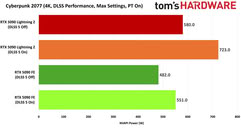
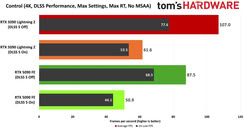
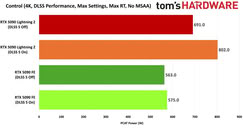
The Founders Edition, limited to a single 12V-2x6 connector, dropped framerates by 42 to 49 percent with DLSS 5 enabled and consistently hit its 575 W power limit while doing so. The MSI Lightning Z, with a dual-connector setup and a 1000 W limit, took a smaller hit and held better 1% lows, while pulling far more power. In Hogwarts Legacy, it jumped from 480 W to 720 W with neural rendering active, which is a sizeable 50% increase. That leaves single-connector RTX 5090 cards apparently underprovisioned for a feature this demanding, at least unofficially.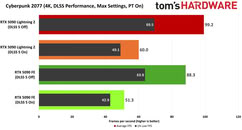
 The Founders Edition wasn't short on compute so much as it was limited by its own power ceiling. This is notable given how much scrutiny the 12V-2x6 connector has already drawn this generation. DLSS 5 officially launches September 3 with NBA 2K27, and it should become clear within days whether NVIDIA's first-party version fares any better on the Founder's Edition RTX 5090. If not, we might have to wait for future Super variants or next-gen cards to truly maximize the potential of DLSS 5.
Source:
Tom's Hardware
The Founders Edition, limited to a single 12V-2x6 connector, dropped framerates by 42 to 49 percent with DLSS 5 enabled and consistently hit its 575 W power limit while doing so. The MSI Lightning Z, with a dual-connector setup and a 1000 W limit, took a smaller hit and held better 1% lows, while pulling far more power. In Hogwarts Legacy, it jumped from 480 W to 720 W with neural rendering active, which is a sizeable 50% increase. That leaves single-connector RTX 5090 cards apparently underprovisioned for a feature this demanding, at least unofficially.


52 Comments on Early DLSS 5 Testing Suggests the RTX 5090's Single Power Connector Might Be the Bottleneck
To increase power draw.
For the ones without UV to push them into Furmark territory (and mind you Furmark testing lasts far less than gaming sessions).
For the ones with light/moderate UV to get them back at baseline.
No one gets left behind!
Of course the intent had to be disguised into something extremely desirable, this is clearly poison apple maxxing. Jensen has outdone himself.
DLSS5 is the signal that starts the timer, the phone call for the card recall.
Let them come to me, and do not hinder them, for the kingdom of the AI datacenter belongs to such as these.
The connector isn't the issue, the lack of load balancing across the pins is. But people will keep repeating the mantra of "the connector, the connector" because that's easier.
So better to just get rid of all external connections, that way there is no problem!It's not far beyond. The connector is designed to handle up to 625w.
If what you said were true, then every single 5090 would have melted by now. Reality: most don't. Some reddit posts don't change that.No those melted too. Failing molex was one of the main drivers behind the PEX 6 pin being developed.
But the 6/8 pins melted too. So really we're just using too much power to play bing bing wahoos. IGPU only is the solution.
But as usual people will keep defending this garbage connector. No need to get rid of connectors though, we could simply go back to a connector that worked without gimmicky bandaid fixes such as fancy cables or load sensors, and handled above its rated load.Designed and real world are two different things, i'll link you to a nice thread where there are hundreds of reports of the connector melting.
Connectors melting is a well documented issue at the point, no matter if you want to dismiss reddit posts.Those connectors melted less, but of course you'd leave out important context to support your defense.
While intel/nvidia are ultimately responsible for this shitty connector. PCI-SIG? should have enforced a 400w limit at most to retain the safety factor of 1.92. This would then have retained the the same 100% margin as the old 8pin. But even then the utterly enshitified pin standard compounds the issue. The minute contact points of the female pins and the thinner guage wire, even at the lower 400w power draw its still asking for trouble.
DLSS5 has not 50% penalty, it is even higher.
Higher power consumption and it seems it uses different logic units in the graphic card itself.
You should compare stock card settings vs stock card settings but with power limitations for DLSS5.
I conclude most likely around 70% performance penalty at the same Wattage for DLSS 5.
Undervolt and Overclock etc are advertised features but I consider stock settings as default. And the default settings should be argued with. Just because you bought a more expensive graphic card with selected gpu chip does not imply every chips runs in that setting, etc. I assume, I state without any proof, that some graphic cards modells uses very selected graphic card chips from the board partner.
-- I also conclude any nvidia 5090 graphic card test did not provide solid power consumption figures. Root cause, most likely not all logic units in the core were used.
But yes, blame the power limit, not the ineficcient post processing technology that makes NPCs look older and adds brighter tones to ligtning.
Now it's pretty clear why there were 2 RTX 5090s used in Nvidia's demo.
Also, it's pretty clear that running this slop on anything below RTX 5090 will have significantly bigger performance impact.
I'd say DLSS upscaling and FG made sense, since it enabled lower-tier GPUs to render more fps than running on native.
But this technology ... no one asked for it and no one needed it. And since the performance hit is so bad, I wonder who will actually use it.
Anyway, what a discovery was made! When you let GPU draw more power, it will boost to heaven and performance increases! Who would have thought.
In cyberpunk the difference is tiny between the two cards with the heavily overclocked model being slightly more inefficient overall but utilized slightly better with dlss 5.
In control the 5090 z scales better but it becomes a hog.
Any other 600w model with a large cooler will be adequate to have that little extra oomph for dlss 5 without being a power hog (in comparison)
does not change the ~10% - too lazy, do not want to think.
0.183 vs 1.171
or the 680 vs 820 on the first post.
break it down in the smallest quantiy, but the ~10% stays. (i do not care, whatever. feel free to be happy it is 10.1%.) ~ 170 + 17 =~~~ i do not care around 183
-- My first impression, I have to revisit an read it again, oh, it is over the ~600 Wattish what should be allowed. hardly any gpu takes the 75Watt from teh slot, so the 675Wattish claims are also invalid
820 Wattish is far more than 600 Wattish what I read over and over again. Note: Whatever if you argue 675Watt, whatever else, 820W is far more than 675W or 600 Watts.
Some run a nvidia 5090 on a daily basis with 1000 Watts, the connector works also with 800 Watts. In some cases for some people, sometimes, for some time.
it seems the hole table is based on Watts and FPS. It should be stated, e.g Power[W] or more common Power - horiontal divider line Watts.
you really did divide fps / power and call it fps/W. bing says: 87.5/563 0.155417407
i would have done it the other way around, Watt / fps -> to see clearly how much watt is needed for a single frame.
luckily bing also has a 1/x feature to show 6.43428570392
691/107 6.45794393
I read the table wrong.
6.43428570392 vs 6.45794393 Watts costs a Frame.
1/x shows 0.154848046195
you have choosen a bad representation for the same data
6.432 vs 6.457 ignoring rounding shows it more clearly (bing calculator website is garbage i do not see a common round function like anyhting had in year 2000)
1/x
When you assume it scales linear, and just take 100 FPS, who cares, 643 vs 645 Watts imply who cares, without rounding.
(note 100 times of these values -> 6.43428570392 vs 6.45794393 Watts costs a Frame.)
darn back button of my mouse .. i had to type it now two times
((575/50.9) / (563/87.5) - 1) * 100 = 75.569762 %
So a DLSS5 frame costs
76% more poweraround three quarters more power.I stopped reading igorslab arctice this morning, therefore i should apply the same standards, write a summary statement for the masses. three quarter is better for readability as 76%.
@Youseethis Thanks for sharing your data (you were faster with responding as i could save, etc. my post (mouse button fault not mine, of course it was my fault)
note i usually do this in libreoffice, i can set there the visible digits, i can use round function etc. bing can not to that. I verified the table, one line and i was curious on my statement on it.
-- 76% or 101% (2.016 in your table) is a big penalty per watt.
edit 2. i had the numbesr still in the browser split view. The data seems to be taken from post 1. Post 1 is misleading as hogwards legacy efficiency claim are only 50%, when the other user put in the data and showed clearly 75 to 100% performance penalty per watt. I checked one line the maths, therefore i am certain the other lines are also correct. Using a table and a better approach, clearly show the power consumption doubles in worst case per frame. The efficiency is worse as expected, that surprised me.
I already nuked the buffer, afaik around 6.5Watts vs 11.X Watts per Frame. That says everything. (x = any number from 0 to 9)
I also wanted to see how they scale with power in control where the difference is bigger.
The power connectors will cry and the efficiency falls off a cliff. :roll:
Unfortunately, AMD will most likely follow, because money, right?
If Nvidia cancels the 6000 series and comes up with another 5nm round of the refresh of a refresh, then an 48 GB RDNA5 Card on 3nm will be what people want, because it has electrolytes!
DLSS NR is scam wrapped in a joke... or a solution looking for a problem... I can only hope game devs have some commons sense and see through this thinly veiled b$ and don't waist any time on it.
I am now worried about the GPU and VRM temperatures including their hotspot temperatures when DLSS 5 is enabled.