Wednesday, September 16th 2026

AMD Rumored To Have DLSS 5-Like Neural Rendering Coming With RDNA 5

AMD's next-gen RDNA 5 architecture might get its own neural rendering feature, something in the same ballpark as NVIDIA's DLSS 5. That's according to Kepler_L2, a well-known AMD leaker, though it's worth being clear that this is a single-source claim and should be treated as a rumor for now. Posting on the Anandtech forums, Kepler_L2 said AMD will have its own version of "Neural Lighting" comparable to DLSS 5 with its next-gen hardware. Asked whether this would be limited to RDNA 5, the leaker said it's probably going to be the case, since this kind of workload is apparently pretty heavy. That's about as far as the concrete part of the leak goes.

Kepler_L2 also shared thoughts on how AMD's approach should differ from NVIDIA's. He thinks the model should have direct access to raw game data like geometry and depth buffers instead of having to guess at scene details, plus splitting lighting and shading into separate models instead of one pipeline. It's worth stressing that this part is the leaker's own wishlist, and not a description of what AMD is actually building. AMD hasn't confirmed RDNA 5 by name yet, and launch estimates currently range from mid-2027 to early 2028 depending on who you ask. Therefore, even if this pans out, we're probably looking at something that's early in the development pipeline.

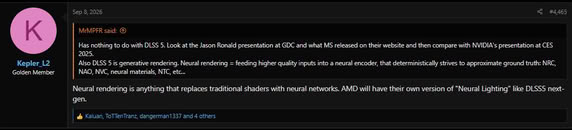
Source: Kepler_L2 on Anandtech Forums
Add your own comment

75 Comments on AMD Rumored To Have DLSS 5-Like Neural Rendering Coming With RDNA 5

#51
LittleBro
Prima.VeraWhy does AMD ALWAYS have to copy nGreedia on absolutely all tech, instead of coming themselves with something new and innovating?!? Is the same story over and over again, starting with DLSS 1, 2,3, 4, 5, 6, etc...
Always copying!!!
Exactly. AMD always copying Nvidia.

I'd like to have an opposite to DLSS/FSR. Instead of rendering at lower than native resolution and then upscaling it, I'd much rather have option to render at >100% scale and just shrink ot down to native. This adds image clarity. Affects effects, textures, geometry. Some games have it, some not.

Ghost Recon Wildlands is a game from 2017, but once you turn resolutiom scaling to 200%, game looks still good even for today's standards. Same goes for. Borderlands 3, on 200% it looks better than BL4. Same goes for Far Cry 5.

Having this sort of option would be great, mainly for older games like C&C Generals or Starcraft 2 or Left 2 Dead. God I loved L4D and L4D2.


But hey, there are still options available:

1. AMD still has time to invent their own shitty connector and unsafe power delivery design.

2. AMD can still introduce neural shit for upcoming generations of GPUs only, meaning locking it up artificially for older cards.

Uhm, wait. Hell, no! That would be another dose of copium.
Posted on Reply
#52
Veseleil
LittleBroExactly. AMD always copying Nvidia.

I'd like to have an opposite to DLSS/FSR. Instead of rendering at lower than native resolution and then upscaling it, I'd much rather have option to render at >100% scale and just shrink ot down to native. This adds image clarity. Affects effects, textures, geometry. Some games have it, some not.

Ghost Recon Wildlands is a game from 2017, but once you turn resolutiom scaling to 200%, game looks still good even for today's standards. Same goes for. Borderlands 3, on 200% it looks better than BL4. Same goes for Far Cry 5.

Having this sort of option would be great, mainly for older games like C&C Generals or Starcraft 2 or Left 2 Dead. God I loved L4D and L4D2.
Hello (world)?

Posted on Reply
#53
CyberPomPom
DenverThat is completely and objectively false. GCN was very strong in compute, so much so that it was used as the foundation for CDNA.

AMD won numerous supercomputer contracts for this very reason. HBM would go on to become increasingly popular in server and compute hardware.

And a dead company doesn't beat anyone.

For those who enjoy gimmicks, AMD demonstrated an AI method to generate ray-traced lighting 5x faster.
gpuopen.com/learn/temporally-stable-generative-illumination/

That's so much closer to what I expected DLSS5 to be.

I mean, who thought, when presented with the concept of neural tools, that some full resolution rerender of the scene through AI slop was the best one!!!

That's so much work for not that much result, 8 ms on a 5090 is a lot of compute, even more on top of path tracing to have something worth of discussion.

This (AMD) kind of solution should be a lot better. It removes the need for costly RT/PT global illumination, and most lighting passes altogether it seems.
Posted on Reply
#54
TumbleGeorge
AleXXX666if you use powerful enough red card and you DON'T need stupid DLSS thing then your gameplay experience will be perfectly same lmfao
The "optimization" is only "magic" "DLSS" option availability vs copy-paste crap like FSR and XeSS :D :rolleyes:
Irony/ let's not forget that there are people who are waiting for their multi-megahertz monitor to hit the market and with DLSS 7 to finally satisfy their e-sport hunger for thousands of FPS./ irony.
Posted on Reply
#55
AusWolf
Prima.VeraIndeed, that's why Microslop should had already provided a DirectX API for this. But since they are way over lazy and incompetent nowadays....
We don't need Microslop. We have Vulkan. (Or do we?)
LuminescentThis news is basically some damage control, AMD has nothing to compete with DLSS5, they "leaked" to some known leaker the news so everyone can keep calm and still buy some AMD.
Just to remember, Nvidia launched DLSS in 2018, Amd launched FSR 4 in 2025, so we could be seeing something similar to DLSS5 on AMD in 5 to 7 years, yeah, that's why AMD is probably at 1% market share.
Bollocks. Both Nvidia and AMD have been talking about neural rendering for years.
Posted on Reply
#56
Essaudio
AMD is a huge business now and can probably fund these efforts a lot better at this point. I always assume that having another option is a good thing for everyone concerned even if you plan to never use it - if it’s worse you ignore it and it will spur on better development hopefully of competitive features and if it’s the same or better one less reason for a single gpu monopoly which is in no one’s best interest.
Posted on Reply
#57
Steevo
AusWolfWe don't need Microslop. We have Vulkan. (Or do we?)


Bollocks. Both Nvidia and AMD have been talking about neural rendering for years.
They will eventually just like with RT/PT, tessellation and other things make it into a standard. Currently there is an active CUDA to AMD HiP tool that allows all the CUDA to run on some red cards as the compute is all the same and handled/setup by the driver for the architecture and blissfully unaware of what code its running.
chrcolukWhy are people bothered about this feature?
There are many of us that want to experience games without artificial anything added. I haven't used RT/PT or any of the new features that also require rendering frames below native resolution and creating fake frames to make up for the huge performance hit.

I have rendered GTA5 at 2.5 times native resolution with all the eye candy and AA turned on and..... some of the jaggies were still there.
Posted on Reply
#58
x4it3n
DrUsmanSaleemAMD's next-gen RDNA 5 architecture might get its own neural rendering feature, something in the same ballpark as NVIDIA's DLSS 5. That's according to Kepler_L2, a well-known AMD leaker, though it's worth being clear that this is a single-source claim and should be treated as a rumor for now. Posting on the Anandtech forums, Kepler_L2 said AMD will have its own version of "Neural Lighting" comparable to DLSS 5 with its next-gen hardware. Asked whether this would be limited to RDNA 5, the leaker said it's probably going to be the case, since this kind of workload is apparently pretty heavy. That's about as far as the concrete part of the leak goes.

Kepler_L2 also shared thoughts on how AMD's approach should differ from NVIDIA's. He thinks the model should have direct access to raw game data like geometry and depth buffers instead of having to guess at scene details, plus splitting lighting and shading into separate models instead of one pipeline. It's worth stressing that this part is the leaker's own wishlist, and not a description of what AMD is actually building. AMD hasn't confirmed RDNA 5 by name yet, and launch estimates currently range from mid-2027 to early 2028 depending on who you ask. Therefore, even if this pans out, we're probably looking at something that's early in the development pipeline.
Well AMD has already confirmed that they were working on Neural Rendering for the next Xbox Helix, how is it a "news" ?! Also given the price of Hardware now, no wonder why they would want AI to do all the heavy lifting for them!
I really hope that RDNA 5 will be a success because Nvidia has stopped real innovation since GTX 10s and RTX 20s...

Ampere -> Lovelace -> Blackwell pretty much all share the same "base architecture", there is no Raster/RT/PT IPC increase, and the RTX 50s are even on the same node as Lovelace lol.
Let's hope Rubin will bring at least 2x RT/PT performance cause when I see the 5090 struggling harddd to run games at 4K DLAA w/ PT we would even need a 3x increase to get 60fps with 4K DLAA & PT on Next-Gen games...
Posted on Reply
#59
Veseleil
chrcolukWhy are people bothered about this feature?
Because altering ≠ enhancing, and people that get it don't want the former, but the latter. And no marketing BS can make them equal. Why the industry prefers (and have set the goal for pushing) the former? Because it saves them money (time and workforce).
Posted on Reply
#60
Steevo
VeseleilBecause altering ≠ enhancing, and people that get it don't want the former, but the latter. And no marketing BS can make them equal. Why the industry prefers (and have set the goal for pushing) the former? Because it saves them money (time and workforce).
Exactly this, give it as an option, just like game mods are an option, but like you said, when it becomes a core part of the game we stop playing a game made by other people with their own ideas and instead are playing AI and whatever it dreamed up.
Posted on Reply
#61
wheresmycar
Good!!

I'm in favour of what DLSS5 brings to the table, obviously not in its current form with that hefty performance hit but you know what I mean... a step in the right direction. I’d take the AI slop over dead eyed plastic mannequins any day of the week.

Its good to see AMD also sees where the industry is heading and won't be sitting on the side-lines. Let them both battle it out for greater efficiency (power/perf) and better results.
Posted on Reply
#62
Naifm92
sometimes i ask myself why AMD is wasting money on this when they're not going to put any effort to implement it in any game?
Posted on Reply
#63
jnv11
Prima.VeraWhy does AMD ALWAYS have to copy nGreedia on absolutely all tech, instead of coming themselves with something new and innovating?!? Is the same story over and over again, starting with DLSS 1, 2,3, 4, 5, 6, etc...
Always copying!!!
Not always. Sometimes, it is the other way around.

Direct3D/DirectX 12 and Vulkan are one example. AMD built Mantle and then standardized it as Direct3D 12 with Microsoft and Vulkan with the Khronos Group which controls OpenGL. Nvidia had to support both, copying AMD.

Another example is the hardware scheduler that allows multiple tasks to be run in parallel in the GPU via asynchronous compute. AMD implemented hardware scheduling in its GCN and later GPUs. Nvidia tried to implement a scheduler that was split between GPU hardware and the driver software in Maxwell, but that slowed loads so badly that it never got enabled. Nvidia finally implemented a full hardware scheduler in Pascal that could schedule and run multiple tasks in parallel via asynchronous compute. (This is different from an instruction scheduler which schedules instructions within a warp, wavefront, or workgroup. AMD does this job in GPU hardware which greatly reduces driver overhead versus Nvidia, while Nvidia splits this job between the driver and hardware, requiring more driver overhead. Each approach has its advantages and disadvantages.)

Another example is resizable BAR. AMD first implemented it in GPUs and then made it the default, using a blacklist for applications that are known to perform worse or fail with it enabled to run those apps without resizable BAR. When paired with an AMD CPU, AMD calls this smart access memory. Nvidia then implemented resizable BAR, but uses a whitelist to decide which applications can use it. Users can manually add other applications to the whitelist. Driver updates could also change which applications are whitelisted by default.

Another example is RDNA 2’s Infinity Cache which greatly reduced VRAM traffic and the latency of memory accesses that hit the Infinity Cache, making it far more efficient and faster versus RDNA 1. Nvidia copied this in Ada Lovelace GPUs by greatly enlarging the L2 cache versus Ampere GPUs, getting similar results.

AMD has sometimes created tech that other GPU vendors like Nvidia have copied.
Posted on Reply
#64
LittleBro
VeseleilHello (world)?

Ah, Mann, scheisse!

That is the tax for not using Adrenaline suite.

Apologies.
Posted on Reply
#65
Doctor Who
gloomliNo more deterministic rendering. Welcome to a world where a game can look completely different on cards from different vendors.
Unfortunately, AMD really has no choice but to follow suit, but hopefully they do it better than Nvidia's DLSS 5 gimmick that promotes lazy development and optimizations.
Prima.VeraWhy does AMD ALWAYS have to copy nGreedia on absolutely all tech, instead of coming themselves with something new and innovating?!? Is the same story over and over again, starting with DLSS 1, 2,3, 4, 5, 6, etc...
Always copying!!!
Nvidia is the graphics card sales king & market leader, unfortunately. Despite DLSS 1, 2, 3, 4, and 5+ being total gimmicks, promoting lazy game optimizations, for example, they need to come out with something equal or better. Where AMD can innovate is in other areas within their designs. I believe within RDNA5 we will see some cool innovations come with it, and some.
Posted on Reply
#66
Vya Domus
SaLaDiN666It will take years for AMD to get there, just SW wise.
DLSS5 is a lot more basic that people realize, it's post processing, it's effectively just a filter, like those "enhance" buttons you have for photos on your phone.
Posted on Reply
#67
wolf
Better Than Native
Naifm92sometimes i ask myself why AMD is wasting money on this when they're not going to put any effort to implement it in any game?
Their partnerships and getting their features in games has been a sore point in recent years. I do hope they keep trying, but not blocking others from having their tech included too. How long is it since Redstone launched now and how many games are the suite of features in?

I welcome the competition in this space there's so much potential in neural rendering, and I am a bit confused by the sentiment that this is or will forced on people, I suppose time will tell, clearly is very early days yet.
Posted on Reply
#68
chrcoluk
SteevoThey will eventually just like with RT/PT, tessellation and other things make it into a standard. Currently there is an active CUDA to AMD HiP tool that allows all the CUDA to run on some red cards as the compute is all the same and handled/setup by the driver for the architecture and blissfully unaware of what code its running.


There are many of us that want to experience games without artificial anything added. I haven't used RT/PT or any of the new features that also require rendering frames below native resolution and creating fake frames to make up for the huge performance hit.

I have rendered GTA5 at 2.5 times native resolution with all the eye candy and AA turned on and..... some of the jaggies were still there.
Oh sorry I meant why do they want the feature.
Posted on Reply
#69
Steevo
chrcolukOh sorry I meant why do they want the feature.
I would like to have it as a tool in the toolbox, in its current form it would be questionable on its effectiveness for the performance hit, but seeing it in the hands of the modding community already and able to run on AMD cards, granted with extreme performance hit, it could be cool to play around with and use, just like graphic mods for games. I ran mods on Skyrim and played the shit out of it.
Posted on Reply
#70
THU31
I don't like the idea of devs having to implement multiple technologies like this, where they have to tweak many parameters. It's a lot of unnecessary work, unlike upscaling or frame gen which does everything automatically.
Posted on Reply
#71
TumbleGeorge
THU31It's a lot of unnecessary work, unlike upscaling or frame gen which does everything automatically.
It is for cost of consumers which pay expensive and power hungry graphic card to calculate this"free" features.
Posted on Reply
#72
jnv11
My biggest worries about DLSS 5-type technologies are the power supply chain and the power consumption.

Will this cause graphics cards to generate even bigger power spikes that can damage power supply units which are too undersized to have to absorb those power spikes?

Will this cause more graphics cards' VRMs to fail due to the load that the GPU will put on them, especially the ones with the minimal VRMs?

Will this cause North American residential electrical circuits to blow fuses or trip circuit breakers? Standard residential circuits in North America tend to be 15 amps at 120 volts which means that the max is 1800 watts on the whole circuit if you don't allow some watts for margin, safety and other loads on the circuit like the monitor; so having too many high end computers running DLSS 5 or one high end computer with DLSS 5 while the circuit has another heavy load on the circuit like a laser printer on a typical residential North American circuit breaker could cause it to trip. Sometimes one cannot separate the computer and the laser printer because the computer also doubles as a work computer and needs a VPN to connect to the work network, and the VPN is not set up to allow network traffic to a printer on the home network. This would force one to connect the laser printer to the computer via USB so that the printer can print, which would make it impractical to separate the laser printer and the computer onto separate electrical circuits.
Posted on Reply
#73
Chrispy_
Ugh, do they have to?
Given how bad the perfomance of DLSS5 is on mid-range Blackwell cards using 5th-generation tensor cores, I'd rather AMD didn't waste their efforts on a first-gen solution that's not part of the DirectX or Vulkan spec yet. Until it's deemed a useful feature for mainstream GPUs, it'll remain an interesting toy for people with high-end cards in a tiny subset of AAA, TWIMTBT/sponsored games it's actually trained on. Sure, we've had fun playing with it unofficially but it's way too heavy for what it offers, even on my 5070Ti I'm not using it because it decimates the framerate and I paid the big bucks for my GPU so that I could get high framerates.

I don't think DLSS5 is usable on a 5060Ti 16GB right now, not at sensible resolutions like 1080p/1440p so if it's literally a flagship-only option for people spending $800+ on GPUs, then it's irrelevant to the overwhelming majority of the market.

Sometimes, Nvidia gets things wrong, AMD and Intel don't need to enable them.
Posted on Reply
#74
Red Hood
The extra "ai" compute performance and vram required for this would make their next gen cards even more expensive and attractive to the ai tech bros which would further increase the price

Studios can already make good looking games without an instagram filter
Posted on Reply
#75
Doctor Who
Vya DomusDLSS5 is a lot more basic that people realize, it's post processing, it's effectively just a filter, like those "enhance" buttons you have for photos on your phone.
Well, it definitely changes the artistic intent and gives you an artificial feel (negative feel that is) of the game(s) when DLSS 5 is enabled.
Posted on Reply
Add your own comment
Nov 12th, 2026 06:33 PST change timezone

New Forum Posts

Popular Reviews

TPU on YouTube

Controversial News Posts