Sunday, September 27th 2026
Modder Squeezes 74% More Performance Out of DLSS 5 on AMD Radeon in One Day
Modders working on bringing NVIDIA's DLSS 5 Neural Rendering to AMD Radeon GPUs just had their busiest day yet. The developer behind the DLSS-NR-on-AMD tool shipped two new versions within 24 hours, Alpha 0.3.3 and Alpha 0.4.0, together adding roughly 74% performance on Radeon hardware, according to the project's own GitHub release notes. YouTuber Ancient Gameplays tested the update in Cyberpunk 2077 at 3440x1440, and saw framerates climb from around 30 FPS on earlier builds to roughly 50 FPS on Alpha 0.4.0. That's a big jump for a workaround that started out barely playable. The original mod release had poor performance, but it looks like that's being addressed.
The tool works by feeding NVIDIA's own DLSS 5 DLL into Radeon RX 9000 GPUs, and reportedly RX 7000 cards too, intercepting the calls the DLL expects and routing the neural computation onto AMD hardware, since RDNA 4 supports the FP8 math DLSS 5 relies on. Alpha 0.3.3 also added a graphical installer with a built-in settings editor and overlay controls, so getting Neural Rendering running on Radeon apparently no longer means digging through file paths manually. Moreover, just today, the Alpha 0.4.1 update brought another 8% jump in overall performance, and a 9% performance increase under heavy gameplay loads.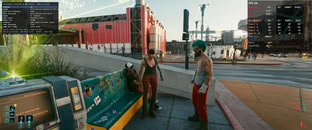

 The developer has reportedly told Ancient Gameplays that another major update is coming soon. At this pace, DLSS-NR-on-AMD could eventually get close to NVIDIA's own implementation, at least on paper. The modding community has been doing some great work ever since the DLSS 5 DLL leaked with NBA 2K27. The technology has since been ported over to RTX 40, RTX 30, RTX 20, AMD Radeon, and even Intel integrated graphics. As for the AMD implementation, the progress certainly looks promising for an unofficial mod barely a few weeks old.
Sources:
DLSS-NR on AMD (GitHub), Ancient Gameplays on YouTube, Wccftech
The tool works by feeding NVIDIA's own DLSS 5 DLL into Radeon RX 9000 GPUs, and reportedly RX 7000 cards too, intercepting the calls the DLL expects and routing the neural computation onto AMD hardware, since RDNA 4 supports the FP8 math DLSS 5 relies on. Alpha 0.3.3 also added a graphical installer with a built-in settings editor and overlay controls, so getting Neural Rendering running on Radeon apparently no longer means digging through file paths manually. Moreover, just today, the Alpha 0.4.1 update brought another 8% jump in overall performance, and a 9% performance increase under heavy gameplay loads.


161 Comments on Modder Squeezes 74% More Performance Out of DLSS 5 on AMD Radeon in One Day
Fine, if it's that hard for you, I won't push you anymore.
Bottom line after checking a total of 92 games they are more optimized today that upscaling and fg exists then they were back when these technologies didn't. If 92 games didn't convince you then you don't want to be convinced you just want to spew your usual thing. Don't let me stop you
Amazing..... :D
While doing all that you ignored 92 game tests from tpu that completely disproved your point because tpu is using a high end psu and motherboard. If this is somehow real and you aren't trolling, oh boy, I'm sorry. I really am.
The reason people pay NV's premium is for these features. If you can just get them to work on AMD cards for half the price or less then why not?
Thanks to Optiscaler I've been able to enjoy FSR4 on titles that released while DLSS 2 & 3 were still a thing and ML FSR was just a twinkle in AMD's eyes.
Now all AMD needs to do is actually release high end cards with the kind of oomph required to really run this stuff.
If only we'd gotten a 96CU RDNA 4 card, would have really been something... Hope AMD doesn't make the same mistake with RDNA5.
Then we see that the RTX 3080, RX 6700, and RX 7700 all fail to break past 30 FPS at 4K. By contrast, the RX 7800 and RTX 4070 are the ones that manage to clear 30 FPS. So these two, using Performance upscaling, are the bare minimum required for someone to cross the 60 FPS threshold. That is precisely why these two are recommended in the table. And as for that 30% gap, you're the only one translating it into 400%, simply because you need to write something—and that something has to be absurd—in order to create false impressions. We know very well, however, that if the RTX 3070 gets, say, 50 FPS and the RTX 4070 is 30% faster, the RTX 4070 will hit 65 FPS. Consequently, the RTX 4070 is the one that gets listed as recommended in the specs table. At lower resolutions where 8GB is sufficient, the RTX 3070 can fit right in. A 400% performance delta isn't required. That's your own math. By your ...proprietary math logic, since the RTX 3070 gets 68 FPS at 1080p, it ought to get 17 FPS at 4K. Yet in reality, it delivers 26.5 FPS.High end PSU? Really? You write here that I mentioned high end PSU and you are saying that I am trolling? You better be sorry with this kind of tricks.That is true. They promise people mind-blowing Ray Tracing or even Path Tracing, and then turn around and tell them "Go buy an RTX 5050"—or even an RTX 3050, because hey, why not?
That said, at the high end, it's safe to say "I'm turning RT on." Not because I say so, but because Nvidia says so. No, I don't mean because they put it in their marketing ads; I mean that if they didn't feel their competitors were reaching—or would soon reach—similar performance in RT and perhaps even PT, they wouldn't be announcing DLSS 5 right now. They would have held it back for 2 to 3 years down the line.
5060 Ti was just a weird mess because AMD didn't meet the MSRP at release at all and the 9060 XT ended up being the same price for 5-10% less raster performance on average and all the classic Nvidia vs. AMD debate.
Gen-on-gen improvement look great on the AMD side only because the RX 7800 XT acted like an artificial wall blocking the access to superior performance by being anything between -5% and +5% faster than the 6800 XT, RT included. The RX 7600 was also inferior on all points to the 4060 and the 7600 XT is just a 7600 with double the VRAM, it wasn't a 4060 Ti competitor. Their last-gen products were pretty much underwhelming on that point all around compared to RDNA2. The only cards above 6900 XT performance from AMD back then were the 7900 XTX and XT. 7800 XT failed to even beat the 6800 XT at pretty much the same price (and dropped very quickly at the end of its life cycle, but the 6800 XT retained most of its value on the used market as well because of that, until RDNA2 got put in Maintenance Mode). The only great deal when it comes to gen-on-gen improvement was the 7700 XT, and that was only if you could get it for significantly less than the 7800 XT price (roughly €150 below 7800 XT instead of their €50-80 MSRP difference).
RT is whatever, but I'll remind everyone here that FSR Redstone suite is still basically nowhere to be found.
The 7800 XT came at the same price as the 6700 XT before, and the 9070 XT after. That's a decent gen-on-gen improvement, imo. Also, the 9060 XT has been a good £100-150 cheaper than the 5060 Ti since day one.
Still, none of this has anything to do with what I said in the post you replied to. You missed my point entirely.
Point to me where exactly did I say any of that. RT was included in the comparison for games that it is included in the ultra preset, because that's also exactly how the 1060 was compared, by using ultra preset, not enabling individual settings not part of the preset. Do you understand what consistency is in a comparison?
And the 9070xt came at the same price as the 7800xt? Lol. The 7800xt was 500 EU since day one till the day it went eol. The 9070xt was 650 for like 7 days and then went to 800. Sure same price....
Don't worry about hard-core Nvidia fans, they will survive. Their cards are still getting driver support and the latest upscalers. They will be fine
Honestly, this conversation is pointless. It would be best if we concluded it now by not concluding anything.I paid £550 for mine at launch price. I actually overshot a bit, the 7800 XT was $499 MSRP, the 9070 XT was 599. Still not bad considering it's on par with the 7900 XTX which was a grand when it launched. Not to mention the 6800 XT was 649, considerably more than the 7800 XT, so it wouldn't be fair to say that there wasn't any improvement there.
I know, I know, trying to look at the positives is a bad thing when it comes to AMD. How dare I do that. What a piece of sh* card it is. Shame on me for buying one or even mentioning it. Better? :roll:I did.
9070 XT MSRP is $600 (€680 back during release, €636 equivalent today), which isn't the MSRP of the 7800 XT, it's just inbetween the 7800 XT and 6800 XT, and it took Back-to-School and Black Friday 2025 just to see it at MSRP.
We can talk about current market prices if you like, but I don't see much point in doing so because nothing currently for sale makes any sense.Why Germany?OK, my country (which isn't Germany) doesn't matter. Does yours?
Are you expecting me to look up prices in literally every single country across the world before making my assumptions? Are you for real? :confused:Terrible. I'm sure the card's performance doesn't account for that enormous MSRP. ;)
3.......
Same goes for planned FSR 5. Shame on AMD for pulling it back from Github.
So, when you see that this approach isn't working, you stop playing the part of the benevolent fool. You cannot keep releasing your technologies for free and, in doing so, practically hand over your competitive advantage to your rival's products. You cannot give away your technologies for free only to watch YouTubers and reviewers claim your products fall short because they lack access to your competitor's exclusive features.
At some point, you have to stop handing out flowers, because doing so actively hurts both you and the market competitiveness of your products. It's that simple. Consumers and tech media did not support open tech. They mocked it and undervalued it. Since the public effectively voted for proprietary, exclusive technologies over open ones, that is precisely what they will get.
Do I agree with this? No. Does it matter? No. What matters is having competitive companies. While making FSR 4 open and free might be the morally right thing to do, given how the tech world and press operate today, it would be disastrous—it would simply reinforce the existing monopoly.
On the flip side, could CUDA and DLSS be made open and free instead? Right? Why not? Why should we demand that one company always operate in a specific altruistic way regardless of the circumstances, when we would never demand the same from the other—simply because we've grown accustomed to how the latter operates and accept it as their right?
Modder brings DLSS 4.5 to Radeon RX 9000 GPUs, RDNA 4 uses native FP8 - VideoCardz.com