Monday, January 20th 2020

Rumor: NVIDIA's Next Generation GeForce RTX 3080 and RTX 3070 "Ampere" Graphics Cards Detailed
NVIDIA's next-generation of graphics cards codenamed Ampere is set to arrive sometime this year, presumably around GTC 2020 which takes place on March 22nd. Before the CEO of NVIDIA, Jensen Huang officially reveals the specifications of these new GPUs, we have the latest round of rumors coming our way. According to VideoCardz, which cites multiple sources, the die configurations of the upcoming GeForce RTX 3070 and RTX 3080 have been detailed. Using the latest 7 nm manufacturing process from Samsung, this generation of NVIDIA GPU offers a big improvement from the previous generation.
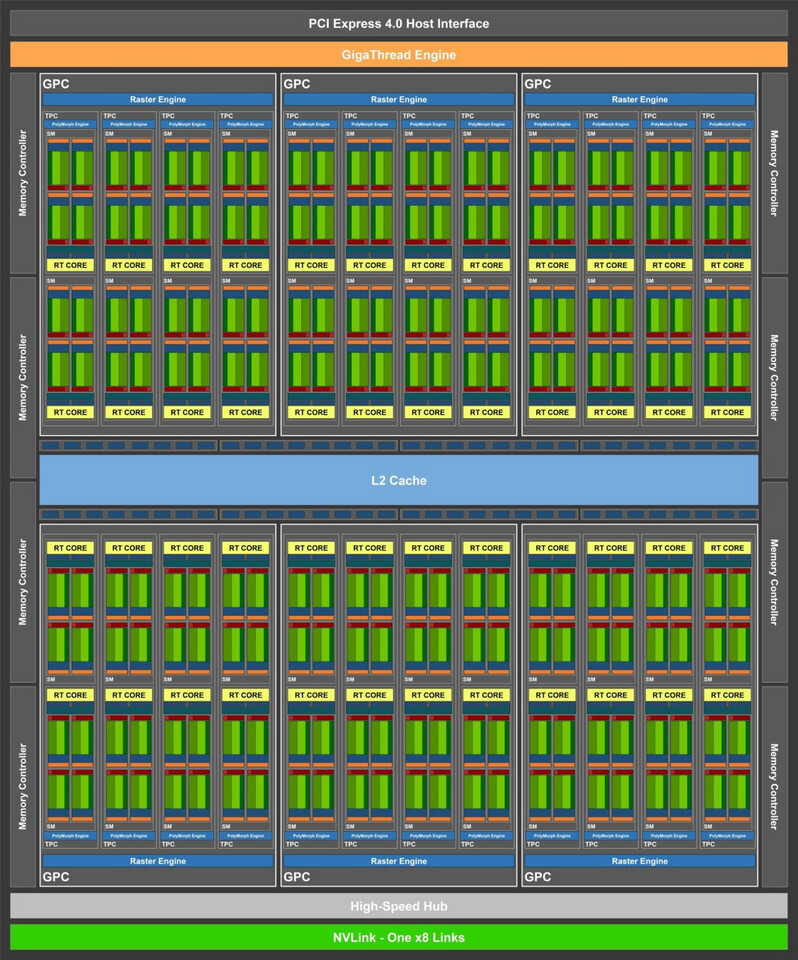
For starters the two dies which have appeared have codenames like GA103 and GA104, standing for RTX 3080 and RTX 3070 respectively. Perhaps the biggest surprise is the Streaming Multiprocessor (SM) count. The smaller GA104 die has as much as 48 SMs, resulting in 3072 CUDA cores, while the bigger, oddly named, GA103 die has as much as 60 SMs that result in 3840 CUDA cores in total. These improvements in SM count should result in a notable performance increase across the board. Alongside the increase in SM count, there is also a new memory bus width. The smaller GA104 die that should end up in RTX 3070 uses a 256-bit memory bus allowing for 8/16 GB of GDDR6 memory, while its bigger brother, the GA103, has a 320-bit wide bus that allows the card to be configured with either 10 or 20 GB of GDDR6 memory. In the images below you can check out the alleged diagrams for yourself and see if this looks fake or not, however, it is recommended to take this rumor with a grain of salt.
Source:
VideoCardz
For starters the two dies which have appeared have codenames like GA103 and GA104, standing for RTX 3080 and RTX 3070 respectively. Perhaps the biggest surprise is the Streaming Multiprocessor (SM) count. The smaller GA104 die has as much as 48 SMs, resulting in 3072 CUDA cores, while the bigger, oddly named, GA103 die has as much as 60 SMs that result in 3840 CUDA cores in total. These improvements in SM count should result in a notable performance increase across the board. Alongside the increase in SM count, there is also a new memory bus width. The smaller GA104 die that should end up in RTX 3070 uses a 256-bit memory bus allowing for 8/16 GB of GDDR6 memory, while its bigger brother, the GA103, has a 320-bit wide bus that allows the card to be configured with either 10 or 20 GB of GDDR6 memory. In the images below you can check out the alleged diagrams for yourself and see if this looks fake or not, however, it is recommended to take this rumor with a grain of salt.

173 Comments on Rumor: NVIDIA's Next Generation GeForce RTX 3080 and RTX 3070 "Ampere" Graphics Cards Detailed
Average performance increase over previous generation:
RTX 2080 Ti over GTX 1080 Ti 33% (low due to the introduction of RT Cores and Tensor cores on the 2080 Ti instead of just a lot more CUDA cores)
GTX 1080 Ti over GTX 980 Ti 75%
GTX 980 Ti over GTX 780 Ti 41%
GTX 780 Ti over GTX 580 204%
GTX 580 over GTX 285 70%
@64K
You skipped a few generations. The GTX 480, and GTX 680 are missing. ;)
My experiences with multi gpu have been great. It's obviously not for everyone given that the scaling is never 1:1, and in some cases not even close, but if you have tons of cash and / or are just a hardware enthusiast that wants maximum image quality and / or framerates, it's something I'd recommend people try.Ya I'd like to think they'll get the prices back down into the realm of reason, but I am skeptical with NVidia. :) I may need to just plan on buying 2nd hand Turing once the prices get down into reasonable territory.
The GTX 680 has nothing to do with the comparisons that I was making. It was a midrange Kepler. It wasn't the high end. That was some shenanigans that Nvidia pulled on the uninformed. The GTX 780 Ti which came later was the high end Kepler.
Edit: cat got you tongue? :p
We still don't know what Nvidia's next gen even is at this point. In the worst case, we're looking at a shrink of Turing with some tweaks and higher clocks, but it could also be a major architectural improvement. While I'm not sure I believe the details of this "leak", I do think future improvements will come from architectural changes rather than just "doubling" of SMs every node shrink.
1.use the performance of ps5 as reference,so expect a 350-400 rtx3060 card trading blows with 2070s/2080og
2.have a lot of sku options from the very beginning to be able to respond to changing pricepoints fluidly,hence the new a103 die
3.jack up the prices in the ~2080 super/2080Ti (rtx3070) territory and upwards.expect $600 3070 cards.
HBM's higher bandwidth, lower power consumption and increased cost only makes sense in compute environments where the memory subsystem is completely maxed out transferring data between the host system and other cards in that system.
Hard to recall Nvidia ever doing a lame 10-15% imprvement on new(er) architecture.
www.techpowerup.com/forums/threads/geforce-rtx-2070-super-beats-radeon-5700-xt-in-ffxv-benchmark.256966/#post-4072865
Edit: That said. I am half tempted to pick up a second V56 and see what happens. For science.
They just need to either REALLY make it work so scaling is better and consistent across a lot more titles, or abort alltogether.
Unless you are running 4K and don't want to drop $1K on a 60 fps capable card, I suppose its viable.. but the writing has been on the wall for years now, it is a, and rightfully so, a dieing breed.
3070 = RTX 2080
3080 = RTX 2080 Ti
3080 Ti = RTX Titanium
So shouldn't be any surprises here tbh...