Sunday, March 22nd 2020

Intel Rocket Lake-S Platform Detailed, Features PCIe 4.0 and Xe Graphics
Intel's upcoming Rocket Lake-S desktop platform is expected to arrive sometime later this year, however, we didn't have any concrete details on what will it bring. Thanks to the exclusive information obtained by VideoCardz'es sources at Intel, there are some more details regarding the RKL-S platform. To start, the RKL-S platform is based on a 500-series chipset. This is an iteration of the upcoming 400-series chipset, and it features many platform improvements. The 500-series chipset based motherboards will supposedly have an LGA 1200 socket, which is an improvement in pin count compared to LGA 1151 socket found on 300 series chipset.
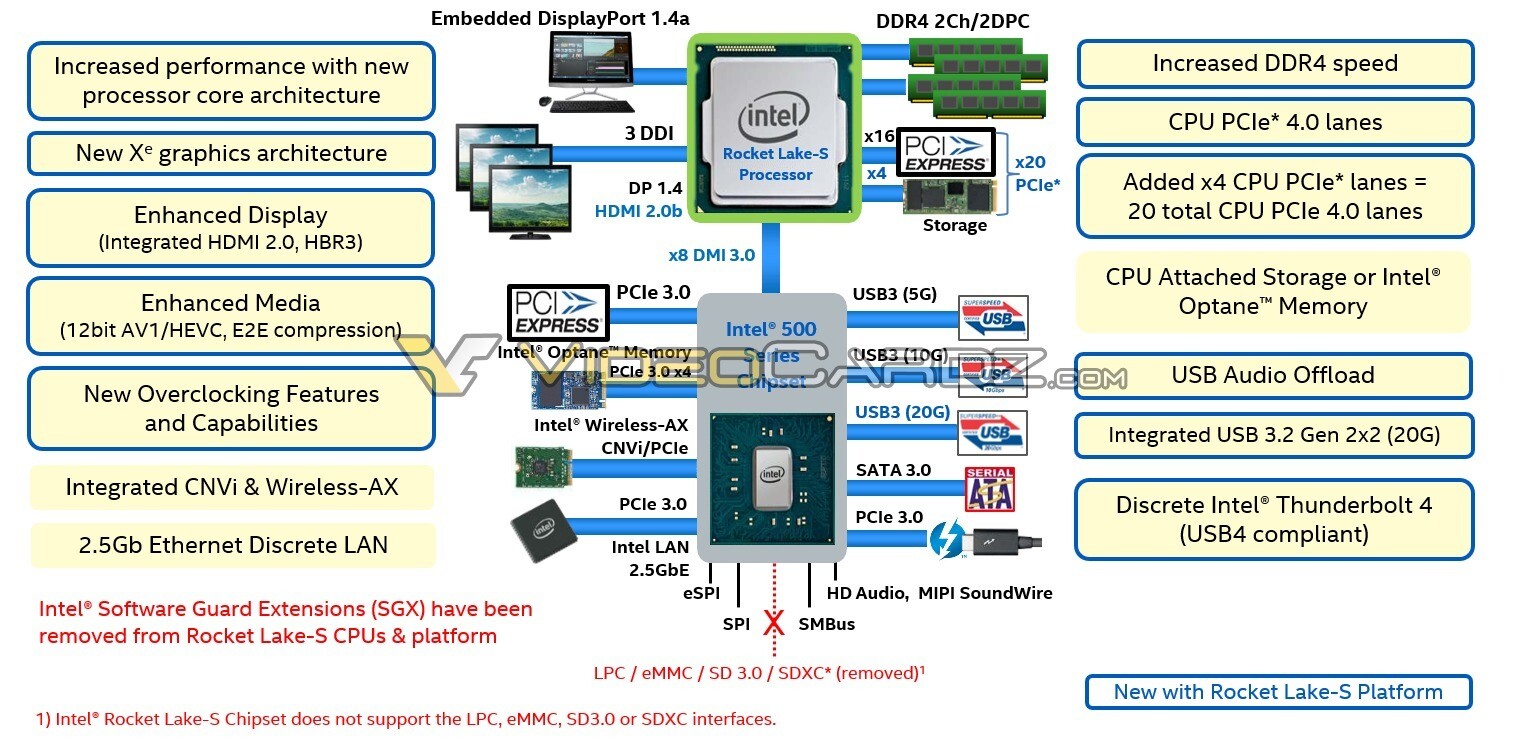
The main improvement is the CPU core itself, which is supposedly a 14 nm adaptation of Tiger Lake-U based on Willow Cove core. This design is representing a backport of IP to an older manufacturing node, which results in bigger die space due to larger node used. When it comes to the platform improvements, it will support the long-awaited PCIe 4.0 connection already present on competing platforms from AMD. It will enable much faster SSD speeds as there are already PCIe 4.0 NVMe devices that run at 7 GB/s speeds. With RKL-S, there will be 20 PCIe 4.0 lanes present, where four would go to the NVMe SSD and 16 would go to the PCIe slots from GPUs. Another interesting feature of the RKL-S is the addition of Xe graphics found on the CPU die, meant as iGPU. Supposedly based on Gen12 graphics, it will bring support for HDMI 2.0b and DisplayPort 1.4a connectors.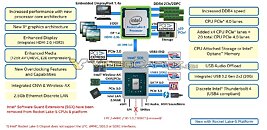 Some things like Direct Media Interface (DMI) will double the bandwidth and now there will be eight links present, compared to four of the previous platforms. Announced at CES 2020, ThunderBolt 4 will also be present along with USB 3.2 20G. Additionally, Intel Software Guard Extensions (SGX) have been removed to improve the security of the platform, as the SGX has proved to be quite vulnerable to many kinds of attacks and exploits. There are some updated media encoding standards as well, like 12-bit AV1/HEVC and E2E compression.
Source:
VideoCardz
The main improvement is the CPU core itself, which is supposedly a 14 nm adaptation of Tiger Lake-U based on Willow Cove core. This design is representing a backport of IP to an older manufacturing node, which results in bigger die space due to larger node used. When it comes to the platform improvements, it will support the long-awaited PCIe 4.0 connection already present on competing platforms from AMD. It will enable much faster SSD speeds as there are already PCIe 4.0 NVMe devices that run at 7 GB/s speeds. With RKL-S, there will be 20 PCIe 4.0 lanes present, where four would go to the NVMe SSD and 16 would go to the PCIe slots from GPUs. Another interesting feature of the RKL-S is the addition of Xe graphics found on the CPU die, meant as iGPU. Supposedly based on Gen12 graphics, it will bring support for HDMI 2.0b and DisplayPort 1.4a connectors.
113 Comments on Intel Rocket Lake-S Platform Detailed, Features PCIe 4.0 and Xe Graphics
Your first paragraph succinctly explains why this is exactly a rumor and not a leak. It does not in any way qualify as a leak until the source can be somehow shown to be believable. Until then, it is by definition a rumor.
Pretty much anyone can fake the impression of veracity in something like this, all it requires is some superficial knowledge and the ability to type in a style similar to someone else. All you are saying here is that you are gullible enough to believe anything posted to the internet if it "seems true". Which is a very poor approach to judging the veracity of information. You would do well to turn up your skepticism dial significantly.
There's absolutely nothing in the definition of a rumor that says it originates with someone who "doesn't understand" or doesn't have the access to information. And rumors are prefectly capable of being true. This could be posted by Brian Krzanich himself and it would be a rumor until it is actually verified that the person posting it actually is him.
Damn, I'm so tired of the internet mixing these two up. These days you even see articles about "leaked" renders of consoles etc. that are very clearly nothing more than a fan-made model pulled straight out of someone's imagination. I think it's due to the appearance of "professional leakers" like EVleaks who post their stuff directly on twitter - that they do so and people immediately call it a leak leads others to think "oh, anything posted to twitter is a leak and not a rumor", disregarding the fact that these qualify as leaks due to the long history of accurate information from these sources. Of course even they are often wrong as many leaks are based on outdated information or are just poorly sourced. The point being: nothing is a leak until it can be said to come from a believable source. And "random person on Chinese BBS" is not a believable source.
Rumour is when wccftech posts AdoredTV Jim educated/not-so-educated guesstimates of what exactly to expect.
Rumour is like a broken phone wire, one source | origin spreads information to another and during this process, you get the information modified or transfered with missing details, added false details, etc.
And where do you think WCCFTech and AdoredTV gets their rumors from? Sure, from time to time they make up stuff all on their own, but the vast majority of time it comes precisely from internet randos like the Chinese BBS post you linked. And no, there's nothing in the meaning of the word "rumor" that says the contents and meaning will change in transmission. That can happen with any type of information, verified or not, if transmitted through word-of-mouth. That's a fault of the means of information transmission and not a function of the veracity of the information itself - and as said before, the difference between a rumor and a leak is exactly the veracity of the latter and the insecurity of the former. A rumor may or may not be true, while a leak must be true or have been true at some point (as there would otherwise not be any information to leak).
Valantar put it pretty nicely; a leak must originate from something real, a piece of evidence from someone with direct access to sensitive information, a standard which most claimed "leaks" fail to meet. This can, of course, include partners of Intel/AMD/Nvidia.
But it's important to remember that the credibility of the source is always important. Making something look official is easy, and so is tampering with something that is genuine.
One interesting point for speculation I guess (assuming this has any degree of accuracy, which we can't know with rumors like this): if Rocket Lake is a new arch, would they keep doing the current double U-series lineup? I get that there are other differences (10nm vs. 14nm, iGPU, etc.), but why would Intel keep selling two different series of U chips if both are roughly the same arch? Why not then just stick to the one? The only explanation I can see is that they are either unable or unwilling to backport their new iGPU to14nm, as that would then be the only selling point for TGL. Another possibility I guess would be wanting to use 10nm for something rather than just leaving it idle while refining it towards actual usefulness, but .... that's rather fatalist, no? Either way, if this turns out to be accurate Intel buyers are still stuck with the choice of either maximum CPU or maximum GPU performance. That's too bad.
Is there anything Intel could do to convince you?Bad? That's the only logical option.
Some chips are built around faster IGP, which makes them more usable for IGP gaming - a use case where stronger CPU wouldn't be utilized anyway.
Other (most) chips are CPU-oriented, which makes them better for everything outside of IGP gaming - and a much better companion for more powerful discrete GPUs.
If the top of the range SoC offered the best CPU and the best IGP in the lineup, it would mean all other chips are not opimal in use of package size or power consumption. It would make no sense.
The majority of laptops and desktops are low-end/cheaper models, so there is certainly a demand for CPUs that are just "good enough", and Intel can't meet demand as of right now. I suspect 14nm will account for a solid portion of Intel's production volume until at least 2022, and I don't see the need for bringing everything quickly to the lower end.The GPU might be a factor. I know some rumors claim "Rocket Lake" will use a 10nm GPU, but very cut down. Either way, the new iGPU ported to 14nm would probably eat a good portion for the U-series power budget, so it probably makes more sense to just keep the old one, as it is a low-end market anyway.</speculation>
Every Zen2 chip has a massive 14nm I/O die. Mobile SoCs are generation behind - still 14nm. And of course AMD still makes and sells Zen and Zen+ desktop/server parts as well.
In fact, I'd love to see their ratio of 14nm vs 7nm wafers. I bet it's 2:1 at best at the moment.
Despite all of Intel's "failures" on 10nm, they are probably close to matching AMD's 7nm in terms of units shipped, while having only a tiny fraction of their total volume on 10nm. By the end of this year Intel will very likely use make more wafers as well, but even then it will not be enough for the majority of their products.
AMD have been lucky to have TSMC's high power 7nm capacity mostly for themselves, but that is changing.
So the reality is more nuanced than most people think.
Also, what you're saying seems to take for granted that there has to be several pieces of silicon within a market segment, which ... no, there doesn't. A single top-end SKU with everything enabled with lower-end SKUs with parts of the iGPU disabled, some cores disabled, or just lower clocks, makes perfect sense as long as that top-end SKU isn't an overly large die. That's how chips are binned to reduce waste, after all. If all you need is CPU performance that top-end SKU will not in any way be handicapped by also having a powerful iGPU - it will simply be idle. The same goes for the other way around. But users will have the option for better performance in other workloads, which you are arguing against for some reason.That is true, but then Intel is the market leader and recently had a 9:1 or higher sales advantage across all segments (so it would be really weird if AMD somehow had them matched on volume at this point - even with AMD buying wafers from others that tells us Intel has had the capacity to produce enough chips for 90% of the market), and also has a massive fab operation while AMD contracts chip production to TSMC. Thus AMD has to share fab space with TSMC's other customers, including behemoth Apple which has until recently likely occupied the majority of TSMC's 7nm fab capacity, or at least a very large portion of it. There's no such thing as "TSMC's high power 7nm capacity" - there are different design libraries and different revisions of each node, but all TSMC 7nm is still made across the same selection of fabs and on the same equipment (though they obviously keep anything that can be made at a single fab to one locale). So despite Intel shipping Ice Lake in "significant numbers" (though currently limited to a relatively small selection of thin-and-lights, with Comet Lake being far more prevalent), there is currently zero reason to believe Intel's 10nm node is anywhere near the kind of yields you would expect for a high volume node, nor that its performance is where it should be. If it was, they would be transitioning 14nm fabs to 10nm (to increase chip output per fab on the denser node), which would then likely mean transitioning all mobile chips to 10nm while freeing up 14nm capacity for the lucrative server and enterprise markets, while also readying 10nm designs for all market segments. There is nothing indicating that any of this is happening. So no, Intel 10nm is by no means working as it should. All signs (including Intel's own public plans) point towards Intel planning to keep 10nm limping along, with 14nm as the backbone of the company's production, until 7nm arrives to get things going as they should.Not forgetting anything. There is however a significant difference between continuing production of a previous-generation product (which Intel also does) to fulfill long-term contracts and maximise ROI on already taped-out and mature silicon, and making brand-new designs on an old node. AMD absolutely makes a lot of 14nm stuff still, but they aren't announcing new products on the node. Bringing the I/O die into this argument is also a bit odd - it's not a part that would benefit whatsoever from a smaller node (physical interconnects generally scale poorly with node shrinks), so why use an expensive smaller node for that when it's better utilized for parts that would benefit? If Intel did an MCM part I would absolutely not criticize them whatsoever for using 14nm or even 22nm for parts of it - that would be the smart thing to do.