Friday, February 6th 2026

Intel Arc B390 Panther Lake iGPU Impresses in Linux Performance Tests
Intel's Arc graphics solutions initially had a rough start to life on the Linux side of things, but it seems as though the tide is changing. Phoronix recently tested the new Panther Lake Intel Arc B390 iGPU in the Intel Core Ultra X7 358H, comparing the new iGPU to the venerable Radeon 890M in the AMD Ryzen AI 9 HX 370, and Intel's iGPU consistently outpaces the Radeon iGPU, which isn't a surprise if you've been keeping track of early benchmarks on Windows. The publication tested the new Xe3 integrated graphics in an MSI Prestige 14 running the latest Mesa 26.0 drivers on Linux Kernel version 6.19 on Ubuntu 26.04.
When it comes to gaming, the only games in which the Xe3 iGPU was bested by the AMD competition were Counterstrike 2, running at 1920×1200, and Quake II RTX. In every other game, the Intel Arc B390 beat both the AMD competition and the Intel Core Ultra 7 155H and Core Ultra 7 258V significantly. Depending on the game and in-game settings, the Arc B390 was anywhere between 15% and upwards of 50%. Hitman 3 was a particularly impressive outlier, with the B390 managing to get over 50% more FPS than the nearest competitor and 64% more FPS than the Radeon 890M at 1920×1200 and low settings, with similar gains at medium quality settings, and a slightly less impressive performance improvement when bumping up to ultra settings.
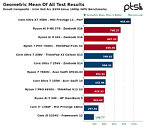
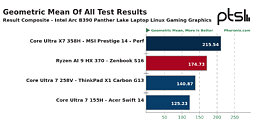
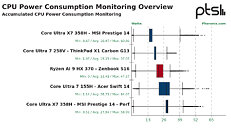 A similar story played out when it came to gaming benchmarks, with the Arc B390 coming out on top in 3DMark Wild Life Extreme—scoring 20% better than the Radeon 890M—and 3DMark Solar Bay, which was a closer victory, and GravityMark, where the Arc B390 once again dominated in OpenGL, Vulkan, and Vulkan Ray Tracing benchmarks. The Arc iGPU also performed admirably in Unigine Superposition, Valley, and Heaven, where it was never less than 30% ahead of the competition. Curiously, the AMD Radeon 890M still traded blows with the Arc B390 in terms of efficiency, even if raw performance wasn't quite there for Team Red.
Source:
Phoronix
When it comes to gaming, the only games in which the Xe3 iGPU was bested by the AMD competition were Counterstrike 2, running at 1920×1200, and Quake II RTX. In every other game, the Intel Arc B390 beat both the AMD competition and the Intel Core Ultra 7 155H and Core Ultra 7 258V significantly. Depending on the game and in-game settings, the Arc B390 was anywhere between 15% and upwards of 50%. Hitman 3 was a particularly impressive outlier, with the B390 managing to get over 50% more FPS than the nearest competitor and 64% more FPS than the Radeon 890M at 1920×1200 and low settings, with similar gains at medium quality settings, and a slightly less impressive performance improvement when bumping up to ultra settings.


11 Comments on Intel Arc B390 Panther Lake iGPU Impresses in Linux Performance Tests
So, performance-per-Watt was similar when Panther Lake was tested in Performance mode, which is not out-of-the-box experience. Panther Lake laptops come with Balanced mode by default, in order for Intel to sell the claim of longer battery life. Phoronix did not publish gaming tests in Balanced mode, as buyers would experience it. Had he done this, we would have seen less impressive gaming uplift due to Balanced mode running the CPU at 500 MHz lower clocks.
CPU
Phoronix corrected this mistake in CPU performance teats and published graphs in both modes. Benchmarks and narrative change significantly when tested in Balance and then in Performance mode. In Balanced mode (out-of-the-box, 4.3 GHz max), Strix Point 370 is ~13% faster on average than X7 358H in MSI Prestige, but less efficient. In Performance mode, Panther Lake is only 5% faster than Strix 370 and it reaches the rated 4.8 GHz, but it loses its efficiency. This is 18 months after Strix Point came out...
www.phoronix.com/review/intel-panther-lake-linux-power/9
To be more efficient, X7 358H needs to run in Balanced mode and lower clocks, which hurts performance. To be more performant, it needs to run in Performance mode with higher clocks, which hurts efficiency and seriously shortens battery life. The difference between the modes is 500 MHz on this machine.
It looks like Intel Panther Lake cannot have its cake and eat it. Buyers will only experience long battery life with crippled CPU and iGPU performance in Balanced mode, which is out-of-the-box experience.
Also, gaming laptops tend to have longer Tau values than ultrabooks, up to approximately one minute of running in PL2 state before reverting to PL1 sustained. I would like to see how gaming benchmarks differ between Tau period and post-Tau period. To show real world gaming performance, reviewers will need to have in mind sustained testing in PL1 state, as this is how users will experience games, rather than seeing high fps number from PL2 state benchmark in the first minute of running tests.